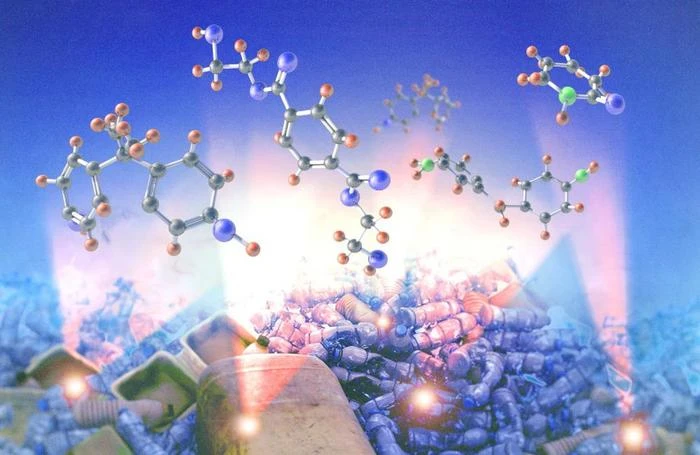
(Press-News.org) Almost 80% of plastic in the waste stream ends up in landfills or accumulates in the environment. Oak Ridge National Laboratory scientists have developed a technology that converts a conventionally unrecyclable mixture of plastic waste into useful chemicals, presenting a new strategy in the toolkit to combat global plastic waste.
The technology, invented by ORNL’s Tomonori Saito and former postdoctoral researcher Md Arifuzzaman, uses an exceptionally efficient organocatalyst that allows selective deconstruction of various plastics, including a mixture of diverse consumer plastics. Arifuzzaman, now with Re-Du, is a current Innovation Crossroads fellow.
Production of chemicals from plastic waste requires less energy and releases fewer greenhouse gases than conventional petroleum-based production. Such a pathway provides a critical step toward a net-zero society, the scientists said.
“This concept offers highly efficient and low-carbon chemical recycling of plastics and presents a promising strategy toward establishing closed-loop circularity of plastics,” said Saito, corresponding author of the study published in Materials Horizons. – Lawrence Bernard
END
New recycling method fights plastic waste
Turning mixed plastic into useful chemicals
2023-09-20
ELSE PRESS RELEASES FROM THIS DATE:
Low follow-up kidney testing after hospital discharge with moderate to severe AKI
2023-09-20
A study of Canadian hospitalizations from 2007-2019 show that over 75% of patients with moderate to severe acute kidney injury (AKI) do not get appropriate follow-up kidney health testing after hospital discharge.
A study in Alberta, Canada, examined care received by over 20,000 hospitalized with AKI during hospitalization and after discharge between 2009 and 2017. The results, recently published in the American Journal of Kidney Diseases (AJKD), showed that a low proportion of patients with moderate to severe AKI were seen by a kidney specialist ...
Unzipping mRNA rallies plant cells to fight infection
2023-09-20
DURHAM, N.C. -- Living things from bacteria to plants to humans must constantly adjust the chemical soup of proteins -- the workhorse molecules of life -- inside their cells to adapt to stress or changing conditions, such as when nutrients are scarce, or when a pathogen attacks.
Now, researchers have identified a previously unknown molecular mechanism that helps explain how they do it.
Studying a spindly plant called Arabidopsis thaliana, a Duke University-led team discovered short snippets of folded RNA that, under normal conditions, keep levels of defense proteins low to avoid harming the plants themselves. But when the plants detect a pathogen, these folded RNA structures ...
New research findings: Understanding the sex life of coral gives hope of clawing it back from the path to extinction
2023-09-20
For the first time, scientists have mapped the reproductive strategies and life cycle of an endangered coral species, offering hope it can be clawed back from the path to extinction.
The purple cauliflower soft coral, Dendronephthya australis, is endemic to south-eastern Australia, with the largest populations historically found in the Port Stephens estuary in New South Wales. It is one of the 100 priority species on the Federal Government’s Threatened Species Strategy.
Not only is the future ...
New model for in vitro production of human brown fat cells lays groundwork for obesity, diabetes cell therapy
2023-09-20
Brown adipocytes are specialized cells that can use energy to produce heat. This property makes them attractive tools for the treatment of diseases like obesity and type 2 diabetes. Until recently, this therapeutic potential was constrained by limited understanding of how brown adipocyte tissue (BAT) develops from precursors.
A team led by investigators at Brigham and Women’s Hospital, a founding member of the Mass General Brigham healthcare system, identified a set of cellular signaling cues that lead up to brown ...
College athletes experience worse post-injury outcomes for concussions suffered outside of sports
2023-09-20
Philadelphia, September 20, 2023 – Researchers from Children’s Hospital of Philadelphia (CHOP) found that college athletes had worse post-injury outcomes related to concussions they experienced outside of sports than those they experienced while playing sports. Additionally, female athletes who sustained their injury outside of sports had more severe symptoms and more days in sports lost to injury relative to male athletes. These findings suggest the need for improved concussion recognition, reporting, and monitoring outside of sports.
The study was recently published online by the Journal of Athletic Training.
Concussions have the potential to ...
CHOP researchers develop novel method using MRI to study diseases modeled in zebrafish
2023-09-20
Philadelphia, September 20, 2023 – Zebrafish have revolutionized research into a wide variety of rare and complex genetic diseases. In early development stages, their transparent bodies allow researchers to more easily study tissues and organs. However, studying organ-level defects in adult zebrafish presents a variety of challenges that prevent researchers from studying them at a microscopic level.
In a new study, researchers from Children’s Hospital of Philadelphia (CHOP) have developed a noninvasive method for conducting magnetic resonance imaging (MRI) in adult zebrafish. ...
15 top journalists earn aging-focused reporting fellowships
2023-09-20
The Gerontological Society of America (GSA) and the Journalists Network on Generations are welcoming 15 distinguished reporters for the next cohort of the Journalists in Aging Fellows Program, now in its 14th year.
They represent a wide range of general audience, ethnic, and community media outlets, including local and national publications. This year’s group brings the program’s total number of participating reporters to 232. The new fellows were chosen — by a panel of gerontological and editorial professionals — based on their proposals for ...
A brighter brain future for all: AAN sets new vision for brain health by 2050
2023-09-20
MINNEAPOLIS – Do you want to improve your brain health? Neurologists, the experts in brain health, have a plan. The American Academy of Neurology (AAN), the world’s largest association of neurologists and neuroscience professionals with over 40,000 members, is sharing its vision to improve the nation’s brain health by 2050. The new vision is part of a new AAN position statement on brain health, published online September 20, 2023, in Neurology®, the medical journal of the American Academy of Neurology.
The AAN’s vision for national brain health by 2050 includes:
Brain health research that leads to scientific breakthroughs
Preventive neurology as a thriving ...
St. Jude refines definition and hones treatment of hyperdiploid leukemia
2023-09-20
(Memphis, Tenn.— Sept. 20, 2023) Hyperdiploidy is a genetic condition observed in cancer cells, where the cells contain more chromosomes than usual. The condition is particularly prevalent in childhood B-cell acute lymphoblastic leukemia (B-ALL), the most common form of pediatric cancer. To bring clarity to the field, researchers at St. Jude Children’s Research Hospital worked to better define this type of ALL in the context of modern therapy to more accurately predict patient outcomes and guide treatment decisions. The findings were published today in the Journal of Clinical ...
USC develops new preclinical system to better turn lab discoveries into effective treatments
2023-09-20
It is an all-too-common fact that potential drugs can look extremely promising in preclinical laboratory testing but fail when it comes to effectively treating humans. To better translate promising lab findings into effective new treatments, a team of researchers from the Keck School of Medicine of USC, supported by the National Institutes of Health, has developed, and tested, an innovative new system for conducting preclinical research on six potential new stroke treatments, identifying the strongest candidate for further study.
“We now have a feasible preclinical research system ...
LAST 30 PRESS RELEASES:
Father’s tobacco use may raise children’s diabetes risk
Structured exercise programs may help combat “chemo brain” according to new study in JNCCN
The ‘croak’ conundrum: Parasites complicate love signals in frogs
Global trends in the integration of traditional and modern medicine: challenges and opportunities
Medicinal plants with anti-entamoeba histolytica activity: phytochemistry, efficacy, and clinical potential
What a releaf: Tomatoes, carrots and lettuce store pharmaceutical byproducts in their leaves
Evaluating the effects of hypnotics for insomnia in obstructive sleep apnea
A new reagent makes living brains transparent for deeper, non-invasive imaging
Smaller insects more likely to escape fish mouths
Failed experiment by Cambridge scientists leads to surprise drug development breakthrough
Salad packs a healthy punch to meet a growing Vitamin B12 need
Capsule technology opens new window into individual cells
We are not alone: Our Sun escaped together with stellar “twins” from galaxy center
Scientists find new way of measuring activity of cell editors that fuel cancer
Teens using AI meal plans could be eating too few calories — equivalent to skipping a meal
Inconsistent labeling and high doses found in delta-8 THC products: JSAD study
Bringing diabetes treatment into focus
Iowa-led research team names, describes new crocodile that hunted iconic Lucy’s species
One-third of Americans making financial trade-offs to pay for healthcare
Researchers clarify how ketogenic diets treat epilepsy, guiding future therapy development
PsyMetRiC – a new tool to predict physical health risks in young people with psychosis
Island birds reveal surprising link between immunity and gut bacteria
Research presented at international urology conference in London shows how far prostate cancer screening has come
Further evidence of developmental risks linked to epilepsy drugs in pregnancy
Cosmetic procedures need tighter regulation to reduce harm, argue experts
How chaos theory could turn every NHS scan into its own fortress
Vaccine gaps rooted in structural forces, not just personal choices: SFU study
Safer blood clot treatment with apixaban than with rivaroxaban, according to large venous thrombosis trial
Turning herbal waste into a powerful tool for cleaning heavy metal pollution
Immune ‘peacekeepers’ teach the body which foods are safe to eat
[Press-News.org] New recycling method fights plastic wasteTurning mixed plastic into useful chemicals