Why coarse biochar outperforms fine particles against crop disease over time
What if the most important variable in biochar's ability to fight plant disease is one that most growers never think about — particle size?
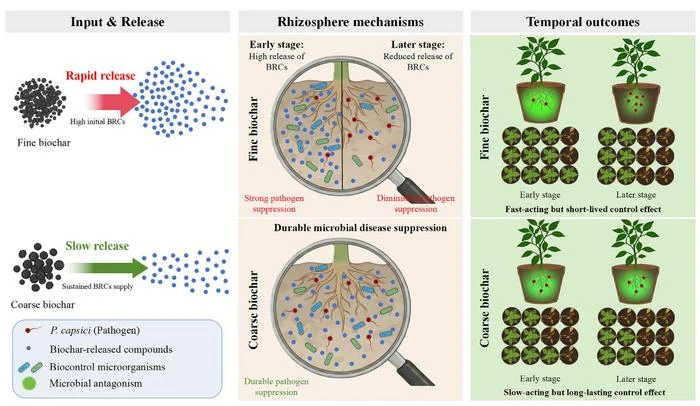
A study published in the journal Biochar tested fine and coarse biochar particles against Phytophthora blight, a devastating soil-borne disease caused by Phytophthora capsici that can wipe out pepper crops. The results were not a simple story of one size being better than another. Instead, the researchers found that particle size dictates the timing of protection — a distinction that could change how biochar is used in agriculture.
Fast release, fast fade
In greenhouse experiments, fine biochar particles delivered strong early protection. Disease severity dropped significantly during the initial stages of plant growth. The mechanism was straightforward: fine particles, with their greater surface area, released minerals and labile organic carbon — easily decomposable carbon compounds — rapidly into the soil. This nutrient burst stimulated beneficial soil microbes that compete with and suppress P. capsici.
But there was a catch. As those readily available compounds were depleted, the protective effect weakened. The microbial populations that had surged in response to the nutrient pulse lost their fuel source. Fine biochar, in other words, was a sprinter — powerful off the blocks, but unable to sustain the pace.
The slow-release advantage of coarse particles
Coarse biochar told a different story. Its initial impact on disease severity was less dramatic. But over time, it maintained stronger suppression than fine particles. The reason traces back to basic physics: larger particles have less surface area relative to their volume, so they release nutrients and organic compounds more gradually.
This slow drip of resources supported a more sustained buildup of beneficial organisms. Key microbial groups — including bacteria in the genus Pseudomonas and fungi such as Trichoderma and Penicillium — thrived under the coarse biochar treatment over extended periods. These organisms are well-documented antagonists of soil pathogens. They outcompete harmful microbes for resources, produce antimicrobial compounds, and in some cases directly parasitize pathogen cells.
Electrical conductivity as a predictor
The researchers identified two measurable drivers behind the microbial shifts: electrical conductivity (a proxy for mineral release into the soil solution) and the concentration of labile organic carbon. Both were closely linked to microbial activity and, ultimately, to disease suppression.
This matters because it points toward testable, practical metrics. Rather than guessing which biochar will work best, growers and agronomists could potentially evaluate a biochar product's release profile — its electrical conductivity curve and carbon lability — to predict how it will perform against specific soil-borne diseases.
That is still a future application, not a current tool. But the mechanistic clarity here is notable. Biochar research has often been criticized for producing inconsistent results across studies. One reason may be that researchers were not controlling for, or even reporting, particle size — lumping together materials with very different release dynamics.
The microbial cast of characters
The study gave unusual attention to the specific organisms involved. Pseudomonas species, long known as plant growth promoters and biocontrol agents, increased under both biochar treatments but were sustained more effectively under coarse particles. Trichoderma, a fungal genus used commercially as a biological pesticide, showed similar patterns. Penicillium species — yes, relatives of the mold that gave us penicillin — also contributed to pathogen suppression in the soil.
These were not organisms introduced from outside. They were native soil microbes whose populations expanded when biochar provided the right nutritional conditions. The biochar did not fight the pathogen directly. It reshaped the microbial battlefield in favor of organisms that already had the tools to do so.
Precision application, not one-size-fits-all
The practical takeaway is that biochar applications could be tailored by particle size depending on the goal. A grower facing an imminent disease outbreak might benefit from fine biochar's rapid action. Someone managing long-term soil health and chronic pathogen pressure might get more value from coarse particles, or from a blend designed to deliver both early and sustained protection.
The researchers framed this as a move toward "precision biochar applications" — selecting physical properties to match specific agricultural challenges rather than treating biochar as a generic soil amendment.
What remains uncertain
This was a greenhouse study, with the controlled conditions that implies. Field conditions introduce variables — rainfall, temperature fluctuations, soil type diversity, interactions with other amendments — that could alter the dynamics observed here. The study focused on a single pathogen system (P. capsici in peppers), so it remains to be seen whether the particle size effect holds for other crop-pathogen combinations.
The biochar was produced from a single feedstock, and production temperature was held constant. Different source materials and pyrolysis conditions could change the release profiles in ways the study did not explore. Sample sizes, while adequate for controlled greenhouse work, were not large enough to capture the full variability that field-scale application would encounter.
Still, the core finding — that a basic physical property of biochar governs the timeline of disease suppression through its effect on nutrient release and microbial community dynamics — is mechanistically coherent and practically relevant. It also suggests that some of the inconsistency in past biochar research might be explained by uncontrolled variation in particle size.
For farmers dealing with soil-borne diseases and looking to reduce chemical pesticide use, particle size is now a variable worth paying attention to. It's not the whole story. But it may be a bigger part of the story than anyone previously realized.