Corn straw plus eggshells: a calcium-modified biochar captures phosphorus before it pollutes
Published in Biochar, volume 8, 2026. Shenyang Agricultural University and collaborators.
What happens to the phosphorus that crops don't use? Much of it washes into rivers and lakes, feeding algal blooms that choke aquatic ecosystems and degrade drinking water. Scientists have spent years exploring biochar — a charcoal-like material produced from organic waste — as a tool to intercept that runoff. But most research has focused on inorganic phosphorus, the simpler chemical form. Organic phosphorus, which accounts for a substantial share of the nutrient in agricultural soils, has remained poorly understood.
A new study in the journal Biochar addresses that gap directly, showing at the molecular level how a calcium-modified biochar interacts with four different organic phosphorus compounds — and why each one behaves differently on the material's surface.
Why does molecular structure determine how phosphorus sticks?
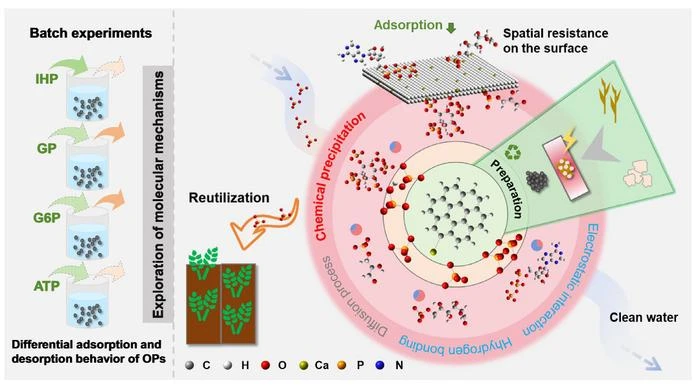
The researchers, led by Wang, Tang, and Zhang, produced their biochar by combining two agricultural waste products: corn straw and eggshells. The eggshells introduce calcium-rich active sites onto the biochar surface, and these calcium components turned out to be the dominant players in capturing organic phosphorus.
The team tested the material against four key organic phosphorus compounds: inositol hexaphosphate (found abundantly in seeds and soils), glycerophosphate, glucose-6-phosphate, and adenosine triphosphate (ATP). Each represents a different molecular architecture — different numbers of phosphate groups, different carbon chain structures, different charge distributions.
The results revealed that these structural differences translate directly into different binding mechanisms. For most compounds, calcium-driven chemical precipitation dominated: the phosphorus reacted with calcium on the biochar surface to form stable calcium-phosphate complexes that resist washing away. ATP was the exception. Its adsorption relied more on hydrogen bonding and electrostatic interactions — weaker forces that make the binding less permanent.
290 milligrams per gram: the top performer
Among the four compounds, inositol hexaphosphate demonstrated the strongest affinity for the calcium-modified biochar, reaching an adsorption capacity of over 290 milligrams of phosphorus per gram of material. The reason is structural: inositol hexaphosphate carries six phosphate groups on a single molecule, giving it multiple points of attachment to the biochar surface. More hooks mean stronger hold.
Molecules with fewer reactive phosphate groups bound less tightly and were more susceptible to desorption — the release of phosphorus back into the surrounding water or soil. This matters enormously for practical applications. A biochar that captures phosphorus during a rainstorm but releases it during the next dry spell has limited value. The study suggests that the effectiveness of any biochar-based phosphorus management system will depend heavily on which forms of organic phosphorus dominate in the target soil.
Not one mechanism, but a combination
Using advanced analytical techniques — including X-ray photoelectron spectroscopy and computational modeling — the researchers showed that adsorption is not governed by any single process. Instead, it involves a combination of chemical reactions, surface interactions, and molecular-level coordination, all shaped by the phosphorus compound's structure.
Both the phosphate groups and the carbon chain backbone of each molecule influence how it interacts with the biochar. Even small differences in functional groups or charge distribution significantly affect whether phosphorus is retained or released. The finding argues against a one-size-fits-all approach to biochar design. Different soils contain different mixtures of organic phosphorus compounds, and the optimal biochar formulation may need to be tailored accordingly.
Stability under real-world conditions
Laboratory adsorption experiments can be misleading if the material fails under field conditions. The researchers tested their calcium-modified biochar under varying pH levels and in the presence of competing ions — conditions that more closely approximate actual soil and wastewater environments. The material maintained its adsorption performance across these challenges, a necessary (though not sufficient) condition for practical deployment.
The pH resilience is particularly relevant. Agricultural soils range widely in acidity, and a biochar that works at pH 7 but fails at pH 5 would be limited to a narrow set of applications. The calcium-modified material appears to handle this range, though long-term field trials would be needed to confirm laboratory results hold over growing seasons and across soil types.
From soil amendment to precision nutrient tool
The study's implications extend beyond phosphorus capture. Global phosphorus reserves are finite — most projections estimate economically extractable phosphate rock will last between 50 and 300 years, depending on demand growth and recovery rates. Technologies that capture phosphorus from agricultural runoff and potentially return it to productive use could address both pollution and resource scarcity simultaneously.
But significant questions remain before calcium-modified biochar moves from the laboratory to the field at scale. The study tested pure compounds in controlled solutions, not the complex mixtures of organic and inorganic phosphorus found in real soils. The corn straw and eggshell feedstock is appealingly cheap and abundant, but production costs at scale, energy inputs for pyrolysis, and the material's longevity in soil have not been characterized here.
The authors themselves frame the contribution carefully. This is a mechanistic study — it explains how and why different phosphorus molecules bind to a specific biochar, not how that biochar performs in a cornfield over five years. That next step will require agronomic field trials, economic analysis, and assessment of whether the biochar affects soil microbial communities or crop uptake patterns.
Still, the molecular-level clarity the study provides is the kind of foundational knowledge that makes applied work possible. Designing better phosphorus-capture materials requires understanding which mechanisms matter for which molecules. This study delivers that understanding with unusual precision.