An end to the battle between touchscreens and long fingernails is on the horizon
Published 2026-03-23 · Original archive entry · Explore research explainers
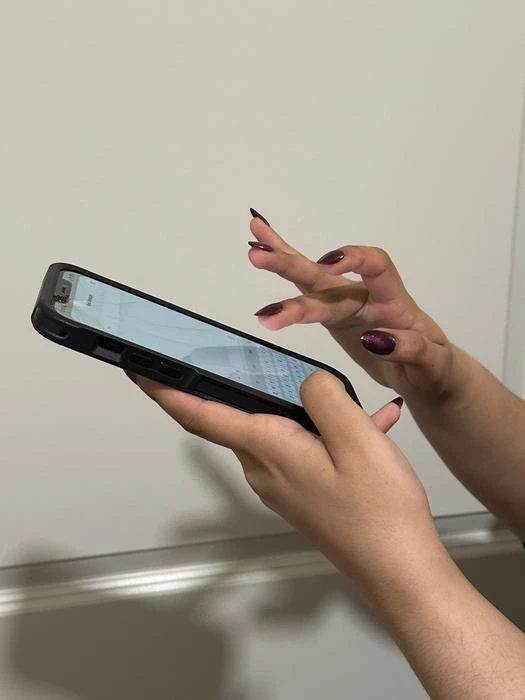
ATLANTA, March 23, 2026— Anybody who tried to use a smartphone or tablet with long nails knows that there’s a learning curve. Rather than effortlessly tapping with a fingertip, you must awkwardly lay the pads of your fingers onto the screen. Wouldn’t it be easier if you could just type with your fingernails instead? To try and make this idea a reality, a group of researchers are formulating a clear nail polish that could turn long fingernails into touchscreen-compatible styluses.
The team from Centenary College of Louisiana will present their results at the spring meeting of the American Chemical Society (ACS). ACS Spring 2026 is being held March 22-26; it features nearly 11,000 presentations on a range of science topics.
Manasi Desai, an undergraduate at Centenary, had an interest in cosmetic chemistry and went to her research supervisor, Joshua Lawrence, looking for a suitable project. Lawrence, an organometallic chemist, explains that “chemists are here to solve problems and to try to make your world better.” So, they looked around to see what problem might need solving. When they noticed the difficulty many people had when operating smartphones with long nails — including a phlebotomist at a bloodwork appointment — they asked if a touchscreen-compatible nail would be useful. The answer was a resounding “yes, please!” And thus, Desai’s project came to be.
Most modern touchscreens, such as those in smartphones and tablets, are known as capacitive touchscreens. They work by creating a small electric field across the screen. When a conductive material — something that allows electricity to flow through itself — disrupts that field, like your finger or a droplet of water, the surface changes its capacitance. Then, the device interprets that capacitance change as a touch.
But, tapping a screen with a nonconductive material, like a long fingernail or pencil eraser, does not change the capacitance and, as a result, the device doesn’t register the touch. So, to make long fingernails touchscreen compatible, they need to carry a small electric charge.
Previously, other researchers have attempted this by incorporating electrically conductive carbon nanotubes or metallic particles into nail polish, but these substances can introduce hazards to the manufacturers, as they’re dangerous if inhaled. Additionally, the additives result in a deep black or metallic shimmer, limiting the shade range of the polishes. Lawrence and Desai wanted to instead create a polish that was, ideally, both clear and nontoxic to both the wearer and the manufacturer.
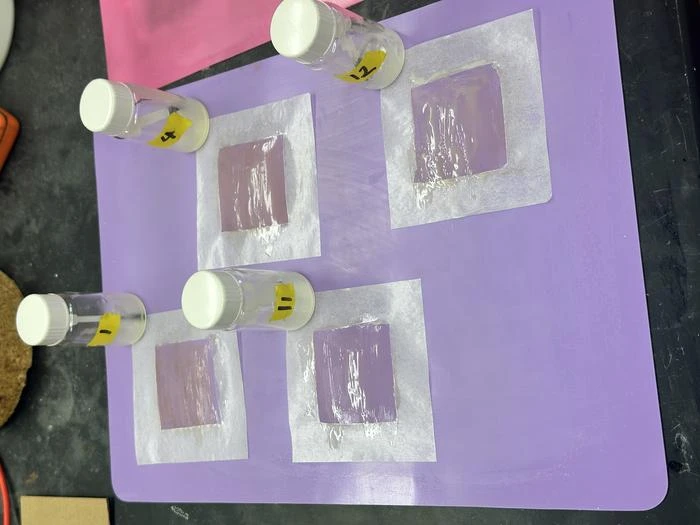
To find the perfect combination of clarity and conductivity, Desai turned to good, old-fashioned trial and error. Using 13 commercially available clear-coat polishes and more than 50 different additives, she slowly worked her way through the combinations to find which ones resulted in a conductive topcoat for nails. The molecules that performed the best were forms of taurine, an organic compound commonly sold as a dietary supplement, and ethanolamine, another simple, organic molecule.
Ethanolamine provided the conductivity and polish compatibility they were looking for but has some toxicity. And while modified taurine formula is nontoxic, it took on a slightly opaque hue. But when combined, these additives created a formula that was able to register as a touch on a smartphone, so it’s a promising first step. “Our final, clear polish could be put over any manicure or even bare nails, which could help people with calluses on their fingertips, too. So, it has both a cosmetic and lifestyle benefit,” explains Desai.
Unlike the previous attempts, Lawrence and Desai believe that their polish works through a slightly different pathway: acid-base chemistry instead of inherently conductive metal or carbon nanotubes. They arrived at this hypothesis because the best initial results came from ethanolamine-based formulas, which can release protons to move charge around. Therefore, they think that when the nail polish contacts a touchscreen’s electric field, it causes the protons to jump between the molecules, changing the polish’s capacitance ever so slightly — but just enough for the smartphone to recognize it as a touch.
These initial results are promising, but the team still has a long way to go before the polish will be available on store shelves. Even the best-performing ethanolamine-taurine formula is finicky and doesn’t yet work consistently when painted on a nail. Plus, ethanolamine evaporates quickly, so the polish only works on a touchscreen for a few hours once outside of the bottle, and researchers would prefer a truly nontoxic compound. Despite these setbacks, the researchers now have an idea of how the successful formula works, and they are continuing to screen compounds and test new formulas to find the best-performing combination.
“We’re doing the hard work of finding things that don’t work, and eventually, if you do that long enough, you find something that does,” concludes Lawrence.
The research was funded by the Centenary College of Louisiana, the Albert Sklar Family and the Sklar Chair in Chemistry. The researchers have submitted a provisional patent on this research.
A Headline Science YouTube Short about this topic will be posted on Monday, March 23. Reporters can access the video during the embargo period, and once the embargo is lifted, the same URL will allow the public to access the content. Visit the ACS Spring 2026 program to learn more about this presentation, “Modification of nail polish formulations for conductivity to operate capacitive touchscreens,” and other science presentations.
###
The American Chemical Society (ACS) is a nonprofit organization founded in 1876 and chartered by the U.S. Congress. ACS is committed to improving all lives through the transforming power of chemistry. Its mission is to advance scientific knowledge, empower a global community and champion scientific integrity, and its vision is a world built on science. The Society is a global leader in promoting excellence in science education and providing access to chemistry-related information and research through its multiple research solutions, peer-reviewed journals, scientific conferences, e-books and weekly news periodical Chemical & Engineering News. ACS journals are among the most cited, most trusted and most read within the scientific literature; however, ACS itself does not conduct chemical research. As a leader in scientific information solutions, its CAS Division partners with global innovators to accelerate breakthroughs by curating, connecting and analyzing the world’s scientific knowledge. ACS’ main offices are in Washington, D.C., and Columbus, Ohio.
To automatically receive press releases from the American Chemical Society, contact newsroom@acs.org.
Note to journalists: Please report that this research was presented at a meeting of the American Chemical Society. ACS does not conduct research, but publishes and publicizes peer-reviewed scientific studies.
Follow us: Facebook | LinkedIn | Instagram
Modification of nail polish formulations for conductivity to operate capacitive touchscreens
Title
Modification of nail polish formulations for conductivity to operate capacitive touchscreens
Abstract
Most smartphones use capacitive touchscreen technology, the operation of which relies on skin conductivity. This is challenging for users with long manicures or zombie fingers. We describe nail polish formulations that achieve sufficient conductivity to disrupt the stored electrical field in capacitive touchscreens and register as touch events. Commercial nail polishes were used to test additives for formula compatibility and electrical performance. Nail polish formulations were coated onto a silicone mat and the resistance of the dried films were measured; formulations with noninfinite resistance were tested on capacitive touchscreens. We will present four successful and numerous unsuccessful formulations.
END
The team from Centenary College of Louisiana will present their results at the spring meeting of the American Chemical Society (ACS). ACS Spring 2026 is being held March 22-26; it features nearly 11,000 presentations on a range of science topics.
Manasi Desai, an undergraduate at Centenary, had an interest in cosmetic chemistry and went to her research supervisor, Joshua Lawrence, looking for a suitable project. Lawrence, an organometallic chemist, explains that “chemists are here to solve problems and to try to make your world better.” So, they looked around to see what problem might need solving. When they noticed the difficulty many people had when operating smartphones with long nails — including a phlebotomist at a bloodwork appointment — they asked if a touchscreen-compatible nail would be useful. The answer was a resounding “yes, please!” And thus, Desai’s project came to be.
Most modern touchscreens, such as those in smartphones and tablets, are known as capacitive touchscreens. They work by creating a small electric field across the screen. When a conductive material — something that allows electricity to flow through itself — disrupts that field, like your finger or a droplet of water, the surface changes its capacitance. Then, the device interprets that capacitance change as a touch.
But, tapping a screen with a nonconductive material, like a long fingernail or pencil eraser, does not change the capacitance and, as a result, the device doesn’t register the touch. So, to make long fingernails touchscreen compatible, they need to carry a small electric charge.
Previously, other researchers have attempted this by incorporating electrically conductive carbon nanotubes or metallic particles into nail polish, but these substances can introduce hazards to the manufacturers, as they’re dangerous if inhaled. Additionally, the additives result in a deep black or metallic shimmer, limiting the shade range of the polishes. Lawrence and Desai wanted to instead create a polish that was, ideally, both clear and nontoxic to both the wearer and the manufacturer.
To find the perfect combination of clarity and conductivity, Desai turned to good, old-fashioned trial and error. Using 13 commercially available clear-coat polishes and more than 50 different additives, she slowly worked her way through the combinations to find which ones resulted in a conductive topcoat for nails. The molecules that performed the best were forms of taurine, an organic compound commonly sold as a dietary supplement, and ethanolamine, another simple, organic molecule.
Ethanolamine provided the conductivity and polish compatibility they were looking for but has some toxicity. And while modified taurine formula is nontoxic, it took on a slightly opaque hue. But when combined, these additives created a formula that was able to register as a touch on a smartphone, so it’s a promising first step. “Our final, clear polish could be put over any manicure or even bare nails, which could help people with calluses on their fingertips, too. So, it has both a cosmetic and lifestyle benefit,” explains Desai.
Unlike the previous attempts, Lawrence and Desai believe that their polish works through a slightly different pathway: acid-base chemistry instead of inherently conductive metal or carbon nanotubes. They arrived at this hypothesis because the best initial results came from ethanolamine-based formulas, which can release protons to move charge around. Therefore, they think that when the nail polish contacts a touchscreen’s electric field, it causes the protons to jump between the molecules, changing the polish’s capacitance ever so slightly — but just enough for the smartphone to recognize it as a touch.
These initial results are promising, but the team still has a long way to go before the polish will be available on store shelves. Even the best-performing ethanolamine-taurine formula is finicky and doesn’t yet work consistently when painted on a nail. Plus, ethanolamine evaporates quickly, so the polish only works on a touchscreen for a few hours once outside of the bottle, and researchers would prefer a truly nontoxic compound. Despite these setbacks, the researchers now have an idea of how the successful formula works, and they are continuing to screen compounds and test new formulas to find the best-performing combination.
“We’re doing the hard work of finding things that don’t work, and eventually, if you do that long enough, you find something that does,” concludes Lawrence.
The research was funded by the Centenary College of Louisiana, the Albert Sklar Family and the Sklar Chair in Chemistry. The researchers have submitted a provisional patent on this research.
A Headline Science YouTube Short about this topic will be posted on Monday, March 23. Reporters can access the video during the embargo period, and once the embargo is lifted, the same URL will allow the public to access the content. Visit the ACS Spring 2026 program to learn more about this presentation, “Modification of nail polish formulations for conductivity to operate capacitive touchscreens,” and other science presentations.
###
The American Chemical Society (ACS) is a nonprofit organization founded in 1876 and chartered by the U.S. Congress. ACS is committed to improving all lives through the transforming power of chemistry. Its mission is to advance scientific knowledge, empower a global community and champion scientific integrity, and its vision is a world built on science. The Society is a global leader in promoting excellence in science education and providing access to chemistry-related information and research through its multiple research solutions, peer-reviewed journals, scientific conferences, e-books and weekly news periodical Chemical & Engineering News. ACS journals are among the most cited, most trusted and most read within the scientific literature; however, ACS itself does not conduct chemical research. As a leader in scientific information solutions, its CAS Division partners with global innovators to accelerate breakthroughs by curating, connecting and analyzing the world’s scientific knowledge. ACS’ main offices are in Washington, D.C., and Columbus, Ohio.
To automatically receive press releases from the American Chemical Society, contact newsroom@acs.org.
Note to journalists: Please report that this research was presented at a meeting of the American Chemical Society. ACS does not conduct research, but publishes and publicizes peer-reviewed scientific studies.
Follow us: Facebook | LinkedIn | Instagram
Modification of nail polish formulations for conductivity to operate capacitive touchscreens
Title
Modification of nail polish formulations for conductivity to operate capacitive touchscreens
Abstract
Most smartphones use capacitive touchscreen technology, the operation of which relies on skin conductivity. This is challenging for users with long manicures or zombie fingers. We describe nail polish formulations that achieve sufficient conductivity to disrupt the stored electrical field in capacitive touchscreens and register as touch events. Commercial nail polishes were used to test additives for formula compatibility and electrical performance. Nail polish formulations were coated onto a silicone mat and the resistance of the dried films were measured; formulations with noninfinite resistance were tested on capacitive touchscreens. We will present four successful and numerous unsuccessful formulations.
END
Attachments