‘Space archaeology’ reveals first dynamic history of a giant spiral galaxy
For the first time, astronomers used galactic archaeology techniques to trace the chemical “fossil record” of a galaxy outside the Milky Way
Published 2026-03-23 · Original archive entry · Explore research explainers
Cambridge, MA (March 23, 2026) — A team of astronomers led by the Center for Astrophysics | Harvard and Smithsonian have for the first time used galactic archaeology, the study of detailed chemical fingerprints in deep space, to trace the history of a galaxy outside the Milky Way.
The study, published today in the journal Nature Astronomy, demonstrates a new way to reconstruct the evolution of distant galaxies, and opens up a new field of astronomy, called “extragalactic archaeology.”
“This is the first time that a chemical archaeology method has been used with such fine detail outside our own galaxy,” says Lisa Kewley, lead author, Harvard professor, and director of the Center for Astrophysics. “We want to understand how we got here. How did our own Milky Way form, and how did we end up breathing the oxygen that we're breathing right now?”
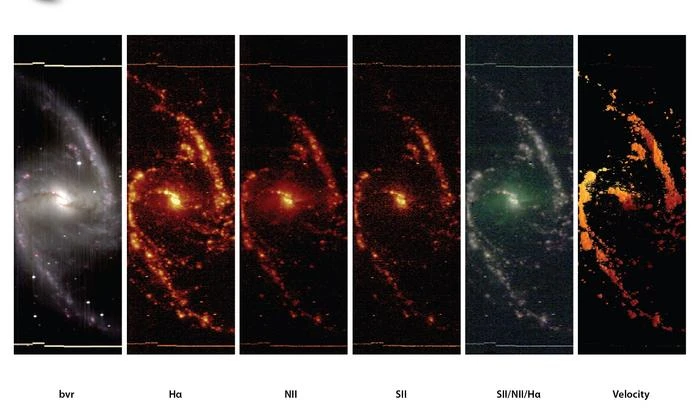
Using data from the TYPHOON survey on the Irénée du Pont telescope at the Las Campanas Observatory, the scientists examined the nearby spiral galaxy NGC 1365, whose wide disc shape is oriented so we can see it face-on from Earth. They achieved resolution sharp enough to separate and study individual star-forming clouds in the galaxy.
When they’re young, hot stars shine brightly in the ultraviolet, and that intense light can excite nearby gases, Kewley explains. Each element, such as oxygen, in the gas then produces bright, narrow lines of light.
Astronomers know that the centers of galaxies usually have more heavy elements, including oxygen, while the outer parts have less. The oxygen pattern is shaped by several factors, including where and when stars formed and exploded as supernovae, how gas has flowed in or out of the galaxy, and past mergers with other galaxies.
By measuring how the oxygen patterns change across a galaxy and comparing with state-of-the-art galaxy simulations in the Illustris Project, the astronomers traced how the galaxy grew and merged with other galaxies over 12 billion years of cosmic time. The simulations track the motion of gas, star formation, black holes, and chemical evolution in galaxies from shortly after the Big Bang to the present day.
The astronomers searched through simulations of about 20,000 galaxies and found one that closely matched NGC 1365’s observed properties, from which they inferred the galaxy’s likely merger and growth history.
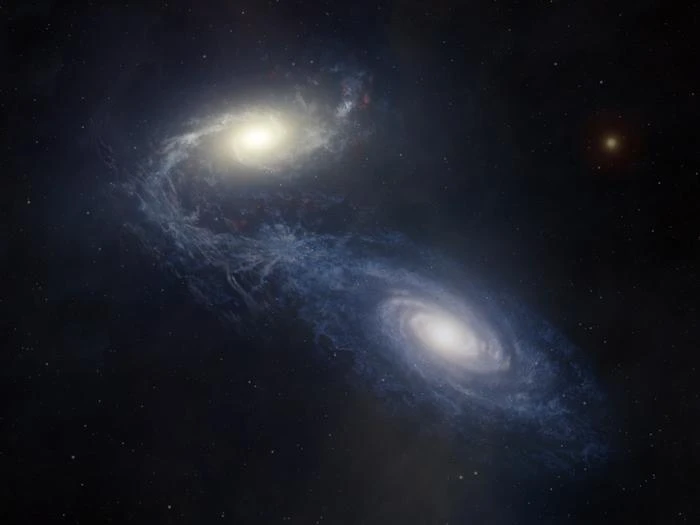
The astronomers found that NGC 1365’s central region formed early in the galaxy’s history and developed a large amount of oxygen. The gas further out built up over 12 billion years through collisions with smaller dwarf galaxies. The gas in the outer spiral arms of the galaxy probably formed relatively late, over the last few billion years, and was also fed by gas and stars from merging dwarf galaxies.
“It’s very exciting to see our simulations matched so closely by data from another galaxy,” said Lars Hernquist, Mallinckrodt Professor of Astrophysics at Harvard and a CfA astronomer. "This study shows that the astronomical processes we model on computers are shaping galaxies like NGC 1365 over billions of years."
Overall, the study shows NGC 1365 began as a small galaxy and slowly grew into a giant spiral via multiple mergers with smaller dwarf galaxies.
The astronomers establish extragalactic archaeology as a powerful new approach and tool that demonstrates that chemical fingerprints in a galaxy’s gas can reveal its history, said Kewley.
“This study shows really well how you can produce observations to be directly aided by theory,” she said. “I think it's also going to impact how we work together as theorists and observers, because this project was 50 percent theory and 50 percent observations, and you couldn't do one without the other. You need both to come to these conclusions.”
By studying galaxies like NGC 1365, which bears similarities to the Milky Way, astronomers can gain insight into how typical or unusual our own galaxy may be and the different pathways galaxies can take to reach their current states
“Do all spiral galaxies form in a similar way?” asked Kewley. “Are there differences between their formation? Where is their oxygen distributed now? Is our Milky Way different or unique in any way? Those are the questions we want to answer.”
END
The study, published today in the journal Nature Astronomy, demonstrates a new way to reconstruct the evolution of distant galaxies, and opens up a new field of astronomy, called “extragalactic archaeology.”
“This is the first time that a chemical archaeology method has been used with such fine detail outside our own galaxy,” says Lisa Kewley, lead author, Harvard professor, and director of the Center for Astrophysics. “We want to understand how we got here. How did our own Milky Way form, and how did we end up breathing the oxygen that we're breathing right now?”
Using data from the TYPHOON survey on the Irénée du Pont telescope at the Las Campanas Observatory, the scientists examined the nearby spiral galaxy NGC 1365, whose wide disc shape is oriented so we can see it face-on from Earth. They achieved resolution sharp enough to separate and study individual star-forming clouds in the galaxy.
When they’re young, hot stars shine brightly in the ultraviolet, and that intense light can excite nearby gases, Kewley explains. Each element, such as oxygen, in the gas then produces bright, narrow lines of light.
Astronomers know that the centers of galaxies usually have more heavy elements, including oxygen, while the outer parts have less. The oxygen pattern is shaped by several factors, including where and when stars formed and exploded as supernovae, how gas has flowed in or out of the galaxy, and past mergers with other galaxies.
By measuring how the oxygen patterns change across a galaxy and comparing with state-of-the-art galaxy simulations in the Illustris Project, the astronomers traced how the galaxy grew and merged with other galaxies over 12 billion years of cosmic time. The simulations track the motion of gas, star formation, black holes, and chemical evolution in galaxies from shortly after the Big Bang to the present day.
The astronomers searched through simulations of about 20,000 galaxies and found one that closely matched NGC 1365’s observed properties, from which they inferred the galaxy’s likely merger and growth history.
The astronomers found that NGC 1365’s central region formed early in the galaxy’s history and developed a large amount of oxygen. The gas further out built up over 12 billion years through collisions with smaller dwarf galaxies. The gas in the outer spiral arms of the galaxy probably formed relatively late, over the last few billion years, and was also fed by gas and stars from merging dwarf galaxies.
“It’s very exciting to see our simulations matched so closely by data from another galaxy,” said Lars Hernquist, Mallinckrodt Professor of Astrophysics at Harvard and a CfA astronomer. "This study shows that the astronomical processes we model on computers are shaping galaxies like NGC 1365 over billions of years."
Overall, the study shows NGC 1365 began as a small galaxy and slowly grew into a giant spiral via multiple mergers with smaller dwarf galaxies.
The astronomers establish extragalactic archaeology as a powerful new approach and tool that demonstrates that chemical fingerprints in a galaxy’s gas can reveal its history, said Kewley.
“This study shows really well how you can produce observations to be directly aided by theory,” she said. “I think it's also going to impact how we work together as theorists and observers, because this project was 50 percent theory and 50 percent observations, and you couldn't do one without the other. You need both to come to these conclusions.”
By studying galaxies like NGC 1365, which bears similarities to the Milky Way, astronomers can gain insight into how typical or unusual our own galaxy may be and the different pathways galaxies can take to reach their current states
“Do all spiral galaxies form in a similar way?” asked Kewley. “Are there differences between their formation? Where is their oxygen distributed now? Is our Milky Way different or unique in any way? Those are the questions we want to answer.”
END
Attachments