Climate change may complicate avalanche risk across the Pacific Northwest
Published 2026-03-23 · Original archive entry · Explore research explainers
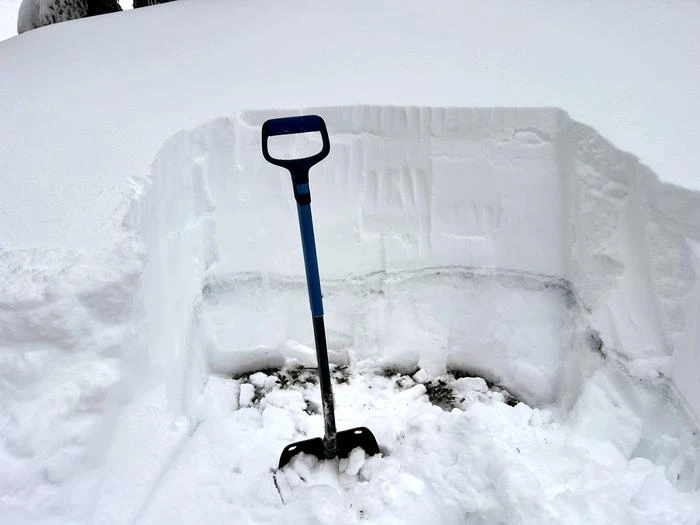
This winter was one of the warmest on record across the West; as a result, many snowy, alpine areas have seen bouts of winter rainfall where there would ordinarily only be snow. These unusual weather patterns have contributed to an abysmal ski season, but they can also set the stage for dangerous avalanches. At temperatures close to freezing, precipitation can fall as rain but freeze when it hits the snow, forming an icy crust. Snow that accumulates on top of that crust is unstable and prone to abrupt slides, causing an avalanche that can close down a major highway in moments, endanger backcountry skiers and more.
Avalanche experts in Western Washington know how to manage the risks associated with rain-on-snow events, but many of their counterparts in colder regions like Eastern Washington, Idaho and Montana are less familiar with these dynamics. New research from the University of Washington shows that as winters in these regions warm, their snowpacks may come to resemble those of maritime areas, with more rain-on-snow events, icy crusts and complex avalanche forecasting.
The findings were published February 25 in ARC Geophysical Research.
“This winter’s warmth is a harbinger,” said lead author Clinton Alden, a UW graduate student of civil and environmental engineering. “We know that temperatures will keep rising, and our work is a red flag for cooler regions of the greater Pacific Northwest, such as Idaho and Western Montana, that aren’t used to dealing with ice crusts and their resulting avalanche problems.”
The study is part of a larger effort to understand the structure of snow as it accumulates, which has implications for weather and avalanche forecasting, wildlife dynamics and more.
“Snow scientists are pretty good at measuring snow depth and volume,” said senior author Jessica Lundquist, a UW professor of civil and environmental engineering. “We’re also pretty good at figuring out how much water you get if all that snow melts. But our models aren’t as good at representing snow structure, such as layers of different densities and crystal types that increase avalanche risks. And we really want to know how the structure of snow changes as the climate changes. That’s a tricky question that no one has tackled, particularly for rain-on-snow conditions.”
To dig into that question, the researchers studied how warming influences ice layer formation in seasonal snowpacks. First, they collected temperature and precipitation data captured by 53 monitoring stations across the Pacific Northwest for the past 25 years. They used a computer model to identify days when ice layers likely formed at each location. They then checked the model against real-world measurements at one of the locations — a station at Snoqualmie Pass — and found that the model matched the measurements with 74% accuracy.
Finally, they used the same model to simulate those same 25 winters at 2 C and 4 C warmer than they were, and looked for changes to the number of ice crusts across the region. According to the UW Climate Impacts Group, the Pacific Northwest is expected to warm by 2 C to 5 C by 2050 as compared to pre-2000 temperatures.
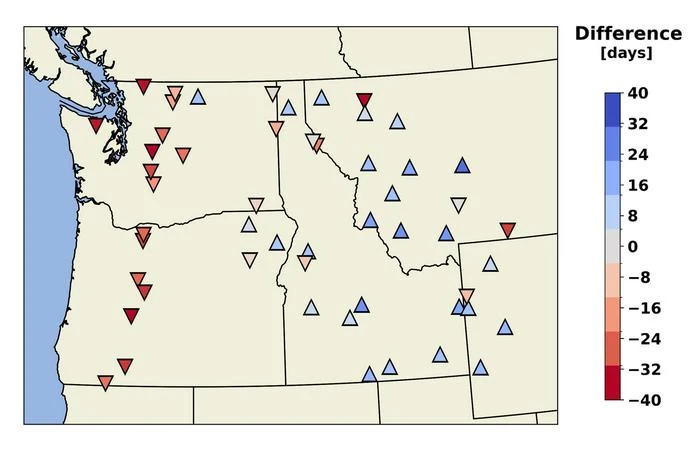
The results were split regionally by the Cascade mountains. In colder, inland parts of the Pacific Northwest — places like Eastern Washington, Idaho and Montana — higher temperatures created more rain-on-snow days and more avalanche-prone ice layers. Locations in the warmer, maritime Cascades saw the opposite effect: Higher temperatures created slush instead of ice, potentially reducing the avalanche risk associated with ice crusts.
The predicted snowpack changes may also impact wildlife behavior. Some foraging mammals, such as reindeer, dig down into the snow in search of food and may have a hard time breaking through an icy crust. Conversely, firm ice might provide a better running surface for animals fleeing predators. Specific regional effects will require additional study.
What’s clear now is that those who work or play in avalanche terrain in broad swaths of the Pacific Northwest — and even beyond — may need to adjust to a new set of risk factors.
“I get calls from avalanche forecasters in places like Colorado, Wyoming and Montana. They tell me they’re getting rain at 10,000 feet, which they’ve never seen before,” said co-author John Stimberis, the avalanche forecaster supervisor at Washington State Department of Transportation at Snoqualmie Pass, who earned his master’s in transportation and highway engineering at the UW. “They want to know when to expect the onset of avalanches and when to expect the return to stability.”
Alden hopes that this research will encourage further collaboration within the avalanche forecasting community.
“I’d love to see this shared with avalanche forecasters widely, both as a call to action and as a way to help them understand what their snowpack might look like in the future,” Alden said.
Benjamin K. Sullender, the director of geospatial science at Audubon Alaska and former doctoral student of environmental and forest sciences at the UW, is a co-author.
This research was funded by the NASA Interdisciplinary Research in Earth Science program and the UW Program on Climate Change’s Graubard Fellowship.
For more information, contact Alden at cdalden@uw.edu.
END
Avalanche experts in Western Washington know how to manage the risks associated with rain-on-snow events, but many of their counterparts in colder regions like Eastern Washington, Idaho and Montana are less familiar with these dynamics. New research from the University of Washington shows that as winters in these regions warm, their snowpacks may come to resemble those of maritime areas, with more rain-on-snow events, icy crusts and complex avalanche forecasting.
The findings were published February 25 in ARC Geophysical Research.
“This winter’s warmth is a harbinger,” said lead author Clinton Alden, a UW graduate student of civil and environmental engineering. “We know that temperatures will keep rising, and our work is a red flag for cooler regions of the greater Pacific Northwest, such as Idaho and Western Montana, that aren’t used to dealing with ice crusts and their resulting avalanche problems.”
The study is part of a larger effort to understand the structure of snow as it accumulates, which has implications for weather and avalanche forecasting, wildlife dynamics and more.
“Snow scientists are pretty good at measuring snow depth and volume,” said senior author Jessica Lundquist, a UW professor of civil and environmental engineering. “We’re also pretty good at figuring out how much water you get if all that snow melts. But our models aren’t as good at representing snow structure, such as layers of different densities and crystal types that increase avalanche risks. And we really want to know how the structure of snow changes as the climate changes. That’s a tricky question that no one has tackled, particularly for rain-on-snow conditions.”
To dig into that question, the researchers studied how warming influences ice layer formation in seasonal snowpacks. First, they collected temperature and precipitation data captured by 53 monitoring stations across the Pacific Northwest for the past 25 years. They used a computer model to identify days when ice layers likely formed at each location. They then checked the model against real-world measurements at one of the locations — a station at Snoqualmie Pass — and found that the model matched the measurements with 74% accuracy.
Finally, they used the same model to simulate those same 25 winters at 2 C and 4 C warmer than they were, and looked for changes to the number of ice crusts across the region. According to the UW Climate Impacts Group, the Pacific Northwest is expected to warm by 2 C to 5 C by 2050 as compared to pre-2000 temperatures.
The results were split regionally by the Cascade mountains. In colder, inland parts of the Pacific Northwest — places like Eastern Washington, Idaho and Montana — higher temperatures created more rain-on-snow days and more avalanche-prone ice layers. Locations in the warmer, maritime Cascades saw the opposite effect: Higher temperatures created slush instead of ice, potentially reducing the avalanche risk associated with ice crusts.
The predicted snowpack changes may also impact wildlife behavior. Some foraging mammals, such as reindeer, dig down into the snow in search of food and may have a hard time breaking through an icy crust. Conversely, firm ice might provide a better running surface for animals fleeing predators. Specific regional effects will require additional study.
What’s clear now is that those who work or play in avalanche terrain in broad swaths of the Pacific Northwest — and even beyond — may need to adjust to a new set of risk factors.
“I get calls from avalanche forecasters in places like Colorado, Wyoming and Montana. They tell me they’re getting rain at 10,000 feet, which they’ve never seen before,” said co-author John Stimberis, the avalanche forecaster supervisor at Washington State Department of Transportation at Snoqualmie Pass, who earned his master’s in transportation and highway engineering at the UW. “They want to know when to expect the onset of avalanches and when to expect the return to stability.”
Alden hopes that this research will encourage further collaboration within the avalanche forecasting community.
“I’d love to see this shared with avalanche forecasters widely, both as a call to action and as a way to help them understand what their snowpack might look like in the future,” Alden said.
Benjamin K. Sullender, the director of geospatial science at Audubon Alaska and former doctoral student of environmental and forest sciences at the UW, is a co-author.
This research was funded by the NASA Interdisciplinary Research in Earth Science program and the UW Program on Climate Change’s Graubard Fellowship.
For more information, contact Alden at cdalden@uw.edu.
END
Attachments