Large language models and creativity
Published 2026-03-24 · Original archive entry · Explore research explainers
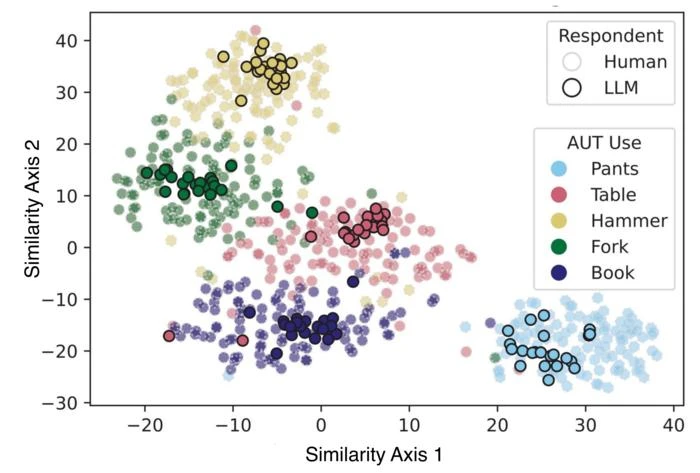
Can using a large language model (LLM) make a person more creative? Prior work has shown that using LLMs can make creative outputs more homogeneous,but this homogenization could stem from the specific LLM used or from widespread use of the same model. Emily Wenger and Yoed N. Kenett asked humans recruited from the Prolific platform and a broad range of LLMs to complete multiple tasks designed to measure different facets of creativity. For example, one task asked participants to come up with as many uses as possible for an item like a fork or a pair of pants. Another task asked participants to think of 10 nouns that are as different from one another as possible. Across the board, the authors found that LLM responses were significantly more similar to each other than human responses. In isolation, a single LLM response to a task was typically rated as roughly equally creative or more creative than the average human response. However, when compared to other outputs from other LLMs—whether Gemini, GPT, or Llama—similar ideas and responses emerged again and again. Increasing model temperature, which describes the level of randomness in model outputs, made the responses more variable than those produced by lower-temperature settings, but higher temperatures also quickly turned the outputs into gibberish that did not fulfill task requirements. According to the authors, it is likely the use of LLMs in general, rather than the use of any specific LLM, that causes outputs to be homogeneous. Whether LLMs can be improved to reach or surpass human creativity is an open question, given that by their nature, they lack bodies, experiences, intentions, individuality, or understanding, some or all of which may be necessary to simulate human creativity. According to the authors, relying on LLMs for brainstorming, problem solving, or making art risks harming human thinking.
END
END