Snow flies create their own heat to avoid freezing
New study finds specialized insect produces bursts of heat and antifreeze proteins
Published 2026-03-24 · Original archive entry · Explore research explainers
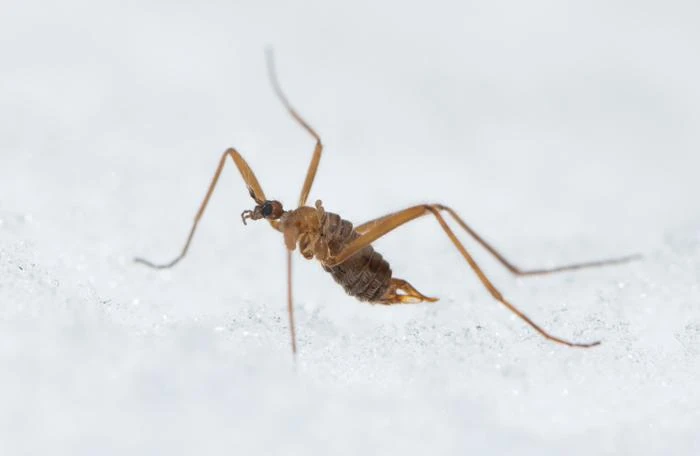
Snow flies might be undergoing an identity crisis.
In a new study, Northwestern University scientists explored how snow flies — small, wingless insects that crawl across snow to find mates and lay eggs — survive in freezing cold temperatures. They discovered this snow-dwelling fly uses a surprising combination of strategies: it generates its own body heat like a mammal and produces antifreeze proteins like an Arctic fish.
While sub-zero temperatures are a death sentence for most other insects, these adaptations allow snow flies to remain active at temperatures as low as -6 degrees Celsius (or 21.2 degrees Fahrenheit).
The findings shed light on how life has adapted to survive in extreme environments and potentially could inform new strategies for protecting cells, tissues and materials from cold damage.
The study will be published on Tuesday (March 24) in the journal Current Biology.
“Insects are cold-blooded, so they are at the mercy of external temperatures,” said Northwestern’s Marco Gallio, who led the study. “But they have a mind-boggling ability to adapt to extremes. When it gets cold, a common strategy is to find shelter and become dormant until conditions get better. But instead of slowing down, snow flies actually prefer freezing cold, snowy conditions and hide away when the snow melts and it gets warm. They really push the limit of what’s possible. Now we’ve found snow flies aren’t just tolerating the cold, they have multiple ways to counteract it.”
An expert on how temperature affects biology, Gallio is the Soretta and Henry Shapiro Research Professor in Molecular Biology and a professor of neurobiology at Northwestern’s Weinberg College of Arts and Sciences. He co-led the study with Marcus Stensmyr, a biology professor at Lund University in Sweden. Northwestern coauthors include William Kath, the Margaret B. Fuller Boos Professor of Engineering Sciences and Applied Mathematics at Northwestern’s McCormick School of Engineering, and Alessia Para, a research associate professor of neurobiology at Weinberg. Gallio and Kath also are affiliates of the NSF-Simons National Institute for Theory and Mathematics in Biology (NITMB).
Like sequencing ‘an alien species’
Before scientists can understand an organism’s unusual behavior, they need to uncover its biological tools. To do this, Gallio and his collaborators were the first to sequence the snow fly’s genome. They then compared it to that of related insects that are not specialized to withstand cold. After analyzing the fly’s full genome, the researchers then studied its RNA, which provided information about which genes the fly actually uses to survive the cold. Kath’s Ph.D. student Richard Suhendra conducted these complex genomic comparisons.
The results revealed a baffling set of genetic information.
“We couldn’t find many of the genes within any database,” Gallio said. “Initially, I thought we must have sequenced some alien species. It’s very rare for an active gene, which makes a protein, to not have a match.”
Eventually, Gallio and his team realized the mysterious genes produced multiple antifreeze proteins. Similar to antifreeze proteins found in Arctic fish, the snow fly’s proteins bind to ice crystals to prevent them from growing. This ice shield protects cells from damage caused by freezing.
“Remarkably, some of the antifreeze proteins we found are actually structurally related to those of Arctic fish,” Gallio said. “That suggests evolution came to the same solution for a common problem.”
In the same analysis, the team found an unusual set of genes tied to energy use and cellular processes associated with heat generation. Together, those genetic clues suggested something unexpected. Not only does the snow fly resist freezing, but it also generates its own heat.
“We found genes that in larger animals are associated with mitochondrial thermogenesis in brown adipose tissue,” Gallio said. “Many animals like marmots and polar bears have brown fat, which is there to produce heat. When they go into hibernation, they burn this stored fat to produce heat rather than to produce chemical energy. So, in some ways snow flies use a combination of the strategies used by polar bears and by Arctic fish.”
Ice blocked, heat unlocked
To test how the antifreeze proteins function, Matthew Capek, a Ph.D. student in the Gallio Lab, engineered fruit flies to produce one of the snow fly’s proteins. He then tested their survival by placing flies in the lab’s freezer. Compared to normal fruit flies, the engineered fruit flies were indeed far more likely to survive freezing. The experiment confirmed these proteins act like microscopic ice blockers. By blocking the growth of ice crystals, the proteins stop freezing before it can spread.
In another set of experiments, the researchers explored whether the snow fly truly could generate its own heat. To do this, they measured the insect’s internal temperature while lowering the temperature of the surrounding environment to below freezing. During this cooling process, snow flies consistently stayed slightly warmer than expected — by a couple of degrees Celsius compared to control insects.
“Other insects, like bees and moths, shiver to increase their heat,” Stensmyr said. “But we found no evidence of shivering. Snow flies instead likely produce heat at the cellular level, more similar to how mammals and even some plants generate heat.”
For an animal living at the edge of freezing, a brief burst of warmth can mean the difference between life and death. It may give snow flies just enough time to seek cover and avoid freezing when conditions suddenly change.
Built to endure
In yet another defense against the cold, snow flies are far less sensitive to cold-induced pain, the researchers found. Most people have experienced the stinging bite of touching ice or an iron railing on a freezing winter’s day. Reactive molecules within cells trigger that painful sensation to prompt organisms to avoid harmful conditions. But the snow fly appears to have rewired that response.
Gallio and his collaborators found that a key sensory protein — one that typically helps animals detect harmful stimuli — is far less sensitive in the snow fly than in other insects. As a result, the insect can tolerate higher levels of cold pain. This enables it to continue functioning in conditions that would overwhelm most species.
“It turns out that a specific irritant receptor is 30 times less sensitive in snow flies than in mosquitoes and fruit flies,” Gallio said. “So, they can cope with higher levels of noxious irritants produced by cold exposure.”
Next, the team plans to dig deeper into how snow flies generate heat at the cellular level and to explore the insect’s full range of antifreeze proteins. That work eventually could reveal whether other species use similar strategies to survive extreme cold.
The study, “Coordinated molecular and physiological adaptations enable activity at subfreezing temperature in the snow fly Chionea alexandriana,” will appear in the April 6 volume of the journal and feature on the cover. The work in the various labs was partially supported by the National Institutes of Health, the Pew Scholars Program, the McKnight Foundation, the Paula M. Trienens Institute for Sustainability and Energy, the Crafoord Foundation, the National Science Foundation, the Simons Foundation and NITMB. External collaborators included the DNAzoo project and Olga Dudchenko and Erez Lieberman Aiden, who are both faculty members at Rice University and at the Baylor College of Medicine.
END
In a new study, Northwestern University scientists explored how snow flies — small, wingless insects that crawl across snow to find mates and lay eggs — survive in freezing cold temperatures. They discovered this snow-dwelling fly uses a surprising combination of strategies: it generates its own body heat like a mammal and produces antifreeze proteins like an Arctic fish.
While sub-zero temperatures are a death sentence for most other insects, these adaptations allow snow flies to remain active at temperatures as low as -6 degrees Celsius (or 21.2 degrees Fahrenheit).
The findings shed light on how life has adapted to survive in extreme environments and potentially could inform new strategies for protecting cells, tissues and materials from cold damage.
The study will be published on Tuesday (March 24) in the journal Current Biology.
“Insects are cold-blooded, so they are at the mercy of external temperatures,” said Northwestern’s Marco Gallio, who led the study. “But they have a mind-boggling ability to adapt to extremes. When it gets cold, a common strategy is to find shelter and become dormant until conditions get better. But instead of slowing down, snow flies actually prefer freezing cold, snowy conditions and hide away when the snow melts and it gets warm. They really push the limit of what’s possible. Now we’ve found snow flies aren’t just tolerating the cold, they have multiple ways to counteract it.”
An expert on how temperature affects biology, Gallio is the Soretta and Henry Shapiro Research Professor in Molecular Biology and a professor of neurobiology at Northwestern’s Weinberg College of Arts and Sciences. He co-led the study with Marcus Stensmyr, a biology professor at Lund University in Sweden. Northwestern coauthors include William Kath, the Margaret B. Fuller Boos Professor of Engineering Sciences and Applied Mathematics at Northwestern’s McCormick School of Engineering, and Alessia Para, a research associate professor of neurobiology at Weinberg. Gallio and Kath also are affiliates of the NSF-Simons National Institute for Theory and Mathematics in Biology (NITMB).
Like sequencing ‘an alien species’
Before scientists can understand an organism’s unusual behavior, they need to uncover its biological tools. To do this, Gallio and his collaborators were the first to sequence the snow fly’s genome. They then compared it to that of related insects that are not specialized to withstand cold. After analyzing the fly’s full genome, the researchers then studied its RNA, which provided information about which genes the fly actually uses to survive the cold. Kath’s Ph.D. student Richard Suhendra conducted these complex genomic comparisons.
The results revealed a baffling set of genetic information.
“We couldn’t find many of the genes within any database,” Gallio said. “Initially, I thought we must have sequenced some alien species. It’s very rare for an active gene, which makes a protein, to not have a match.”
Eventually, Gallio and his team realized the mysterious genes produced multiple antifreeze proteins. Similar to antifreeze proteins found in Arctic fish, the snow fly’s proteins bind to ice crystals to prevent them from growing. This ice shield protects cells from damage caused by freezing.
“Remarkably, some of the antifreeze proteins we found are actually structurally related to those of Arctic fish,” Gallio said. “That suggests evolution came to the same solution for a common problem.”
In the same analysis, the team found an unusual set of genes tied to energy use and cellular processes associated with heat generation. Together, those genetic clues suggested something unexpected. Not only does the snow fly resist freezing, but it also generates its own heat.
“We found genes that in larger animals are associated with mitochondrial thermogenesis in brown adipose tissue,” Gallio said. “Many animals like marmots and polar bears have brown fat, which is there to produce heat. When they go into hibernation, they burn this stored fat to produce heat rather than to produce chemical energy. So, in some ways snow flies use a combination of the strategies used by polar bears and by Arctic fish.”
Ice blocked, heat unlocked
To test how the antifreeze proteins function, Matthew Capek, a Ph.D. student in the Gallio Lab, engineered fruit flies to produce one of the snow fly’s proteins. He then tested their survival by placing flies in the lab’s freezer. Compared to normal fruit flies, the engineered fruit flies were indeed far more likely to survive freezing. The experiment confirmed these proteins act like microscopic ice blockers. By blocking the growth of ice crystals, the proteins stop freezing before it can spread.
In another set of experiments, the researchers explored whether the snow fly truly could generate its own heat. To do this, they measured the insect’s internal temperature while lowering the temperature of the surrounding environment to below freezing. During this cooling process, snow flies consistently stayed slightly warmer than expected — by a couple of degrees Celsius compared to control insects.
“Other insects, like bees and moths, shiver to increase their heat,” Stensmyr said. “But we found no evidence of shivering. Snow flies instead likely produce heat at the cellular level, more similar to how mammals and even some plants generate heat.”
For an animal living at the edge of freezing, a brief burst of warmth can mean the difference between life and death. It may give snow flies just enough time to seek cover and avoid freezing when conditions suddenly change.
Built to endure
In yet another defense against the cold, snow flies are far less sensitive to cold-induced pain, the researchers found. Most people have experienced the stinging bite of touching ice or an iron railing on a freezing winter’s day. Reactive molecules within cells trigger that painful sensation to prompt organisms to avoid harmful conditions. But the snow fly appears to have rewired that response.
Gallio and his collaborators found that a key sensory protein — one that typically helps animals detect harmful stimuli — is far less sensitive in the snow fly than in other insects. As a result, the insect can tolerate higher levels of cold pain. This enables it to continue functioning in conditions that would overwhelm most species.
“It turns out that a specific irritant receptor is 30 times less sensitive in snow flies than in mosquitoes and fruit flies,” Gallio said. “So, they can cope with higher levels of noxious irritants produced by cold exposure.”
Next, the team plans to dig deeper into how snow flies generate heat at the cellular level and to explore the insect’s full range of antifreeze proteins. That work eventually could reveal whether other species use similar strategies to survive extreme cold.
The study, “Coordinated molecular and physiological adaptations enable activity at subfreezing temperature in the snow fly Chionea alexandriana,” will appear in the April 6 volume of the journal and feature on the cover. The work in the various labs was partially supported by the National Institutes of Health, the Pew Scholars Program, the McKnight Foundation, the Paula M. Trienens Institute for Sustainability and Energy, the Crafoord Foundation, the National Science Foundation, the Simons Foundation and NITMB. External collaborators included the DNAzoo project and Olga Dudchenko and Erez Lieberman Aiden, who are both faculty members at Rice University and at the Baylor College of Medicine.
END