Scientists discover new genetic disease that causes premature aging and cognitive deficits
Study implicates a surprising gene, shows how its mutation affects cells and identifies a potential treatment
Published 2026-03-24 · Original archive entry · Explore research explainers
Scientists at Sanford Burnham Prebys Medical Discovery Institute and an international team of collaborators have defined a new genetic disease marked by premature aging and deficits in brain function.
The researchers published results on March 19, 2026, in Nature Communications that describe the first known project to combine genome sequencing with cellular reprogramming to identify which gene mutation is at fault and study how it causes the symptoms observed in patients suffering from this newly discovered disease.
“Our collaborator identified a family of patients whose teenaged members had whitening hairs and other characteristics associated with premature aging conditions known as progeria syndromes,” said senior and corresponding author Su-Chun Zhang, MD, PhD, the Jeanne and Gary Herberger Leadership Chair in Neuroscience and the director of and professor in the Center for Neurologic Diseases at Sanford Burnham Prebys.
“Cognitive functions are often well-preserved in these conditions, however, so it was clear from the patients’ progressive loss of motor skills and neurological and intellectual deficits that this was an unknown disease.”
The research team used both genome sequencing and a method for mapping recessive traits to trace the disease to a surprising spot within these patients’ DNA. The investigators implicated a mutation in the IVNS1ABP gene, which holds the instructional codes for building IVNS1ABP, an influenza virus non-structural protein-1 binding protein.
“Relatively little research has been done on this gene and protein, and no one has ever linked them to the biology of aging, premature aging diseases or neuropathy,” said Fang Yuan, PhD, staff scientist at Sanford Burnham Prebys and first author of the study.
“It was a mystery in many ways, and one we were determined to solve.”
To explore the effects of this gene mutation, the scientists acquired samples of skin cells from the affected patients and reprogrammed them into induced pluripotent stem cells. These cells were coaxed into a state that is more mature than a stem cell but not yet a neuron or other brain or nerve cell.
These precursor cells—known as neural progenitor cells—retain the patients’ mutation in the IVNS1ABP gene, enabling experiments to understand what changes it causes on the cellular level.
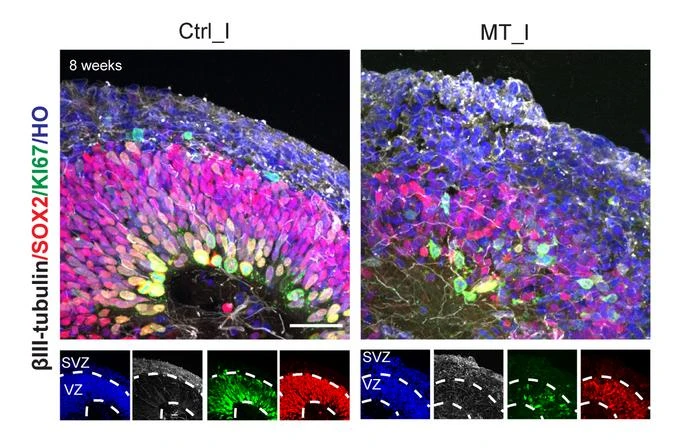
“Under the microscope, we found that the patient-derived cells with the mutation grow much slower compared to the control group reprogrammed from a sibling without the disease,” said Zhang.
This lethargic growth suggested that the cells had entered a zombie-like state called cellular senescence. Damage to DNA often causes cells to become senescent. When the research team looked at markers of genetic harm, they found three different indicators of injury to the genome, as well as an increased expression level of a cell cycle inhibitor gene associated with cellular senescence called CDKN2A.
“To narrow in on what was causing these cells to become senescent, we ran follow-up experiments showing that DNA damage was occurring during cell division, and we saw that it could be severe enough to cause cell death,” said Yuan.
Because the mutated gene had no known direct link to cell division, the investigators hypothesized that their observation may be due to interactions between multiple proteins. Their experiments compiled a list of 14 potential proteins that may be involved. Ten of them were connected to actin, one of the structural components that gives shape and structure to a cell.
“During cell division, the actin filament needs to form an anchoring structure, and it usually forms a very round and even ring structure,” said Zhang. “But in the mutant cells, the altered actin forms a shrunken and irregularly shaped ring, so cells are not pulled apart in a symmetrical way and suffer damage.”
The scientists suspected that the mutation was affecting how the cell precisely coordinates the dynamic process of building this actin anchoring structure.
“When these actin dynamics are altered, the cell cannot perform cell division at the right time and in the right place,” said Yuan.
The research team demonstrated that mutant cells had altered actin dynamics, and that the cells could be treated with chemicals to stabilize the actin structure and improve the rate of normal cell division.
“This research highlights the potential of using cellular reprogramming and patient-derived stem cell models to study rare and unknown diseases,” said Zhang.
“And we already showed that if we correct some of the steps in the molecular processes, then we can fix some of the defects, at least in the cellular model,” said Yuan.
“It will be important to complement these findings with studies in an animal model we’re developing, but what we’ve done already demonstrates that this approach is a powerful tool for defining new diseases and developing potential treatments.”
Additional authors include:
The study’s DOI is 10.1038/s41467-026-70756-x.
END
The researchers published results on March 19, 2026, in Nature Communications that describe the first known project to combine genome sequencing with cellular reprogramming to identify which gene mutation is at fault and study how it causes the symptoms observed in patients suffering from this newly discovered disease.
“Our collaborator identified a family of patients whose teenaged members had whitening hairs and other characteristics associated with premature aging conditions known as progeria syndromes,” said senior and corresponding author Su-Chun Zhang, MD, PhD, the Jeanne and Gary Herberger Leadership Chair in Neuroscience and the director of and professor in the Center for Neurologic Diseases at Sanford Burnham Prebys.
“Cognitive functions are often well-preserved in these conditions, however, so it was clear from the patients’ progressive loss of motor skills and neurological and intellectual deficits that this was an unknown disease.”
The research team used both genome sequencing and a method for mapping recessive traits to trace the disease to a surprising spot within these patients’ DNA. The investigators implicated a mutation in the IVNS1ABP gene, which holds the instructional codes for building IVNS1ABP, an influenza virus non-structural protein-1 binding protein.
“Relatively little research has been done on this gene and protein, and no one has ever linked them to the biology of aging, premature aging diseases or neuropathy,” said Fang Yuan, PhD, staff scientist at Sanford Burnham Prebys and first author of the study.
“It was a mystery in many ways, and one we were determined to solve.”
To explore the effects of this gene mutation, the scientists acquired samples of skin cells from the affected patients and reprogrammed them into induced pluripotent stem cells. These cells were coaxed into a state that is more mature than a stem cell but not yet a neuron or other brain or nerve cell.
These precursor cells—known as neural progenitor cells—retain the patients’ mutation in the IVNS1ABP gene, enabling experiments to understand what changes it causes on the cellular level.
“Under the microscope, we found that the patient-derived cells with the mutation grow much slower compared to the control group reprogrammed from a sibling without the disease,” said Zhang.
This lethargic growth suggested that the cells had entered a zombie-like state called cellular senescence. Damage to DNA often causes cells to become senescent. When the research team looked at markers of genetic harm, they found three different indicators of injury to the genome, as well as an increased expression level of a cell cycle inhibitor gene associated with cellular senescence called CDKN2A.
“To narrow in on what was causing these cells to become senescent, we ran follow-up experiments showing that DNA damage was occurring during cell division, and we saw that it could be severe enough to cause cell death,” said Yuan.
Because the mutated gene had no known direct link to cell division, the investigators hypothesized that their observation may be due to interactions between multiple proteins. Their experiments compiled a list of 14 potential proteins that may be involved. Ten of them were connected to actin, one of the structural components that gives shape and structure to a cell.
“During cell division, the actin filament needs to form an anchoring structure, and it usually forms a very round and even ring structure,” said Zhang. “But in the mutant cells, the altered actin forms a shrunken and irregularly shaped ring, so cells are not pulled apart in a symmetrical way and suffer damage.”
The scientists suspected that the mutation was affecting how the cell precisely coordinates the dynamic process of building this actin anchoring structure.
“When these actin dynamics are altered, the cell cannot perform cell division at the right time and in the right place,” said Yuan.
The research team demonstrated that mutant cells had altered actin dynamics, and that the cells could be treated with chemicals to stabilize the actin structure and improve the rate of normal cell division.
“This research highlights the potential of using cellular reprogramming and patient-derived stem cell models to study rare and unknown diseases,” said Zhang.
“And we already showed that if we correct some of the steps in the molecular processes, then we can fix some of the defects, at least in the cellular model,” said Yuan.
“It will be important to complement these findings with studies in an animal model we’re developing, but what we’ve done already demonstrates that this approach is a powerful tool for defining new diseases and developing potential treatments.”
Additional authors include:
- Ye Sing Tan, Qiang Yuan, Shu-Min Chou, Yu-Hsin Yen and Gunaseelan Narayanan from Duke-National University of Singapore (NUS) Medical School
- Haofei Wang from The University of North Carolina at Chapel Hill
- Ain Nur Ali, Carine Bonnard and Bruno Reversade from the Agency for Science, Technology and Research in Singapore
- Lei Zhou from The Hong Kong Polytechnic University
- Mohammad Shboul from Jordan University of Science and Technology
The study’s DOI is 10.1038/s41467-026-70756-x.
END
Attachments