After record-breaking results in fusion research, this highly successful project is winding down to make way for new experiments
The Large Helical Device produced key findings about fusion for nearly 30 years
Published 2026-03-24 · Original archive entry · Explore research explainers
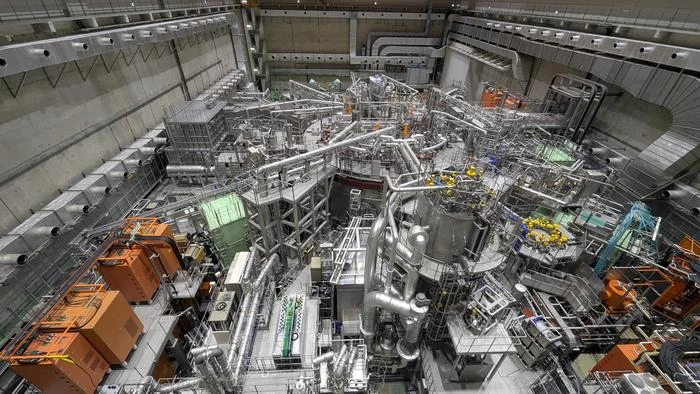
The U.S. Department of Energy’s Princeton Plasma Physics Laboratory (PPPL) is celebrating the successful conclusion of a research marathon on Japan’s Large Helical Device (LHD). Since it began operations in 1998, LHD has been a critical test bed for international research on fusion energy, helping to prove that stellarators can be a stable and reliable pathway toward creating a limitless source of energy on Earth.
The international collaboration involved a few dozen PPPL researchers, some of whom lived in Toki, Japan, for months at a time to work alongside colleagues at the National Institute for Fusion Science (NIFS). With the program’s final experimental campaign now officially completed, LHD leaves behind a wealth of data that will guide the design of future power plants.
“LHD pushed science forward in so many areas, both in terms of theory and experimental findings,” said Novimir Pablant, the division head for stellarator experiments at PPPL. “It played a role similar to PPPL’s Tokamak Fusion Test Reactor for tokamaks; you can’t point to one single thing it did because it contributed to advancing the scientific principles necessary for the realization of future fusion systems across the board.” Pablant said LHD has also developed and matured many technologies needed for fusion, including the superconducting coils that confine the plasma fuel, the high-energy neutral beams that heat it and hardware designed for extended periods rather than short bursts.
Two possible paths to star power
Fusion is the same process that powers the sun and the stars. It occurs when the centers of atoms, called nuclei, are forced together under extreme pressures and temperatures in a process that releases massive amounts of energy. Fusion energy scientists work with plasma: an ultrahot, charged gas that can be manipulated by magnetic fields. During fusion, the plasma can reach temperatures hotter than the core of the sun. So, it cannot be held by any physical container. Instead, machines like LHD use massive superconducting magnets to try to hold the plasma at the ideal temperatures and pressures for fusion energy production.
Two of the leading designs for these machines are the tokamak and the stellarator. Tokamaks, such as PPPL’s National Spherical Torus Experiment-Upgrade, use a doughnut-shaped chamber and a combination of external magnets and an electrical current running through the plasma to create the magnetic field that holds the plasma in place. LHD, in contrast, is a stellarator. These kinds of fusion systems rely entirely on precisely shaped external magnets twisted into complex configurations to shape the plasma. Experimental results from LHD offer insights that complement tokamak research as scientists work toward making fusion a practical energy source.
“We have known since the 1970s that stellarators could solve the sustainment and disruption problems that have challenged tokamaks forever,” said Michael Zarnstorff, a physicist at PPPL and former deputy director for research. “LHD proved this definitively, showing the fusion community that you can eliminate the disruption problem simply by building the machine with this type of magnetic configuration. LHD sustained megawatt-level plasmas for almost an hour.”
PPPL’s innovative diagnostics were an important part of LHD
PPPL brought significant U.S. technical expertise to LHD in Japan, particularly in the field of diagnostics: the specialized tools used to measure what is happening inside the plasma.
“For more than 20 years, PPPL has contributed a great deal to our project. They have brought great knowledge and expertise to LHD experiments and published many papers based on LHD data,” said Motoshi Goto, a professor at SOKENDAI (The Graduate University for Advanced Studies) and researcher at NIFS in Japan. “We have very close relationships between our institutes, and the diagnostic systems developed through this collaboration are currently among the best in the world.”
One major contribution was the X-ray imaging crystal spectrometer (XICS). This diagnostic allowed scientists to measure ion temperatures and plasma flows with incredible precision. Another key piece of hardware was the impurity powder dropper, a device designed to improve plasma performance by adding precise amounts of impurities during fusion.
These contributions helped LHD achieve several world-record milestones. While tokamaks often struggle with sudden plasma disruptions that can halt an experiment, the LHD’s unique helical design proved it could run smoothly for long periods. The machine achieved steady-state pulses lasting up to 48 minutes, a feat that demonstrated its potential for the continuous operation required by a commercial power plant.
“LHD has a unique feature to produce plasmas resistant and resilient to external disturbances, and the PPPL powder dropper can control the supply of many kinds of species to plasma easily and flexibly. This combination has opened many new doors in plasma physics and fusion science,” said Hiroshi Yamada, NIFS director general and professor emeritus of the Graduate School of Frontier Sciences at The University of Tokyo.
PPPL staff research physicist Federico Nespoli started working with collaborators from LHD on the impurity powder dropper when he first joined the Lab in 2019. “We still have a lot of data that we collected during the last LHD experimental campaign, and I will definitely keep working with NIFS colleagues on the analysis and interpretation of these data, as well as extending our research to similar experiments to be performed in the Wendelstein 7-X stellarator in Germany as part of our international team,” said Nespoli.
Some experiments looked at the interaction between the materials that make up the inside of LHD and the plasma to try to find the ideal materials to make future stellarators. Shota Abe, another PPPL staff research physicist, was part of a team that put samples of diamond and diamond-like carbon materials into LHD to see how it could handle the heat. The diamond samples were made at PPPL’s Quantum Diamond Laboratory before traveling to Japan. “It’s a very exciting project because it’s synergistic, both internationally and interdisciplinarily. It brings together people from LHD, PPPL fusion researchers and people who work in PPPL’s Quantum Diamond Lab,” Abe said.
PPPL and NIFS collaborations to continue
Though LHD completed its final run, Goto says its scientific impact is far from over. NIFS has made all 27 years of LHD experimental data publicly available on the web, an important contribution to global science. This open-access policy allows researchers at PPPL and other institutions around the world to continue analyzing the findings for years to come. This data will be vital as scientists move toward building the next generation of optimized stellarators, which aim to be even more efficient.
“There is still a great deal of analysis to be done on the data from the final LHD campaigns. The inherent stability of LHD’s magnetic configuration provided us with a unique dataset, which will be of great interest as the world fusion program moves toward steady-state devices such as a fusion pilot plant,” said PPPL research physicist Robert Lunsford.
The collaboration between PPPL and NIFS will also transition to new, more flexible experimental devices. These include the Compact Helical Device (CHD) and its upgraded version, CHD-U. These machines will focus on understanding “micro-collective phenomena,” exploring how individual particles move and interact within the plasma.
“LHD has been incredibly valuable as a diagnostic test bed,” Pablant said. “We were able to take the knowledge, engineering and physics lessons learned over decades and successfully transfer those concepts to other devices, ensuring that LHD’s legacy continues in the next generation of machines.”
PPPL’s contributions to this work were performed under the auspices of the U.S. DOE Office of Fusion Energy Sciences under contract number DE-AC02-09CH11466.
About Princeton Plasma Physics Laboratory
PPPL is mastering the art of using plasma — the fourth state of matter — to solve some of the world’s toughest science and technology challenges. Nestled on Princeton University’s Forrestal Campus in Plainsboro, New Jersey, our research ignites innovation in a range of applications, including fusion energy, nanoscale fabrication, quantum materials and devices, and sustainability science. The University manages the Laboratory for the U.S. Department of Energy’s Office of Science, which is the nation’s single largest supporter of basic research in the physical sciences. Feel the heat at https://energy.gov/science and https://www.pppl.gov.
END
The international collaboration involved a few dozen PPPL researchers, some of whom lived in Toki, Japan, for months at a time to work alongside colleagues at the National Institute for Fusion Science (NIFS). With the program’s final experimental campaign now officially completed, LHD leaves behind a wealth of data that will guide the design of future power plants.
“LHD pushed science forward in so many areas, both in terms of theory and experimental findings,” said Novimir Pablant, the division head for stellarator experiments at PPPL. “It played a role similar to PPPL’s Tokamak Fusion Test Reactor for tokamaks; you can’t point to one single thing it did because it contributed to advancing the scientific principles necessary for the realization of future fusion systems across the board.” Pablant said LHD has also developed and matured many technologies needed for fusion, including the superconducting coils that confine the plasma fuel, the high-energy neutral beams that heat it and hardware designed for extended periods rather than short bursts.
Two possible paths to star power
Fusion is the same process that powers the sun and the stars. It occurs when the centers of atoms, called nuclei, are forced together under extreme pressures and temperatures in a process that releases massive amounts of energy. Fusion energy scientists work with plasma: an ultrahot, charged gas that can be manipulated by magnetic fields. During fusion, the plasma can reach temperatures hotter than the core of the sun. So, it cannot be held by any physical container. Instead, machines like LHD use massive superconducting magnets to try to hold the plasma at the ideal temperatures and pressures for fusion energy production.
Two of the leading designs for these machines are the tokamak and the stellarator. Tokamaks, such as PPPL’s National Spherical Torus Experiment-Upgrade, use a doughnut-shaped chamber and a combination of external magnets and an electrical current running through the plasma to create the magnetic field that holds the plasma in place. LHD, in contrast, is a stellarator. These kinds of fusion systems rely entirely on precisely shaped external magnets twisted into complex configurations to shape the plasma. Experimental results from LHD offer insights that complement tokamak research as scientists work toward making fusion a practical energy source.
“We have known since the 1970s that stellarators could solve the sustainment and disruption problems that have challenged tokamaks forever,” said Michael Zarnstorff, a physicist at PPPL and former deputy director for research. “LHD proved this definitively, showing the fusion community that you can eliminate the disruption problem simply by building the machine with this type of magnetic configuration. LHD sustained megawatt-level plasmas for almost an hour.”
PPPL’s innovative diagnostics were an important part of LHD
PPPL brought significant U.S. technical expertise to LHD in Japan, particularly in the field of diagnostics: the specialized tools used to measure what is happening inside the plasma.
“For more than 20 years, PPPL has contributed a great deal to our project. They have brought great knowledge and expertise to LHD experiments and published many papers based on LHD data,” said Motoshi Goto, a professor at SOKENDAI (The Graduate University for Advanced Studies) and researcher at NIFS in Japan. “We have very close relationships between our institutes, and the diagnostic systems developed through this collaboration are currently among the best in the world.”
One major contribution was the X-ray imaging crystal spectrometer (XICS). This diagnostic allowed scientists to measure ion temperatures and plasma flows with incredible precision. Another key piece of hardware was the impurity powder dropper, a device designed to improve plasma performance by adding precise amounts of impurities during fusion.
These contributions helped LHD achieve several world-record milestones. While tokamaks often struggle with sudden plasma disruptions that can halt an experiment, the LHD’s unique helical design proved it could run smoothly for long periods. The machine achieved steady-state pulses lasting up to 48 minutes, a feat that demonstrated its potential for the continuous operation required by a commercial power plant.
“LHD has a unique feature to produce plasmas resistant and resilient to external disturbances, and the PPPL powder dropper can control the supply of many kinds of species to plasma easily and flexibly. This combination has opened many new doors in plasma physics and fusion science,” said Hiroshi Yamada, NIFS director general and professor emeritus of the Graduate School of Frontier Sciences at The University of Tokyo.
PPPL staff research physicist Federico Nespoli started working with collaborators from LHD on the impurity powder dropper when he first joined the Lab in 2019. “We still have a lot of data that we collected during the last LHD experimental campaign, and I will definitely keep working with NIFS colleagues on the analysis and interpretation of these data, as well as extending our research to similar experiments to be performed in the Wendelstein 7-X stellarator in Germany as part of our international team,” said Nespoli.
Some experiments looked at the interaction between the materials that make up the inside of LHD and the plasma to try to find the ideal materials to make future stellarators. Shota Abe, another PPPL staff research physicist, was part of a team that put samples of diamond and diamond-like carbon materials into LHD to see how it could handle the heat. The diamond samples were made at PPPL’s Quantum Diamond Laboratory before traveling to Japan. “It’s a very exciting project because it’s synergistic, both internationally and interdisciplinarily. It brings together people from LHD, PPPL fusion researchers and people who work in PPPL’s Quantum Diamond Lab,” Abe said.
PPPL and NIFS collaborations to continue
Though LHD completed its final run, Goto says its scientific impact is far from over. NIFS has made all 27 years of LHD experimental data publicly available on the web, an important contribution to global science. This open-access policy allows researchers at PPPL and other institutions around the world to continue analyzing the findings for years to come. This data will be vital as scientists move toward building the next generation of optimized stellarators, which aim to be even more efficient.
“There is still a great deal of analysis to be done on the data from the final LHD campaigns. The inherent stability of LHD’s magnetic configuration provided us with a unique dataset, which will be of great interest as the world fusion program moves toward steady-state devices such as a fusion pilot plant,” said PPPL research physicist Robert Lunsford.
The collaboration between PPPL and NIFS will also transition to new, more flexible experimental devices. These include the Compact Helical Device (CHD) and its upgraded version, CHD-U. These machines will focus on understanding “micro-collective phenomena,” exploring how individual particles move and interact within the plasma.
“LHD has been incredibly valuable as a diagnostic test bed,” Pablant said. “We were able to take the knowledge, engineering and physics lessons learned over decades and successfully transfer those concepts to other devices, ensuring that LHD’s legacy continues in the next generation of machines.”
PPPL’s contributions to this work were performed under the auspices of the U.S. DOE Office of Fusion Energy Sciences under contract number DE-AC02-09CH11466.
About Princeton Plasma Physics Laboratory
PPPL is mastering the art of using plasma — the fourth state of matter — to solve some of the world’s toughest science and technology challenges. Nestled on Princeton University’s Forrestal Campus in Plainsboro, New Jersey, our research ignites innovation in a range of applications, including fusion energy, nanoscale fabrication, quantum materials and devices, and sustainability science. The University manages the Laboratory for the U.S. Department of Energy’s Office of Science, which is the nation’s single largest supporter of basic research in the physical sciences. Feel the heat at https://energy.gov/science and https://www.pppl.gov.
END