Powering the future of South Asia: The economic math behind carbon neutrality
Collaborative research from The University of Haripur and China University of Mining and Technology outlines the precise financial triggers needed to green the SAARC bloc
Published 2026-03-25 · Original archive entry · Explore research explainers
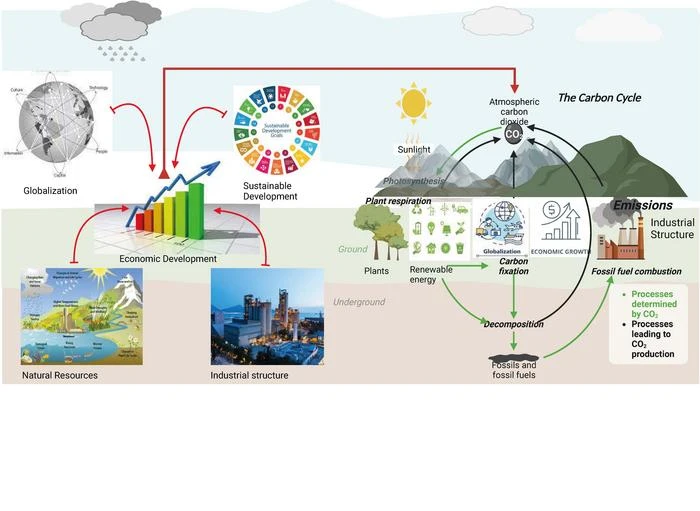
With over a fifth of the global population, the South Asian Association for Regional Cooperation (SAARC) represents a massive piece of the international climate puzzle. Figuring out how these eight nations can expand their economies without severely degrading the atmosphere is an urgent, complex challenge. Now, an in-depth econometric analysis provides a concrete, data-backed roadmap for balancing regional wealth with environmental health.
Authored by corresponding researcher Imran Khan, who bridges the Department of Economics at The University of Haripur in Pakistan and the School of Economics and Management at China University of Mining and Technology in China, this paper replaces theoretical climate goals with hard numbers. By deploying advanced statistical tools—specifically Panel Autoregressive Distributed Lag (ARDL) models and cointegration tests—the research tracks the exact push-and-pull between national wealth generation and carbon dioxide outputs across the region.
The investigation highlights a stubborn economic paradox. As South Asian countries globalize and build up their industrial sectors, their Gross Domestic Product (GDP) reliably climbs. However, this financial growth historically demands a steep atmospheric toll.
Key metrics from the analysis include:
For a region housing billions of people, this empirical evidence confirms that continuous economic prosperity and a green transition are not mutually exclusive. With the right fiscal levers, they are entirely interdependent.
Corresponding Author:
Imran Khan Department of Economics, The University of Haripur, Haripur, Pakistan. School of Economics and Management, China University of Mining and Technology, Xuzhou, Jiangsu, China.
END
Authored by corresponding researcher Imran Khan, who bridges the Department of Economics at The University of Haripur in Pakistan and the School of Economics and Management at China University of Mining and Technology in China, this paper replaces theoretical climate goals with hard numbers. By deploying advanced statistical tools—specifically Panel Autoregressive Distributed Lag (ARDL) models and cointegration tests—the research tracks the exact push-and-pull between national wealth generation and carbon dioxide outputs across the region.
The investigation highlights a stubborn economic paradox. As South Asian countries globalize and build up their industrial sectors, their Gross Domestic Product (GDP) reliably climbs. However, this financial growth historically demands a steep atmospheric toll.
Key metrics from the analysis include:
- The Price of Growth: A 1% jump in globalization translates to a robust 2.61% boost in GDP. Yet, that same 1% increase simultaneously drives up CO2 emissions by 0.278%.
- Industrial Penalties: Similarly, while expanding industrial structures grows the economy by 0.56% per percentage point, it also inflates carbon emissions by 0.222%.
- The Renewable Offset: The most critical finding points to green power as the ultimate stabilizer. The data indicates that boosting Renewable Energy Consumption (REC) by just 1% shrinks long-term CO2 emissions by 0.316%—a reduction powerful enough to counteract the pollution generated by rapid industrial expansion.
For a region housing billions of people, this empirical evidence confirms that continuous economic prosperity and a green transition are not mutually exclusive. With the right fiscal levers, they are entirely interdependent.
Corresponding Author:
Imran Khan Department of Economics, The University of Haripur, Haripur, Pakistan. School of Economics and Management, China University of Mining and Technology, Xuzhou, Jiangsu, China.
END