Recycling perlite: New, improved method saves resources
Method gives smaller greenhouse operations economical, eco-friendly alternative
Published 2011-03-18 · Original archive entry · Explore research explainers
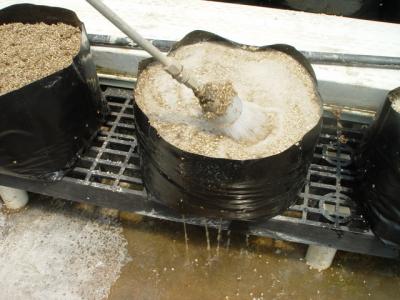
BOSSIER CITY, LA—Perlite, a processed volcanic mineral, is widely used as a component of soilless growing mixes. Lightweight, sterile, and easy to use, perlite is popular with greenhouse growers. But because salt and pathogen buildup can occur when perlite is reused, it must be replaced every year or two to minimize the risk of crop failure. The cost of disposing of old material and replacing it with new perlite can be significant and often prohibitive for smaller greenhouse operations. Hanna Y. Hanna, a researcher at Louisiana State University Agricultural Center's Red River Research Station, has developed a new method for recycling perlite that can save tomato growers a significant amount of money without reducing crop yield.
Hanna, who has done extensive previous research on perlite, says that using the same perlite to grow successive crops like tomatoes can be risky; it tends to compact and is subject to salt build-up and pest contamination. "Steam sterilization of used perlite before planting a new crop is recommended to safeguard against pathogen contamination, but this treatment requires the use of expensive steam generators and is not efficient in desalinating the medium", Hanna said.
In a recent issue of HortTechnology, Hanna reported on a new method developed to accelerate the recycling of perlite. The experiments were conducted in a greenhouse over three growing seasons to evaluate three different methods for perlite recycling and their effects on cost, desalination efficiency, and tomato yield.
Three recycling methods—"no stir/sift-then-disinfect", "stir-then-disinfect", and "sift-then-disinfect"—were put to the test for Hanna's experiments. Each recycling method consisted of two components: the reconditioning action and the hot water treatment. During the experiments, perlite recycled with the no stir/sift-then-disinfect method was not reconditioned before the hot water treatment. Instead, it was agitated with a nozzle mounted on a pressure washer wand during the hot water treatment. Perlite recycled with the stir-then-disinfect method was reconditioned first with an auger mounted on an electric drill, then treated with hot water. Perlite recycled with the sift-then-disinfect method was reconditioned first by sifting the perlite with a homemade apparatus, then treated with hot water.
"The results revealed that recycling perlite with the no stir/sift-then-disinfect method reduced labor input by 49% and 81% compared with the stir-then-disinfect and the sift-then-disinfect methods, respectively. The no stir/sift-then-disinfect method reduced recycling cost by 22% and 50% compared with the other two methods, respectively", Hanna noted. Tomatoes grown in perlite recycled with any of the three methods produced similar marketable and cull yields and fruit weight.
The results showed that the no stir/sift-then-disinfect method is less time-consuming, more economical, and has no negative impact on yield. The new method gives greenhouse tomato growers more cost-effective options for recycling perlite while saving valuable natural resources.
"The cost of renting of a hot water pressure washer and a few miscellaneous items can be the only out-of-pocket expense for using this method. Additionally, the method eliminates labor time and effort to remove old medium from the greenhouse, transport it to a land fill or a vacant field for disposal, and fill other bags with new perlite", Hanna concluded.
INFORMATION:
The complete study and abstract are available on the ASHS HortTechnology electronic journal web site: http://horttech.ashspublications.org/cgi/content/abstract/20/4/746
Founded in 1903, the American Society for Horticultural Science (ASHS) is the largest organization dedicated to advancing all facets of horticultural research, education, and application. More information at ashs.org
Hanna, who has done extensive previous research on perlite, says that using the same perlite to grow successive crops like tomatoes can be risky; it tends to compact and is subject to salt build-up and pest contamination. "Steam sterilization of used perlite before planting a new crop is recommended to safeguard against pathogen contamination, but this treatment requires the use of expensive steam generators and is not efficient in desalinating the medium", Hanna said.
In a recent issue of HortTechnology, Hanna reported on a new method developed to accelerate the recycling of perlite. The experiments were conducted in a greenhouse over three growing seasons to evaluate three different methods for perlite recycling and their effects on cost, desalination efficiency, and tomato yield.
Three recycling methods—"no stir/sift-then-disinfect", "stir-then-disinfect", and "sift-then-disinfect"—were put to the test for Hanna's experiments. Each recycling method consisted of two components: the reconditioning action and the hot water treatment. During the experiments, perlite recycled with the no stir/sift-then-disinfect method was not reconditioned before the hot water treatment. Instead, it was agitated with a nozzle mounted on a pressure washer wand during the hot water treatment. Perlite recycled with the stir-then-disinfect method was reconditioned first with an auger mounted on an electric drill, then treated with hot water. Perlite recycled with the sift-then-disinfect method was reconditioned first by sifting the perlite with a homemade apparatus, then treated with hot water.
"The results revealed that recycling perlite with the no stir/sift-then-disinfect method reduced labor input by 49% and 81% compared with the stir-then-disinfect and the sift-then-disinfect methods, respectively. The no stir/sift-then-disinfect method reduced recycling cost by 22% and 50% compared with the other two methods, respectively", Hanna noted. Tomatoes grown in perlite recycled with any of the three methods produced similar marketable and cull yields and fruit weight.
The results showed that the no stir/sift-then-disinfect method is less time-consuming, more economical, and has no negative impact on yield. The new method gives greenhouse tomato growers more cost-effective options for recycling perlite while saving valuable natural resources.
"The cost of renting of a hot water pressure washer and a few miscellaneous items can be the only out-of-pocket expense for using this method. Additionally, the method eliminates labor time and effort to remove old medium from the greenhouse, transport it to a land fill or a vacant field for disposal, and fill other bags with new perlite", Hanna concluded.
INFORMATION:
The complete study and abstract are available on the ASHS HortTechnology electronic journal web site: http://horttech.ashspublications.org/cgi/content/abstract/20/4/746
Founded in 1903, the American Society for Horticultural Science (ASHS) is the largest organization dedicated to advancing all facets of horticultural research, education, and application. More information at ashs.org