Neolithic man: The first lumberjack?
Transition from hunting to agricultural society parallels development of woodworking tools, Tel Aviv University research reveals
Published 2012-08-09 · Original archive entry · Explore research explainers
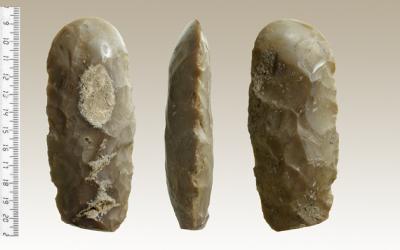
During the Neolithic Age (approximately 10000 BCE), early man evolved from hunter-gatherer to farmer and agriculturalist, living in larger, permanent settlements with a variety of domesticated animals and plant life. This transition brought about significant changes in terms of the economy, architecture, man's relationship to the environment, and more.
Now Dr. Ran Barkai of Tel Aviv University's Department of Archaeology and Ancient Near Eastern Civilizations has shed new light on this milestone in human evolution, demonstrating a direct connection between the development of an agricultural society and the development of woodworking tools.
"Intensive woodworking and tree-felling was a phenomenon that only appeared with the onset of the major changes in human life, including the transition to agriculture and permanent villages," says Dr. Barkai, whose research was published in the journal PLoS One. Prior to the Neolithic period, there is no evidence of tools that were powerful enough to cut and carve wood, let alone fell trees. But new archaeological evidence suggests that as the Neolithic age progressed, sophisticated carpentry developed alongside agriculture.
Evolution of axes
The use of functional tools in relation to woodworking over the course of the Neolithic period has not been studied in detail until now. Through their work at the archaeological site of Motza, a neighbourhood in the Judean Hills, Dr. Barkai and his fellow researchers, Prof. Rick Yerkes of Ohio State University and Dr. Hamudi Khalaily of the Israel Antiquity Authority, have unearthed evidence that increasing sophistication in terms of carpentry tools corresponds with increased agriculture and permanent settlements.
The early part of the Neolithic age is divided into two distinct eras — Pre-Pottery Neolithic A (PPNA) and Pre-Pottery Neolithic B (PPNB). Agriculture and domesticated plants and animals appear only in PPNB, so the transition between these two periods is a watershed moment in human history. And these changes can be tracked in the woodworking tools which belong to each period, says Dr. Barkai.
Within PPNA, humans remained gatherers but lived in more permanent settlements for the first time, he says. Axes associated with this period are small and delicate, used for light carpentry but not suited for felling trees or other massive woodworking tasks. In PPNB, the tools have evolved to much larger and heavier axes, formed by a technique called polishing. The researchers' in-depth analysis of these tools shows that they were used to cut down trees and complete various building projects.
"We can document step by step the transition from the absence of woodworking tools, to delicate woodworking tools, to heavier woodworking tools," Dr. Barkai says, and this follows the "actual transition from the hunter-gatherer lifestyle to agriculture." He also identifies a trial-and-error phase during which humans tried to create an axe strong enough to undertake larger woodworking tasks. Eventually, they succeeded in creating a massive ground stone axe in PPNB.
Home makeover
Whether the transition to an agricultural society led to the development of major carpentry tools or vice versa remains to be determined, says Dr. Barkai, who characterizes it as a "circular argument." Whatever the answer, the parallel changes led to a revolution in lifestyle.
Beyond the change from a hunter-gatherer to an agricultural economy, a new form of architecture also emerged. Not only did people begin to live in permanent villages, but the buildings in which they lived literally took a different shape. The round and oval structures of earlier domiciles were replaced by rectangular structures in PPNB, explains Dr. Barkai. "Evidence tells that us that for each home, approximately 10 wooden beams were needed. Prior to this, there were no homes with wooden beams." In addition, humans began to produce limestone-based plaster floors for their homes — which also represented a growing use of wood, since plaster is manufactured by heating limestone.
These architectural developments, along with building pens and fences for domesticated animals, also necessitated the felling of trees in large quantities.
INFORMATION:
American Friends of Tel Aviv University (www.aftau.org) supports Israel's leading, most comprehensive and most sought-after center of higher learning. Independently ranked 94th among the world's top universities for the impact of its research, TAU's innovations and discoveries are cited more often by the global scientific community than all but 10 other universities.
Internationally recognized for the scope and groundbreaking nature of its research and scholarship, Tel Aviv University consistently produces work with profound implications for the future.
Now Dr. Ran Barkai of Tel Aviv University's Department of Archaeology and Ancient Near Eastern Civilizations has shed new light on this milestone in human evolution, demonstrating a direct connection between the development of an agricultural society and the development of woodworking tools.
"Intensive woodworking and tree-felling was a phenomenon that only appeared with the onset of the major changes in human life, including the transition to agriculture and permanent villages," says Dr. Barkai, whose research was published in the journal PLoS One. Prior to the Neolithic period, there is no evidence of tools that were powerful enough to cut and carve wood, let alone fell trees. But new archaeological evidence suggests that as the Neolithic age progressed, sophisticated carpentry developed alongside agriculture.
Evolution of axes
The use of functional tools in relation to woodworking over the course of the Neolithic period has not been studied in detail until now. Through their work at the archaeological site of Motza, a neighbourhood in the Judean Hills, Dr. Barkai and his fellow researchers, Prof. Rick Yerkes of Ohio State University and Dr. Hamudi Khalaily of the Israel Antiquity Authority, have unearthed evidence that increasing sophistication in terms of carpentry tools corresponds with increased agriculture and permanent settlements.
The early part of the Neolithic age is divided into two distinct eras — Pre-Pottery Neolithic A (PPNA) and Pre-Pottery Neolithic B (PPNB). Agriculture and domesticated plants and animals appear only in PPNB, so the transition between these two periods is a watershed moment in human history. And these changes can be tracked in the woodworking tools which belong to each period, says Dr. Barkai.
Within PPNA, humans remained gatherers but lived in more permanent settlements for the first time, he says. Axes associated with this period are small and delicate, used for light carpentry but not suited for felling trees or other massive woodworking tasks. In PPNB, the tools have evolved to much larger and heavier axes, formed by a technique called polishing. The researchers' in-depth analysis of these tools shows that they were used to cut down trees and complete various building projects.
"We can document step by step the transition from the absence of woodworking tools, to delicate woodworking tools, to heavier woodworking tools," Dr. Barkai says, and this follows the "actual transition from the hunter-gatherer lifestyle to agriculture." He also identifies a trial-and-error phase during which humans tried to create an axe strong enough to undertake larger woodworking tasks. Eventually, they succeeded in creating a massive ground stone axe in PPNB.
Home makeover
Whether the transition to an agricultural society led to the development of major carpentry tools or vice versa remains to be determined, says Dr. Barkai, who characterizes it as a "circular argument." Whatever the answer, the parallel changes led to a revolution in lifestyle.
Beyond the change from a hunter-gatherer to an agricultural economy, a new form of architecture also emerged. Not only did people begin to live in permanent villages, but the buildings in which they lived literally took a different shape. The round and oval structures of earlier domiciles were replaced by rectangular structures in PPNB, explains Dr. Barkai. "Evidence tells that us that for each home, approximately 10 wooden beams were needed. Prior to this, there were no homes with wooden beams." In addition, humans began to produce limestone-based plaster floors for their homes — which also represented a growing use of wood, since plaster is manufactured by heating limestone.
These architectural developments, along with building pens and fences for domesticated animals, also necessitated the felling of trees in large quantities.
INFORMATION:
American Friends of Tel Aviv University (www.aftau.org) supports Israel's leading, most comprehensive and most sought-after center of higher learning. Independently ranked 94th among the world's top universities for the impact of its research, TAU's innovations and discoveries are cited more often by the global scientific community than all but 10 other universities.
Internationally recognized for the scope and groundbreaking nature of its research and scholarship, Tel Aviv University consistently produces work with profound implications for the future.