THE ORIGINAL COLLECTION · SINCE 2010

Environment
press releases.

Research announcements from universities, hospitals and scientific institutions. Explore the stories, people and discoveries behind the headlines.

Original publication datesPage 94
FIND A STORY

Find a past release.

Dates and source material belong to the original release.

Read our research explainers

Browse the collection · original publication order

Introducing co-cultures: When co-habiting animal species share culture
Environment

Introducing co-cultures: When co-habiting animal species share culture

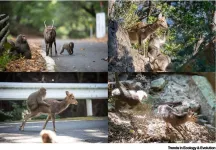
Cooperative hunting, resource sharing, and using the same signals to communicate the same information—these are all examples of cultural sharing that have been observed between distinct animal species. In an opinion piece published June 19 in the journal Trends in Ecology & Evolution, researchers introduce the term “co-culture” to describe cultural sharing between animal species. These relationships are mutual and go beyond one species watching and mimicking another species’ behavior—in co-cultures, both species influence each other in substantial ways. “Co-culture challenges the notion ...

Read the release

Nanoplastics and ‘forever chemicals’ disrupt molecular structures, functionality
Environment

Nanoplastics and ‘forever chemicals’ disrupt molecular structures, functionality

EL PASO, Texas (July 11, 2024) – Researchers at The University of Texas at El Paso have made significant inroads in understanding how nanoplastics and per- and polyfluoroalkyl substances (PFAS) — commonly known as forever chemicals — disrupt biomolecular structure and function. The work shows that the compounds can alter proteins found in human breast milk and infant formulas — potentially causing developmental issues downstream. Nanoplastics and forever chemicals are manmade compounds present throughout the environment; a series of recent studies have linked them to numerous ...

Read the release
Environment

Climate change: Thick sea ice flowing from Arctic Ocean shortening shipping season in Northwest Passage

An increased amount of thick sea ice flowing south from the Arctic Ocean shortened the ice-free shipping season in several parts of the Northwest Passage between 2007 and 2021, according to an analysis in Communications Earth & Environment. The authors suggest this could mean the Northwest Passage is unlikely to become a viable alternative to traditional shipping routes, despite previous hopes that it may become viable due to global warming. The Northwest Passage (NWP) is a commercial shipping route connecting the Atlantic and Pacific Oceans that runs through the Arctic Circle north of North America. Through the Canadian ...

Read the release
Environment

Pathogen prioritization for wastewater surveillance ahead of the Paris 2024 Olympic and Paralympic Games, France

The study by researchers from the French national public health institute aimed to identify priority pathogens that could be suitable for wastewater surveillance (WWS) during the Paris 2024 Olympic and Paralympic Games taking place from 26 July to 11 August and 28 August to 8 September, respectively. The pathogens were evaluated using a Delphi method which integrated evidence from peer-reviewed publications and expert opinion. WWS has become more prominent due to its role during the COVID-19 pandemic. As a non-intrusive, cost-effective surveillance tool, WWS offers ...

Read the release
Environment

Scientists call for ‘major initiative’ to study whether geoengineering should be used on glaciers

A group of scientists have released a landmark report on glacial geoengineering—an emerging field studying whether technology could halt the melting of glaciers and ice sheets as climate change progresses. The white paper represents the first public efforts by glaciologists to assess possible technological interventions that could help address catastrophic sea-level rise scenarios. While it does not endorse any specific interventions, it calls for a “major initiative” in the next decades to research which, if any, interventions could and should be ...

Read the release
Environment

Air pollution harms pollinators more than pests, study finds

Bees and other beneficial bugs are disproportionately harmed by air pollution compared to crop-destroying pests, a new study published in Nature Communications has found. Researchers from the University of Reading analysed data from 120 scientific papers to understand how 40 types of insects in 19 countries respond to air pollutants like ozone, nitrogen oxides, sulfur dioxide and particulate matter. Pollinators - including bees and some moths and butterflies - experienced a 39% decline in foraging ...

Read the release
Scientists release new research on planted mangroves’ ability to store carbon
Environment

Scientists release new research on planted mangroves’ ability to store carbon

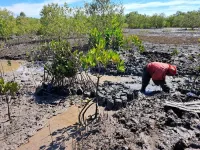
U.S. Forest Service ecologists and partners published new findings on how planted mangroves can store up to 70% of carbon stock to that found in intact stands after only 20 years. Researchers have long known that mangroves are superstars of carbon absorption and storage. But until now, limited information existed on how long it took for carbon stored in planted mangroves to reach levels found in intact mangroves. “About ten years ago, Sahadev Sharma, then with the Institute of Pacific Islands Forestry, and I discovered that 20-year-old mangrove plantations in Cambodia had carbon stocks comparable to those of intact forests,” ...

Read the release
Researchers show promising material for solar energy gets its curious boost from entropy
Environment

Researchers show promising material for solar energy gets its curious boost from entropy

Solar energy is critical for a clean-energy future. Traditionally, solar energy is harvested using silicon – the same semiconductor material used in everyday electronic devices. But silicon solar panels have drawbacks: for instance, they’re expensive and hard to mount on curved surfaces. Researchers have developed alternative materials for solar-energy harvesting to solve such shortcomings. Among the most promising of these are called “organic” semiconductors, carbon-based semiconductors that are Earth-abundant, cheaper and environmentally friendly. “They can potentially lower the production cost for solar panels because these ...

Read the release
Nanocarbon catalyst design unlocks new avenue for sustainable fuel additive production
Environment

Nanocarbon catalyst design unlocks new avenue for sustainable fuel additive production

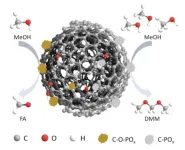
Vehicle exhaust from fossil fuel combustion constitutes a main source of air pollutants like carbon dioxide and carbon monoxide. To mitigate air pollution, researchers are looking into additive to fuels like dimethoxymethane (DMM). But DMM production brings its own environmental hazards. In their paper published June 21 in Carbon Future, a Chinese research team demonstrated how a series of phosphorous-modified nanocarbon catalysts could advance green DMM production. Unique fuel properties of this diesel blend fuel include high oxygen content and chemical stability as well as low toxicity. A blend of DMM and ...

Read the release
Environment

Mozambican Woodlands could store more than double the carbon previously estimated

The capacity of Mozambican woodlands to capture and store carbon is underestimated and potentially undervalued for their protection and restoration, finds new research from an international team of scientists including UCL researchers and led by carbon data provider Sylvera. The research, published in Nature Communications Earth & Environment, found that miombo woodlands, which span large areas of Sub-Saharan Africa, store 1.5 to 2.2 times more carbon than had previously been estimated by standard methods. Named for the miombo trees found in the region, these biomes (geographical areas defined by their local species and ...

Read the release
Environment

Cutting farm nitrous oxide emissions helps climate and ozone layer

Cutting farm nitrous oxide emissions helps climate and ozone layer Adding crushed basalt rocks and special fertilisers can reduce potent nitrous oxide (N2O) greenhouse gas emissions and safeguard the stratospheric ozone layer, which protects us from harmful UV light and reduces nitrate leaching into water bodies protecting ecosystems and human health The new study, led by researchers at the University of Sheffield, highlights methods for reducing N2O emissions, such as enhanced weathering of agricultural soils with ...

Read the release
Groundbreaking study reveals oceanic seabirds chase tropical cyclones
Environment

Groundbreaking study reveals oceanic seabirds chase tropical cyclones

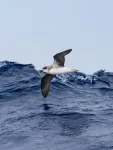
A new study published today in Current Biology, "Oceanic Seabirds Chase Tropical Cyclones," reveals that the rare Desertas Petrels (Pterodroma deserta), a wide-ranging seabird in the North Atlantic, exhibit unique foraging behaviors during hurricane season. Contrary to other pelagic seabirds, these petrels do not avoid intense tropical cyclones but instead exploit the dynamic conditions for their benefit, providing new insights into the impact of cyclones on open ocean marine life. "Initial studies suggested that seabirds either circumnavigate cyclones or seek refuge in the calm eye of the storm. However, the Desertas Petrels we tracked did neither; instead, one-third of ...

Read the release
Study examines tree adaptability to climate change
Environment

Study examines tree adaptability to climate change

During his recent yearlong sabbatical, Daniel Laughlin led a study that found trees can sustain life in temperatures higher or lower than where they are currently growing. While tree species appear to prefer distinct climatic conditions, the true nature of these preferences is obscured by species interactions and dispersal, which limit tree species’ ranges. “We were amazed. The result was crystal clear, and that doesn’t always happen in ecology,” says Laughlin, a professor in the University of Wyoming Department of Botany. “We found that tree species could grow and survive at one common moderate temperature, even though many ...

Read the release
Whale remains tracked to highlight sustainable disposal benefits
Environment

Whale remains tracked to highlight sustainable disposal benefits

A string of whale strandings on the East Australian Coastline and questions around the appropriate disposal methods for the remains has prompted a new study that highlights a sustainable, cultural and ecosystem beneficial offshore removal or decomposition. Dr Olaf Meynecke, from Griffith University’s Whales and Climate Research Program, led the case study, in which a 14m female humpback whale was found floating deceased – likely to due to ship strike – in the coastal waters off Queensland’s Noosa Heads in July 2023. The remains were intercepted before washing up on the shoreline, then repositioned 30km offshore ...

Read the release
How a plant app helps identify the consequences of climate change
Environment

How a plant app helps identify the consequences of climate change

Plants are known to respond to seasonal changes by budding, leafing, and flowering. As climate change stands to shift these so-called phenological stages in the life cycle of plants, access to data about phenological changes – from many different locations and in different plants – can be used to draw conclusions about the actual effects of climate change. However, conducting such analyses require a large amount of data and data collection of this scale would be unthinkable without the help of citizen scientists. “The problem is that the quality of the data suffers when fewer people engage ...

Read the release
Environment

Coral reefs: battlegrounds for survival in a changing climate

(Santa Barbara, Calif.) — Coral reefs, those vibrant underwater cities, stand on the precipice of collapse. While rising ocean temperatures and coral bleaching grab headlines, a new essay in Current Biology reveals a hidden layer of complexity in this fight for survival: the often-overlooked roles of the reefs’ smallest inhabitants. Scientists have long understood the vital partnership between corals and their symbiotic algae, but work by researchers at UC Santa Barbara and University of Georgia highlights how the fate of entire reefs may hinge ...

Read the release
Restored oyster sanctuaries host more marine life
Environment

Restored oyster sanctuaries host more marine life

In the campaign to restore Chesapeake Bay, oyster sanctuaries rank among the most hotly contested strategies. But new research suggests these no-harvest areas are working, and not only for the oysters. In a new study published July 4 in Marine Ecology Progress Series, Smithsonian biologists discovered oyster sanctuaries contain more abundant populations of oysters and other animal life—and the presence of two common parasites is not preventing that. Oysters form the backbone of Chesapeake Bay. Besides injecting millions of dollars into the regional economy each year, they also act as vital habitat and filter feeders that clean the water. But their populations ...

Read the release
Environment

Luther identifying road segments that bisect predicted movement corridors for small priority species in Virginia

David Luther, Associate Professor, Biology, received funding for the project: “Identifying Road Segments that Bisect Predicted Movement Corridors for Small Priority Species in Virginia.” The purpose of this study is to advance the work of the legislated Wildlife Corridor Action Plan (WCAP) and meet the intent of an awarded Federal Highway Administration (FHWA) grant by identifying road segments that may pose a high risk or impede movement of select small terrestrial and semiaquatic animal species that are ...

Read the release
Companies that mitigate climate change reduce their cost of capital
Environment

Companies that mitigate climate change reduce their cost of capital

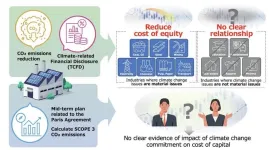
Fukuoka, Japan —The climate crisis is hitting home with more frequent extreme weather events. Companies, particularly those in high-emission industries, are major contributors to global carbon emissions, therefore making them key players in the fight against climate change. Recognizing this responsibility, many businesses are now taking proactive measures to reduce their carbon footprint, by reducing carbon emissions and transparently sharing their environmental strategies and data. The Task Force on Climate-Related Financial Disclosures ...

Read the release
Environment

Study: Weaker ocean circulation could enhance CO2 buildup in the atmosphere

As climate change advances, the ocean’s overturning circulation is predicted to weaken substantially. With such a slowdown, scientists estimate the ocean will pull down less carbon dioxide from the atmosphere. However, a slower circulation should also dredge up less carbon from the deep ocean that would otherwise be released back into the atmosphere. On balance, the ocean should maintain its role in reducing carbon emissions from the atmosphere, if at a slower pace. However, a new study by an MIT researcher finds that scientists may have to rethink the relationship between the ocean’s circulation and its ...

Read the release
Zero-emissions trucks alone won't cut it: Early retirement of polluters key to California's emission goals
Environment

Zero-emissions trucks alone won't cut it: Early retirement of polluters key to California's emission goals

California must implement early retirement for existing heavy-duty vehicles as well as introducing zero-emissions vehicles (ZEVs) to protect Black, Latino and vulnerable communities and hit net zero greenhouse gas (GHG) emissions targets by 2045. This is the outcome of a new study published in Environmental Research: Infrastructure and Sustainability by researchers from Stanford University and Arizona State University. Stringent policies for mandating both ZEVs and early vehicle retirement could reduce cumulative emissions by two-thirds (64%) and reduce half of pollution-related mortality, particularly among disadvantaged communities. California is the world’s 5th largest ...

Read the release
Braiding community values with science is key to ecosystem restoration
Environment

Braiding community values with science is key to ecosystem restoration

Up on the “roof of the world”, one of the world’s largest ecosystem restoration projects is taking place. The Qinghai-Tibetan Plateau (QTP) in western China is the world’s highest plateau and covers a land area roughly five times the size of France. Home to thousands of rare plants and wildlife and the source of water for more than 2.5 billion people, this vital ecosystem is under threat. The region’s grassland is degrading due to climate change and intense livestock grazing. Government ...

Read the release
Environment

Air pollution linked to a decrease in IVF birth rate success, new study shows

A pioneering study, presented today at the ESHRE 40th Annual Meeting in Amsterdam, has revealed that exposure to fine particulate matter (PM) prior to the retrieval of oocytes (eggs) during in vitro fertilisation (IVF) can reduce the odds of achieving a live birth by almost 40% [1]. The study analysed PM10 exposure in the two weeks leading up to oocyte collection, finding that the odds of a live birth decreased by 38% (OR 0.62, 95% CI 0.43-0.89, p=0.010) when comparing the highest quartile of exposure (18.63 to 35.42 µg/m3) to the lowest quartile (7.08 to 12.92 µg/m3). Conducted ...

Read the release
Cranfield and LIPTON Teas and Infusions begin advanced climate change mitigation and resilience field trials
Environment

Cranfield and LIPTON Teas and Infusions begin advanced climate change mitigation and resilience field trials

The project, supported by the Biotechnology and Biological Sciences Research Council (BBSRC) and UK Tea & Infusions Association (UKTIA), aims to improve tea production standards and create data and resources that can benefit the whole industry. The project is co-led and managed by Dr Helen Saini, Head of R&D Sustainable Agriculture at LIPTON Teas and Infusions, and Andrew Thompson, Professor of Molecular Plant Science and Head of Soil, Agrifood and Biosciences at Cranfield University. Tea has the second lowest carbon footprint after tap water but about a quarter of its total greenhouse gas emissions are attributed to fertiliser use. In addition, climate change ...

Read the release
Exploring the radiative effects of precipitation on arctic amplification and energy budget
Environment

Exploring the radiative effects of precipitation on arctic amplification and energy budget

One of the key metrics for climate modelling is radiative forcing. Most climate models, including the general circulation models (GCMs), focus on the effects of different atmospheric factors on radiative forcing. However, there are still large uncertainties in satellite observations and multi-model simulations associated with some atmospheric factors. Among them, clouds are a known source of uncertainty in GCMs, leading to radiative biases. However, another possible source of radiative uncertainty is associated with precipitation. In principle, precipitating particles affect radiative forcing by disrupting incoming shortwave and outgoing longwave radiations. ...

Read the release
From the original Press-News collection. Issuers of news releases are responsible for the accuracy of their content.