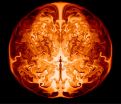
Simulations reveal an unusual death for ancient stars
Certain primordial stars—those 55,000 and 56,000 times the mass of our Sun, or solar masses—may have died unusually. In death, these objects—among the Universe's first-generation of stars—would have exploded as supernovae and burned completely, leaving no remnant black hole behind. Astrophysicists at the University of California, Santa Cruz (UCSC) and the University of Minnesota came to this conclusion after running a number of supercomputer simulations at the Department of Energy's (DOE's) National Energy Research Scientific Computing Center (NERSC) and Minnesota Supercomputing ...
Read the release