PRESS-NEWS.org - Press Release Distribution
PRESS RELEASES DISTRIBUTION

A good night's sleep helps modify deeply rooted attitudes

A good night's sleep helps modify deeply rooted attitudes
2015-05-28
(Press-News.org) This news release is available in Japanese.

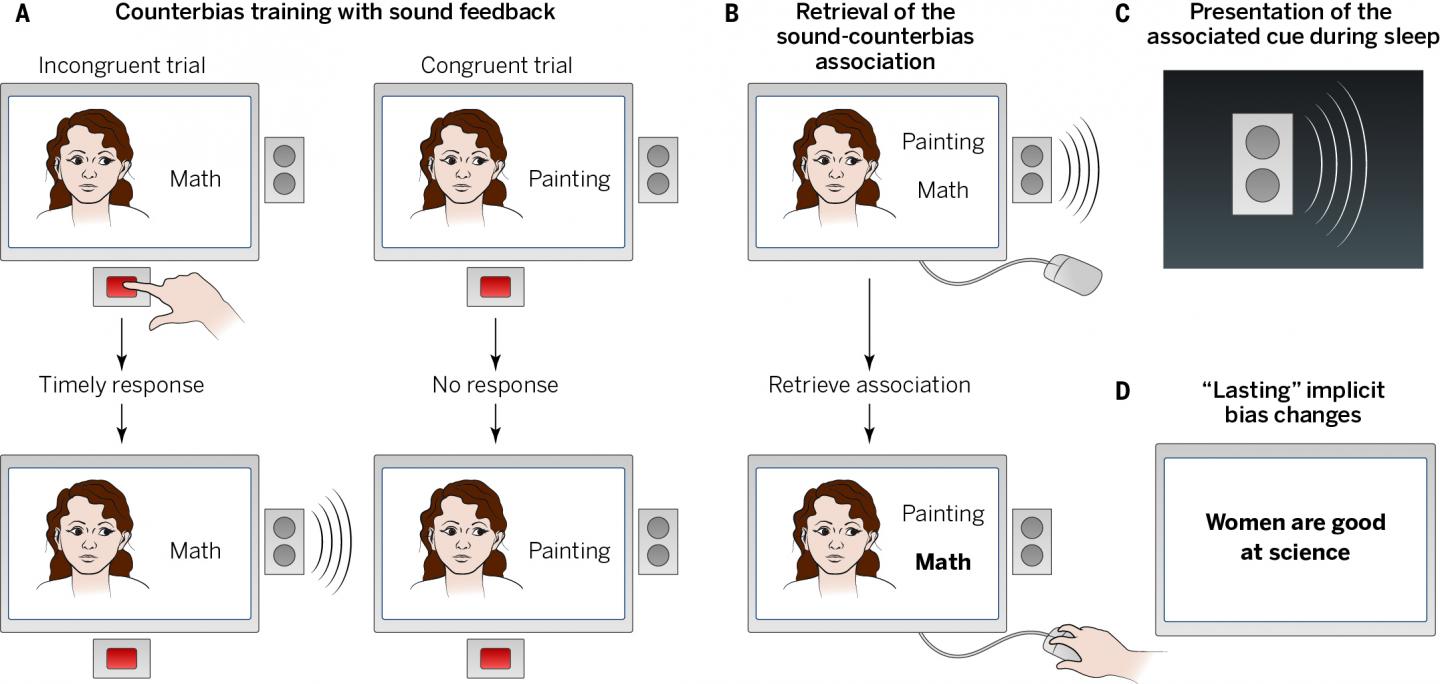
Long-held social biases can be reduced during sleep, a new report suggests. It adds further support to recent research that has shown that memories can be selectively reactivated and strengthened during slumber. Scientists have known that sleep boosts memory formation by resuscitating faint neuron activity shaped during earlier periods, when an individual was awake. This process can be experimentally stimulated by giving a sleeping individual cues related to an earlier period of learning. Now, Xiaoqing Hu and colleagues extend these findings to show that this method not only works for recently learned information but also to influence implicit attitudes learned during childhood. The researchers focused on prejudices of race and gender. In a series of exercises designed to counter typical racial and gender biases, participants were shown pictures of men and women of different races. They learned to associate races and genders with opposing features (female faces with science-related words, for example, and black men with "good" words). A distinctive sound was associated with each type of counter-bias. The participants then took a 90-minute nap during which one sound, by random assignment, was repeatedly played to cue and reactivate a newly learned association. Shortly after waking, and again one week later, the researchers found that implicit social biases were reduced preferentially for the counter-bias training reactivated during sleep (but not for counter-biases not reactivated). Given the implications of this research for societal change, Gordon Feld and Jan Born say in a related Perspective, the study should inspire research to solve remaining issues of targeted memory reactivation during sleep so that its mechanisms are fully understood.

INFORMATION:

Article #14: "Unlearning implicit social biases during sleep," by X. Hu; J.W. Antony; J.D. Creery; I.M. Vargas; G.V. Bodenhausen; K.A. Paller at Northwestern University in Evanston, IL; X. Hu at University of Texas at Austin in Austin, TX; J.W. Antony at Princeton University in Princeton, NJ.


[Attachments] See images for this press release:
A good night's sleep helps modify deeply rooted attitudes

ELSE PRESS RELEASES FROM THIS DATE:

A clear look at an efficient energy converter

2015-05-28
This news release is available in Japanese. Xiaochun Qin and colleagues have provided a high-resolution crystal structure of a plant protein supercomplex critical to photosynthesis, shedding new light on how this extremely effective solar energy converter achieves its impressive performance. The photosynthesis of many plants relies upon the large light-harvesting complex I (LHC1), which surrounds photosystem I (PSI) and captures sunlight. LHC1 is able to transfer the energy it absorbs to the PSI core, where it is converted into chemical energy with close to 100% efficiency. ...

Researchers use light to beat amnesia in mice

Researchers use light to beat amnesia in mice
2015-05-28
This news release is available in Japanese. Memories that have been destabilized and forgotten by mice can nevertheless be retrieved by activating memory engrams, or specific patterns of neurons that fire when memories are encoded, with light, researchers say. These findings provide fresh insight into memory consolidation, or the process by which new, unstable memories transform into stable, long-term memories. Until now, researchers have wondered whether memory consolidation was dependent upon the stabilization of these memory engrams. But Tomás Ryan and colleagues ...

Northern ice caused southern rain during last ice age

2015-05-28
This news release is available in Japanese. Armadas of icebergs that broke off the Greenland ice sheet into the northern Atlantic Ocean during the Last Glacial Period -- between about 110,000 and 12,000 years ago -- often increased methane production in the tropics, according to a new study. These findings illustrate how high-latitude events can influence tropical climate conditions, and they hint at the underlying mechanisms of abrupt climate changes. Such massive discharges of icebergs into the Atlantic are known as Heinrich Events, and researchers have wondered for ...

HIV's sweet tooth is its downfall

2015-05-28
CHICAGO --- HIV has a voracious sweet tooth, which turns out to be its Achilles' heel, reports a new study from Northwestern Medicine and Vanderbilt University. After the virus invades an activated immune cell, it craves sugar and nutrients from the cell to replicate and fuel its wild growth throughout the body. Scientists discovered the switch that turns on the immune cell's abundant sugar and nutrient pipeline. Then they blocked the switch with an experimental compound, shutting down the pipeline, and, thereby, starving HIV to death. The virus was unable to replicate ...

New findings shed light on complexities of emerging zoonotic malaria

2015-05-28
Zoonotic malaria has been shown to be caused by two genetically distinct Plasmodium knowlesi parasite subpopulations associated with different monkey host species in Malaysia, according to new research published in PLOS Pathogens. The authors believe this could have important implications for how the parasite adapts and spreads in humans. Plasmodium knowlesi is a zoonotic malaria parasite which is common in forest-dwelling macaques. In recent years, increasing numbers of cases of knowlesi malaria have been reported in humans. The disease is now the most common form of ...

Wild chimps teach Stanford scientists about gene that encodes HIV-fighting protein

2015-05-28
Different people can vary substantially in their genetic susceptibility to viruses, including HIV. Although the biology that underlies this variation in humans is still being uncovered, it seems that we may be able to learn some key lessons from our closest cousins. A gene variant in chimpanzees in a Tanzanian wildlife preserve probably protects them from rapidly succumbing to the primate equivalent of HIV, Stanford University School of Medicine scientists report in the open access journal PLOS Biology, publishing May 28. The wild chimps inhabit Gombe Stream National ...

Unlearning implicit social biases during sleep

2015-05-28
EVANSTON, Ill. --- Can we learn to rid ourselves of our implicit biases regarding race and gender? A new Northwestern University study indicates that sleep may hold an important key to success in such efforts. Building on prior research, the Northwestern investigators aimed to find out whether learning to alter habitual reactions to other people could be enhanced during sleep. Other researchers have documented many unsavory consequences of common social biases. When playing a videogame with instructions to shoot only people carrying weapons, players were more likely ...

New study shows influence on climate of fresh water during last ice age

New study shows influence on climate of fresh water during last ice age
2015-05-28
CORVALLIS, Ore. - A new study shows how huge influxes of fresh water into the North Atlantic Ocean from icebergs calving off North America during the last ice age had an unexpected effect - they increased the production of methane in the tropical wetlands. Usually increases in methane levels are linked to warming in the Northern Hemisphere, but scientists who are publishing their findings this week in the journal Science have identified rapid increases in methane during particularly cold intervals. These findings are important, researchers say, because they identify ...

ASCO: MEDI4736 combined with tremelimumab results in acceptable toxicity in NSCLC patients

2015-05-28
TAMPA, Fla. - Advanced non-small cell lung cancer (NSCLC) patients have few effective treatment options and low 5-year survival rates. The checkpoint inhibitors MEDI4736 and tremelimumab have both demonstrated acceptable safety and potential efficacy when used as single-agents in several different types of cancer. Scott J. Antonia, M.D., Ph.D., chair of the Thoracic Oncology Department at Moffitt Cancer Center will be presenting data from a phase 1b dose-escalation and expansion study of MEDI4736 combined with tremelimumab at the 2015 American Society of Clinical Oncology ...

ASCO: Component in green tea may help reduce prostate cancer in men at high risk

2015-05-28
TAMPA, Fla. - Prostate cancer is the second most common type of cancer in men and is predicted to result in an estimated 220,00 cases in the United States in 2015. In recent years, an emphasis has been placed on chemoprevention - the use of agents to prevent the development or progression of prostate cancer. A team of researchers led by Nagi B. Kumar, Ph.D., R.D., F.A.D.A. at Moffitt Cancer Center recently published results of a randomized trial that assessed the safety and effectiveness of the active components in green tea to prevent prostate cancer development in men ...

LAST 30 PRESS RELEASES:

Making lighter work of calculating fluid and heat flow

Normalizing blood sugar can halve heart attack risk

Lowering blood sugar cuts heart attack risk in people with prediabetes

Study links genetic variants to risk of blinding eye disease in premature infants

Non-opioid ‘pain sponge’ therapy halts cartilage degeneration and relieves chronic pain

AI can pick up cultural values by mimicking how kids learn

China’s ecological redlines offer fast track to 30 x 30 global conservation goal

Invisible indoor threats: emerging household contaminants and their growing risks to human health

Adding antibody treatment to chemo boosts outcomes for children with rare cancer

Germline pathogenic variants among women without a history of breast cancer

Tanning beds triple melanoma risk, potentially causing broad DNA damage

Unique bond identified as key to viral infection speed

Indoor tanning makes youthful skin much older on a genetic level

Mouse model sheds new light on the causes and potential solutions to human GI problems linked to muscular dystrophy

The Journal of Nuclear Medicine ahead-of-print tip sheet: December 12, 2025

Smarter tools for peering into the microscopic world

Applications open for funding to conduct research in the Kinsey Institute archives

Global measure underestimates the severity of food insecurity

Child survivors of critical illness are missing out on timely follow up care

Risk-based vs annual breast cancer screening / the WISDOM randomized clinical trial

University of Toronto launches Electric Vehicle Innovation Ontario to accelerate advanced EV technologies and build Canada’s innovation advantage

Early relapse predicts poor outcomes in aggressive blood cancer

American College of Lifestyle Medicine applauds two CMS models aligned with lifestyle medicine practice and reimbursement

Clinical trial finds cannabis use not a barrier to quitting nicotine vaping

Supplemental nutrition assistance program policies and food insecurity

Switching immune cells to “night mode” could limit damage after a heart attack, study suggests

URI-based Global RIghts Project report spotlights continued troubling trends in worldwide inhumane treatment

Neutrophils are less aggressive at night, explaining why nighttime heart attacks cause less damage than daytime events

Menopausal hormone therapy may not pose breast cancer risk for women with BRCA mutations

Mobile health tool may improve quality of life for adolescent and young adult breast cancer survivors

[Press-News.org] A good night's sleep helps modify deeply rooted attitudes