PRESS-NEWS.org - Press Release Distribution
PRESS RELEASES DISTRIBUTION

A third of US families face a different kind of poverty

A third of US families face a different kind of poverty
2021-01-06
(Press-News.org) DURHAM, N.C. -- Before the pandemic, one-third of U.S. households with children were already "net worth poor," lacking enough financial resources to sustain their families for three months at a poverty level, finds new research from Duke University.

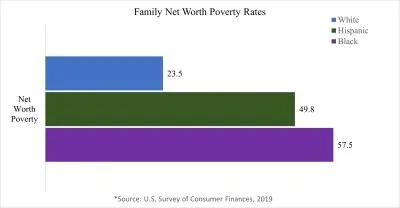
In 2019, 57 percent of Black families and 50 percent of Latino families with children were poor in terms of net worth. By comparison, the rate for white families was 24 percent.

"These 'net worth poor' households have no assets to withstand a sudden economic loss, like we have seen with COVID-19," said Christina Gibson-Davis, co-author of the study and professor of public policy and sociology at Duke University's Center for Child and Family Policy. "Their savings are virtually nil, and they have no financial cushion to provide the basics for their children."

The study is among the first to consider family poverty in terms of assets, not income. Using 1989-2019 data from the Survey of Consumer Finances, researchers analyzed net worth and income data from more than 19,000 U.S. households with children under age 18.

Among households with children, net worth poverty has been steadily rising over the past 30 years, the authors found. In 2019, a two-parent, two-child household was deemed to be net-worth poor if they had less than $6,500 in assets - or less than one-fourth of the federal poverty line.

Families in that category - those with perilously low levels of net worth -- outnumbered families who were poor based on income.

"Uncovering this aspect of poverty, which hinges on wealth, is game-changing," said Lisa Gennetian, co-author of the study and associate professor of early learning policy studies at Duke's Sanford School of Public Policy.

"Most policies focus on income and families meeting their day-to-day needs," Gennetian said. "These efforts are important. But our findings suggest that they are not helping families increase savings that help set children up for success."

Notably, Black and Latino families were twice as likely to experience net worth poverty than to have poverty-level incomes.

"Reducing one kind of poverty isn't helpful if another one is taking its place," said Lisa Keister, study co-author and a professor of sociology at Duke. "Being net worth poor likely limits parents' abilities to invest in their kids and shapes how they think about their kids' future."

The new research appears in the Journal of Marriage and Family.

"Even before the pandemic, many families with children were in a precarious situation," Gibson-Davis said. "Things are not going to get better in the wake of COVID-19."

INFORMATION:

This research was supported by the Russell Sage Foundation and the National Science Foundation (SES-2029790).

CITATION: "Net Worth Poverty in Child Households by Race and Ethnicity, 1989-2019," C. M. Gibson-Davis, L.A. Keister, L.A. Gennetian. Journal of Marriage and Family (2020).


[Attachments] See images for this press release:
A third of US families face a different kind of poverty

ELSE PRESS RELEASES FROM THIS DATE:

Light-based processors boost machine-learning processing

Light-based processors boost machine-learning processing
2021-01-06
The exponential growth of data traffic in our digital age poses some real challenges on processing power. And with the advent of machine learning and AI in, for example, self-driving vehicles and speech recognition, the upward trend is set to continue. All this places a heavy burden on the ability of current computer processors to keep up with demand. Now, an international team of scientists has turned to light to tackle the problem. The researchers developed a new approach and architecture that combines processing and data storage onto a single chip by using light-based, or "photonic" processors, which ...

uOttawa study shows that mindfulness can help ease the pain of breast cancer survivors

uOttawa study shows that mindfulness can help ease the pain of breast cancer survivors
2021-01-06
A study led by University of Ottawa researchers provides empirical evidence that mindfulness has a significant impact on the brain of women suffering from neuropathic pain related to breast cancer treatment. The researchers showed that mindfulness-based stress reduction (MBSR) helps modulate neuropathic pain. Their findings could make a difference in the lives of many women. In Canada, over a quarter of a million women are expected to be diagnosed with breast cancer - the most diagnosed cancer among women worldwide - in 2020. In addition to the psychological impacts of breast cancer, approximately 20 to 50 percent of survivors report experiencing chronic neuropathic pain following treatment. We talked to senior author Dr. Andra Smith, Full Professor at the uOttawa School of Psychology, ...

Mouse study finds link between gut disease and brain injury in premature infants

Mouse study finds link between gut disease and brain injury in premature infants
2021-01-06
Physicians have long known that necrotizing enterocolitis (NEC), a potentially lethal inflammatory condition that destroys a premature infant's intestinal lining, is often connected to the development of severe brain injury in those infants who survive. However, the means by which the diseased intestine "communicates" its devastation to the newborn brain has remained largely unknown. Now, working with mice, researchers at Johns Hopkins Medicine and the University of Lausanne in Switzerland have identified that missing link -- an immune system cell that they say travels from the gut to the ...

A new approach to study autoimmune diseases

A new approach to study autoimmune diseases
2021-01-06
Indianapolis, Ind. - A team of researchers led by the Indiana Biosciences Research Institute Diabetes Center's Scientific Director Decio L. Eizirik, MD, PhD, has found that identifying new treatments for autoimmune diseases requires studying together the immune system AND target tissues. This study, "Gene expression signatures of target tissues in type 1 diabetes, lupus erythematosus, multiple sclerosis and rheumatoid arthritis," is featured in the Jan. 6, 2021, edition of Science Advances. "We must move away from the present "immune-centric-only" view of autoimmune diseases," explains Eizirik. "Indeed, trying to understand these diseases focusing on the immune system only, ...

The link between opioid medication and pancreatic cancer

The link between opioid medication and pancreatic cancer
2021-01-06
Researchers at Rush University Medical Center have found that opioid use might increase a person's risk of developing pancreatic cancer. Published Jan. 6, the study, titled "Opioid Use as a Potential Risk Factor for Pancreatic Cancer in the United States," is the first in the country to show evidence that opioid use may be an unidentified risk factor contributing to the increasing incidence of pancreatic cancer. In fact, opioid misuse and overdose have evolved into a public health crisis. Approximately 70,000 drug overdose deaths were reported in 2017, 68% of which involved an opioid.¹ The use of prescription opioids for the management of chronic pain ...

A third of U.S. families face a different kind of poverty

2021-01-06
DURHAM, N.C. -- Before the pandemic, one-third of U.S. households with children were already "net worth poor," lacking enough financial resources to sustain their families for three months at a poverty level, finds new research from Duke University. In 2019, 57 percent of Black families and 50 percent of Latino families with children were poor in terms of net worth. By comparison, the rate for white families was 24 percent. "These 'net worth poor' households have no assets to withstand a sudden economic loss, like we have seen with COVID-19," said Christina Gibson-Davis, co-author of the study and professor of public policy and sociology at Duke University's Center for Child and Family Policy. "Their ...

New strategy to fight botulinum toxin - expert available

2021-01-06
Related to new research published in the January issue of Science Translational Medicine, Patrick McNutt, PhD, of the Wake Forest Institute for Regenerative Medicine, was part of the research team that demonstrated a new "Trojan horse" approach that produces strong antidotal efficacy in treating lethal botulism in mice, guinea pigs and rhesus macaque monkeys. Furthermore, in a companion article, an independent team demonstrated that a related drug has robust efficacy in mice. "This is one of those serendipitous moments in science where two groups, working independently, demonstrate similar results for a long-standing ...

Investment risk & return from emerging public biotech companies comparable to non-biotech

Investment risk & return from emerging public biotech companies comparable to non-biotech
2021-01-06
Investing in biotech companies may not entail higher risk than investing in other sectors, according to a new report from Bentley University's Center for Integration of Science and Industry. A large scale study of biotechnology companies that completed Initial Public Offerings (IPOs) from 1997-2016 demonstrates that these companies produced more than $100 billion in shareholder value and almost $100 billion in new value creation despite a failure rate greater than 50%. The study compared the financial performance and economic value created by these biotech companies to non-biotechnology controls that had similarly timed IPOs. The findings are published in PLOS ONE in the article "Comparing long-term value creation after biotech and non-biotech ...

How to talk about death and dying

How to talk about death and dying
2021-01-06
Our reluctance to think, talk or communicate about death is even more pronounced when we deal with others' loss compared to our own, new research finds, but either way we tend to frame attitudes and emotions in a sad and negative way. Teaching new more positive ways to address these difficult conversations is the focus of a new paper in PLOS ONE journal by palliative care specialists across Australia. Led by Flinders University's Research Centre for Palliative Care, Death and Dying (RePaDD) and Palliative and Supportive Services, researchers from Flinders, CQUniversity Australia, NT Palliative Care Central Australia and University of Technology Sydney, surveyed 1,491 people about ...

Orange is the new 'block'

2021-01-06
Photosynthetic organisms tap light for fuel, but sometimes there's too much of a good thing. New research from Washington University in St. Louis reveals the core structure of the light-harvesting antenna of cyanobacteria or blue-green algae -- including key features that both collect energy and block excess light absorption. The study, published Jan. 6 in Science Advances, yields insights relevant to future energy applications. Scientists built a model of the large protein complex called phycobilisome that collects and transmits light energy. Phycobilisomes allow cyanobacteria to take advantage of different wavelengths of light than other photosynthetic ...

LAST 30 PRESS RELEASES:

Combined aerobic-resistance exercise: Dual efficacy and efficiency for hepatic steatosis

Expert consensus outlines a standardized framework to evaluate clinical large language models

Bioengineered tissue as a revolutionary treatment for secondary lymphedema

Forty years of tracking trees reveals how global change is impacting Amazon and Andean Forest diversity

Breathing disruptions during sleep widespread in newborns with severe spina bifida

Whales may divide resources to co-exist under pressures from climate change

Why wetland restoration needs citizens on the ground

Sharktober: Study links October shark bite spike to tiger shark reproduction

PPPL launches STELLAR-AI platform to accelerate fusion energy research

Breakthrough in development of reliable satellite-based positioning for dense urban areas

DNA-templated method opens new frontiers in synthesizing amorphous silver nanostructures

Stress-testing AI vision systems: Rethinking how adversarial images are generated

Why a crowded office can be the loneliest place on earth

Choosing the right biochar can lock toxic cadmium in soil, study finds

Desperate race to resurrect newly-named zombie tree

New study links combination of hormone therapy and tirzepatide to greater weight loss after menopause

How molecules move in extreme water environments depends on their shape

Early-life exposure to a common pollutant harms fish development across generations

How is your corn growing? Aerial surveillance provides answers

Center for BrainHealth launches Fourth Annual BrainHealth Week in 2026

Why some messages are more convincing than others

National Foundation for Cancer Research CEO Sujuan Ba Named One of OncoDaily’s 100 Most Influential Oncology CEOs of 2025

New analysis disputes historic earthquake, tsunami and death toll on Greek island

Drexel study finds early intervention helps most autistic children acquire spoken language

Study finds Alzheimer's disease can be evaluated with brain stimulation

Cells that are not our own may unlock secrets about our health

Caring Cross and Boston Children’s Hospital collaborate to expand access to gene therapy for sickle cell disease and beta thalassemia

Mount Sinai review maps the path forward for cancer vaccines, highlighting promise of personalized and combination approaches

Illinois study: How a potential antibiotics ban could affect apple growers

UC Irvine and Jefferson Health researchers find differences between two causes of heart valve narrowing

[Press-News.org] A third of US families face a different kind of poverty