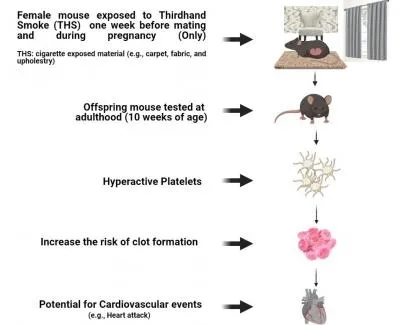
Five studies point to dangers of environmental exposures
New research highlights surprising effects of invisible and often involuntary exposures
2021-04-27
(Press-News.org) Recent years have brought increased attention to the lasting effects of chemicals we unwittingly inhale, touch and ingest while going about our daily lives. The END
ELSE PRESS RELEASES FROM THIS DATE:
Gene changes might explain long-haul COVID-19 symptoms
2021-04-27
Results from a new cell study suggest that the SARS-CoV-2 spike protein can bring about long-term gene expression changes. The findings could help explain why some COVID-19 patients -- referred to as COVID long-haulers -- experience symptoms such as shortness of breath and dizziness long after clearing the infection.
SARS-CoV-2, the virus that causes COVID-19, is covered in tiny spike proteins. During infection, the spike proteins bind with receptors on cells in our body, starting a process that allows the virus to release its genetic material into the inside of the healthy cell.
"We found that exposure to the SARS-CoV-2 spike protein alone was enough to change ...
How does a nose evolve into a blowhole? Study suggests there's more than one way
2021-04-27
The two major types of cetaceans appear to have evolved their characteristic blowholes through different anatomical transformations, according to a study being presented at the END ...
Plant compound shows promise against triple-negative breast cancer
2021-04-27
Findings from a new cell study suggest that the natural plant compound sanguinarine could be a promising tool for targeting triple-negative breast cancer cells. The researchers also found that breast cancer cells derived from people with African American ancestry were more sensitive to sanguinarine than those of European origin.
"Triple negative breast cancer is especially aggressive in African American women, who are also more likely to develop this type of breast cancer than women of European descent," said Samia Messeha, PhD, a research associate in the College of Pharmacy and Pharmaceutical Science at Florida Agricultural and Mechanical ...
Researchers design sensor for fast, inexpensive on-site Ebola detection
2021-04-27
Researchers are developing a new sensor that can detect Ebola in a single drop of blood and provides results in just an hour. With further development, the technology might also enable fast and inexpensive detection of other viruses, including the virus that causes COVID-19.
Ebola is one of the deadliest of all known viruses, killing up to 90% of those infected. Stopping its spread requires quickly detecting and isolating infected people. However, outbreaks tend to occur in remote areas of Africa, requiring blood tests to be transported to distant laboratories for analysis. This leads to significant delays in identifying a new outbreak.
Soma Banerjee, PhD, a visiting scientist in Marit Nilsen-Hamilton's laboratory at Iowa State ...
Researchers uncover potential new way to treat dry mouth
2021-04-27
Researchers studying mice made a serendipitous discovery that could lead to a new dry mouth treatment. More than 10% of people experience dry mouth, which can be caused by medical conditions, radiation treatment, certain medications and aging.
Abigail Boyd, a doctoral candidate at the University of South Alabama, and colleagues made the new discovery while exploring the anti-inflammatory benefits of inhibiting phosphodiesterase-4 (PDE4) enzymes in a mouse model of bacterial lung infection. After noticing that mice treated with a PDE4 inhibitor were salivating, they decided to examine whether this observation could be translated into a dry mouth therapy. They ...
SARS-CoV-2 spike protein alone may cause lung damage
2021-04-27
Using a newly developed mouse model of acute lung injury, researchers found that exposure to the SARS-CoV-2 spike protein alone was enough to induce COVID-19-like symptoms including severe inflammation of the lungs.
SARS-CoV-2, the virus that causes COVID-19, is covered in tiny spike proteins. These proteins bind with receptors on our cells, starting a process that allows the virus to release its genetic material into a healthy cell.
"Our findings show that the SARS-CoV2 spike protein causes lung injury even without the presence of intact virus," said Pavel Solopov, PhD, DVM, research assistant professor at the Frank Reidy Research Center for Bioelectrics at Old Dominion University. "This previously unknown mechanism could cause symptoms before substantial viral replication ...
'Smart shirt' takes a trip to space for science
2021-04-27
A technology-packed tank top offers a simple, effective way to track astronauts' vital signs and physiological changes during spaceflight, according to research being presented at the END ...
Study illuminates how COVID-19 worms its way into the brain
2021-04-27
New research offers an up-close view of how SARS-CoV-2, the virus that causes COVID-19, can spread to the brain. The study helps explain the alarming array of neurological symptoms reported in some patients with COVID-19, as well as why some patients suffer severe neurological effects while others experience none at all.
The researchers report evidence that SARS-CoV-2 can infect both the nerve cells that power our brains (neurons), and the cells in the brain and spinal cord that support and protect neurons (astrocytes).
"Our findings suggest that astrocytes are a pathway through which COVID-19 causes neurological damage," said Ricardo Costa, PhD, a postdoctoral fellow at the ...
Toward a feasible alternative to liver organ transplant
2021-04-27
New insights into how fetal and adult liver cells differ could be used to help make liver cell transplants successful long term. Transplanting functioning liver cells into a patient's liver can help replace liver function that is impaired due to disease.
Today there are many more patients waiting for liver transplants than there are donor organs available. Because liver cell transplantation only requires a portion of cells isolated from a liver, it could allow multiple patients to be treated from one donated organ.
Although liver cell transplants offer a promising life-saving alternative to transplanting the whole organ, the effects aren't long-lasting when adult liver ...
Why older people should chill when it's hot out
2021-04-27
Taking a break from extreme heat, by visiting a cooling center for example, could help our cells protect themselves from damage, according to preliminary findings from a new study. The research, which focused on older people, suggests temporarily cooling down on a hot day helps cells maintain autophagy, a process cells use to rid themselves of dangerous protein buildups caused by stressors like extreme heat.
"By lessening the time spent in a state of elevated internal body temperature, cooling centers may help to preserve autophagy in older adults, which may translate to greater cellular protection and improved health outcomes during an extreme heat event," said James J. McCormick, PhD, a postdoctoral fellow ...
LAST 30 PRESS RELEASES:
Improving sleep isn’t enough: researchers highlight daytime function as key to assessing insomnia treatments
Rice Brain Institute awards first seed grants to jump-start collaborative brain health research
Personalizing cancer treatments significantly improve outcome success
UW researchers analyzed which anthologized writers and books get checked out the most from Seattle Public Library
Study finds food waste compost less effective than potting mix alone
UCLA receives $7.3 million for wide-ranging cannabis research
Why this little-known birth control option deserves more attention
Johns Hopkins-led team creates first map of nerve circuitry in bone, identifies key signals for bone repair
UC Irvine astronomers spot largest known stream of super-heated gas in the universe
Research shows how immune system reacts to pig kidney transplants in living patients
Dark stars could help solve three pressing puzzles of the high-redshift universe
Manganese gets its moment as a potential fuel cell catalyst
“Gifted word learner” dogs can pick up new words by overhearing their owners’ talk
More data, more sharing can help avoid misinterpreting “smoking gun” signals in topological physics
An illegal fentanyl supply shock may have contributed to a dramatic decline in deaths
Some dogs can learn new words by eavesdropping on their owners
Scientists trace facial gestures back to their source. before a smile appears, the brain has already decided
Is “Smoking Gun” evidence enough to prove scientific discovery?
Scientists find microbes enhance the benefits of trees by removing greenhouse gases
KAIST-Yonsei team identifies origin cells for malignant brain tumor common in young adults
Team discovers unexpected oscillation states in magnetic vortices
How the brain creates facial expressions
Researchers observe gas outflow driven by a jet from an active galactic nucleus
Pitt student finds familiar structure just 2 billion years after the Big Bang
Evidence of cross-regional marine plastic pollution in green sea turtles
Patients with clonal hematopoiesis have increased heart disease risk following cancer treatment
Stem cell therapy for stroke shows how cells find their way in the brain
Environment: Up to 4,700 tonnes of litter flows down the Rhine each year
Maternal vaccine receipt and infant hospital and emergency visits for influenza and pertussis
Interim safety of RSVpreF vaccination during pregnancy
[Press-News.org] Five studies point to dangers of environmental exposuresNew research highlights surprising effects of invisible and often involuntary exposures