PRESS-NEWS.org - Press Release Distribution
PRESS RELEASES DISTRIBUTION

Unveiling crucial virulent milRNAs implicated in the initial infection of Fusarium oxysporum f. sp. cubense

Unveiling crucial virulent milRNAs implicated in the initial infection of Fusarium oxysporum f. sp. cubense
2024-05-10
(Press-News.org) Fusarium oxysporum f. sp. cubense (Foc) is a typical soil-borne fungus that causes Fusarium wilt by infecting the roots and blocking the vascular tissues of host banana, and threatens the global banana production. Total four races have been reported in Foc, of which the tropical race 4 (TR4) is the most widespread race. In some severely affected banana plantations, the conventional ‘Cavendish’ variety had to be abandoned for other alternative crops due to the spread of TR4. Therefore, a comprehensive understanding of the pathogenesis of FWB and the development of improved control methods are urgently needed. A growing number of milRNAs have been recognized for their roles in fungal growth, development and pathogenicity. Little is known about the role of these kinds of small RNAs produced by soil-brone fungus Foc in pathogenicity and other biological processes.


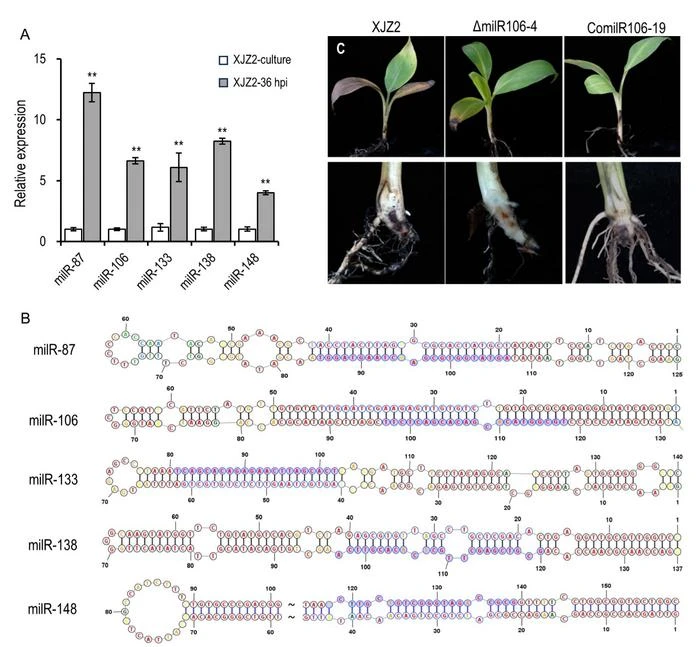
In the study, six milRNAs that are significantly induced during the early stages of Foc infection were identified using small RNA sequencing and bioinformatic analysis. Among them, milR106 stands out due to its unique dependence on the FoDCL2 gene for biosynthesis. In contrast, the production of milR87, milR133, milR138, and milR148 is influenced by both FoDCL2 and FoQDE2. The functional analysis revealed that milR106 plays an important role in Foc virulence by regulating fungal conidiation, hydrogen peroxide sensitivity, and infective growth. Gene ontology analysis of the six milRNAs’ target genes in the banana genome revealed enrichment in defense response to fungus and cellular response to hypoxia, implying the importance of these target genes in response to pathogen infection.


The discovery of these infection-induced, pathogenicity-critical milRNAs provides valuable molecular targets for the design of efficient control strategies against Fusarium wilt of bananas. By unraveling the involvement of milRNAs in Foc's virulence, this work advances our knowledge of the intricate mechanisms underlying this economically important disease and lays the groundwork for future endeavors aimed at enhancing disease resistance in banana cultivars and refining disease management practices.

Full article: 

Unveiling microRNA-like small RNAs implicated in the initial infection of Fusarium oxysporum f. sp. cubense through small RNA sequencing

END

[Attachments] See images for this press release:
Unveiling crucial virulent milRNAs implicated in the initial infection of Fusarium oxysporum f. sp. cubense Unveiling crucial virulent milRNAs implicated in the initial infection of Fusarium oxysporum f. sp. cubense 2 Unveiling crucial virulent milRNAs implicated in the initial infection of Fusarium oxysporum f. sp. cubense 3

ELSE PRESS RELEASES FROM THIS DATE:

Developing an efficient host-vector system for a model archaeon by solving CRISPR-based host-plasmid conflict

2024-05-10
This study is led by Prof. Qunxin She (Shandong University) and Dr. Guanhua Yuan (Shandong University). The research group has constructed versatile genetic tools for Saccharolobus islandicus REY15A, one of the very few archaeal models for archaea biology and CRISPR biology research, and these include efficient genome editing, robust protein expression systems, interference plasmid assay, gene silencing and CRISPR-based gene editing. Nevertheless, plasmid vectors constructed for this crenarchaeon thus far are based solely on the pRN2 cryptic plasmid. “A dual host-vector system is required to enrich the genetic toolbox for this model archaeon.” the ...

Development of technology for producing bioplastics from agricultural and food byproducts by the World Institute of Kimchi

Development of technology for producing bioplastics from agricultural and food byproducts by the World Institute of Kimchi
2024-05-10
As kimchi has been drawing attention as a global healthy food trend, cabbage is one of the representative vegetables used as a main ingredient for manufacturing kimchi overseas. The annual global production of cabbage and other Brassica crops is reported to be 72 million tons, and more than 30% of them are estimated to be discarded during the manufacturing and distribution processes, causing environmental pollution as well as considerable waste disposal costs in the industry. In connection with this problem, Hae Choon Chang, President of the World Institute of Kimchi (WiKim), a government-funded research institute under the Ministry of Science and ICT, announced on April 22 that ...

How the brain is flexible enough for a complex world (without being thrown into chaos)

2024-05-10
Every day our brains strive to optimize a trade-off: With lots of things happening around us even as we also harbor many internal drives and memories, somehow our thoughts must be flexible yet focused enough to guide everything we have to do. In a new paper in Neuron, a team of neuroscientists describes how the brain achieves the cognitive capacity to incorporate all the information that’s relevant without becoming overwhelmed by what’s not. The authors argue that the flexibility arises from a key property observed in many neurons: “mixed selectivity.” While many neuroscientists used to think each cell had just one dedicated function, more recent evidence ...

Tracing HIV in Indonesia

Tracing HIV in Indonesia
2024-05-10
The HIV variant dominant in Indonesia was introduced from Thailand over multiple events. The Kobe University study traces where it came from and how it spread from there, offering insights of possible value to the development of treatments against the disease. HIV is the virus causing AIDS, but one of the things that make it so difficult to treat is that there are many variants of it. Kobe University virologist KAMEOKA Masanori says, “The diversity is increasing every day and the prevalent virus strains differ from region to ...

Metabolism of autism reveals developmental origins

2024-05-10
Researchers at the University of California San Diego School of Medicine have shed new light on the changes in metabolism that occur between birth and the presentation of autism spectrum disorder (ASD) later in childhood. The researchers discovered that a small number of biochemical pathways are responsible for the majority of these changes, which could help inform new early detection and prevention strategies for autism. “At birth, the physical appearance and behavior of a child who will develop autism over the next few years are indistinguishable from that of a neurotypical child. Indeed, in most cases the fate of the child with regard to autism is not ...

Comparative analysis of robot-assisted language learning systems and human tutors in English conversation lessons

Comparative analysis of robot-assisted language learning systems and human tutors in English conversation lessons
2024-05-10
Advancements in large language models, robotics, and software such as text-to-speech, have made it possible to develop robots that can understand language, interact physically, and communicate verbally. These breakthroughs have opened up possibilities for robots to be used for educational purposes. However, this raises the question of whether robots are as good as human tutors. While robots offer certain benefits, they cannot replicate the nuanced interactions and personalized feedback human tutors provide. To determine the suitability of using ...

Under 4-minute milers’ longevity shows that extreme exercise doesn’t seem to curb lifespan

2024-05-10
Extreme exercise doesn’t seem to shorten the lifespan as is widely believed, suggest the findings of a study on the longevity of the first 200 athletes to run a mile in under 4 minutes, and published online in the British Journal of Sports Medicine. They outlive the general population by several years, shows the study, which marks the 70th anniversary of the seminal achievement of Roger Bannister, who was the first person to run a mile in under 4 minutes in May 1954. While regular moderate exercise is considered a pillar of healthy ageing, ...

Journal retracts 6 further articles and corrects 2 others authored by former editor

2024-05-10
The British Journal of Sports Medicine has retracted six further articles authored by former editor, Dr Paul McCrory, and corrected another two, following an extensive investigation of his sole authored content in the journal.* The retractions comprise four ‘warm up’ editorials and one book review due to plagiarism. A letter has also been retracted because of duplicate publication. And a research article and a review article have been corrected due to inappropriate reuse of content. This latest tranche of retractions and corrections completes BMJ’s 2-year investigation ...

Running under a four-minute mile could be the key to a long and healthy life

2024-05-10
A new study released to mark the 70th anniversary of Sir Roger Bannister’s sub-four-minute mile record has revealed the first 200 runners to follow in his footsteps also share another remarkable trait. The study from investigators in Australia and Canada found the 200 elite runners live on average almost five years longer than the general population. Professor Mark Haykowsky, the Research Chair in Aging and Quality of Life in the Faculty of Nursing at the University of Alberta, says the findings published in the British Journal of Sports Medicine demonstrate the vital importance of aerobic fitness. Professor Haykowsky says: “Breaking ...

Transforming common soft magnets into a next-generation thermoelectric conversion materials by 3 minutes heat treatment

Transforming common soft magnets into a next-generation thermoelectric conversion materials by 3 minutes heat treatment
2024-05-10
1. A research team from NIMS and Nagoya University has demonstrated that an iron-based amorphous alloy, widely used as a soft magnetic material in transformers and motors, can be transformed into a "transverse" thermoelectric conversion material that converts electric and thermal currents in orthogonal directions, with just a short period of heat treatment. This is the first example that highlights the importance of microstructure engineering in the development of transverse thermoelectric conversion materials, and provides new design guidelines for materials development to realize environmentally friendly power generation and thermal management technologies ...

LAST 30 PRESS RELEASES:

Ultrasound-responsive in situ antigen "nanocatchers" open a new paradigm for personalized tumor immunotherapy

Environmental “superbugs” in our rivers and soils: new one health review warns of growing antimicrobial resistance crisis

Triple threat in greenhouse farming: how heavy metals, microplastics, and antibiotic resistance genes unite to challenge sustainable food production

Earthworms turn manure into a powerful tool against antibiotic resistance

AI turns water into an early warning network for hidden biological pollutants

Hidden hotspots on “green” plastics: biodegradable and conventional plastics shape very different antibiotic resistance risks in river microbiomes

Engineered biochar enzyme system clears toxic phenolic acids and restores pepper seed germination in continuous cropping soils

Retail therapy fail? Online shopping linked to stress, says study

How well-meaning allies can increase stress for marginalized people

Commercially viable biomanufacturing: designer yeast turns sugar into lucrative chemical 3-HP

Control valve discovered in gut’s plumbing system

George Mason University leads phase 2 clinical trial for pill to help maintain weight loss after GLP-1s

Hop to it: research from Shedd Aquarium tracks conch movement to set new conservation guidance

Weight loss drugs and bariatric surgery improve the body’s fat ‘balance:’ study

The Age of Fishes began with mass death

TB harnesses part of immune defense system to cause infection

Important new source of oxidation in the atmosphere found

A tug-of-war explains a decades-old question about how bacteria swim

Strengthened immune defense against cancer

Engineering the development of the pancreas

The Journal of Nuclear Medicine ahead-of-print tip sheet: Jan. 9, 2026

Mount Sinai researchers help create largest immune cell atlas of bone marrow in multiple myeloma patients

Why it is so hard to get started on an unpleasant task: Scientists identify a “motivation brake”

Body composition changes after bariatric surgery or treatment with GLP-1 receptor agonists

Targeted regulation of abortion providers laws and pregnancies conceived through fertility treatment

Press registration is now open for the 2026 ACMG Annual Clinical Genetics Meeting

Understanding sex-based differences and the role of bone morphogenetic protein signaling in Alzheimer’s disease

Breakthrough in thin-film electrolytes pushes solid oxide fuel cells forward

Clues from the past reveal the West Antarctic Ice Sheet’s vulnerability to warming

Collaborative study uncovers unknown causes of blindness

[Press-News.org] Unveiling crucial virulent milRNAs implicated in the initial infection of Fusarium oxysporum f. sp. cubense