PRESS-NEWS.org - Press Release Distribution
PRESS RELEASES DISTRIBUTION

Study elucidates role of “G900” gene enhancers in asthma-associated inflammation
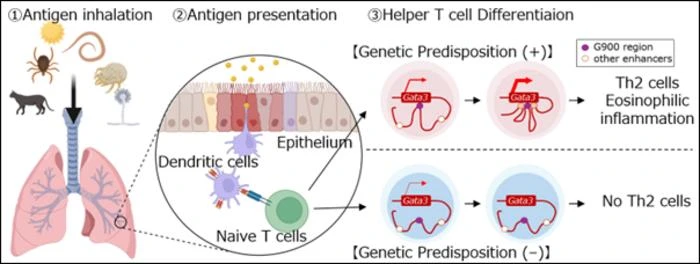
Researchers found that the G900 region in mice genome plays a crucial role in inflammatory pathways, especially after exposure to allergens

Study elucidates role of “G900” gene enhancers in asthma-associated inflammation
2024-06-24
(Press-News.org)

Asthma patients experience respiratory distress due to allergens like house dust mites or pollen. However, the various triggers for asthma share a common pathway involving the release of proteins called type-2 cytokines by Type-2 helper T (Th2) cells and group-2 innate lymphoid cells (ILC2s). Both Th2 and ILC2 require high amounts of GATA-binding protein 3 (GATA3) for their maturation.

Specific gene sequences called enhancers are responsible for elevating the expression of GATA3 genes in humans. Studies have found that by controlling the production of GATA3, enhancers influence the development of Th2 and ILC2. The gene region G900, located close to the GATA3 gene, is currently being investigated for its role in the asthma inflammation pathway. In a recent breakthrough, a study by researchers from Chiba University that was published in Proceedings of the National Academy of Sciences, USA on June 24, 2024, has discovered that the mouse gene region corresponding to the human G900 is involved in Th2 differentiation and consequently in enhancing allergic responses, although not ILC2.

“Multiple genome-wide association studies (GWAS) have aimed to elucidate the underlying biology and predict susceptibility to asthma. The importance of single nucleotide polymorphisms (SNPs) within the 10p14 locus has been indicated in several independent studies, not only in asthma susceptibility but also in a broad spectrum of allergic diseases, including allergic rhinitis, atopic dermatitis, and eosinophilic granulomatosis with polyangiitis”, explains Professor Hiroshi Nakajima of Chiba University, the lead researcher in the study.

To investigate the role of G900 in asthma-associated inflammatory pathways, researchers including Arifumi Iwata, Takashi Kumagai, and Hiroki Furuya of the Graduate School of Medicine at Chiba University, among others, developed mice that lacked the G900 region in their genome. These mG900 “knockout mice” were subsequently exposed to allergens such as papain and house dust mites. Researchers discovered that mG900 knockout mice produce reduced inflammatory response compared to control mice with intact mG900 when exposed to house dust mites. Further, they also found suppression of Th2 differentiation in mG900 knockout mice compared to control mice.

“One aspect we elucidate in our study is the role of the murine G900 region in Th2 differentiation and allergic airway inflammation”, Prof. Nakajima explains. “This region, homologous to the human G900 region associated with asthma, is shown to be essential for in vivo Th2 cell differentiation and allergic responses, particularly in the context of house dust mite (HDM)-induced allergic airway inflammation. Furthermore, we have demonstrated that this G900 region is crucial for optimizing the three-dimensional chromatin structure near GATA3 in Th2 cells”, he further states.

The study’s findings have wide-ranging implications for asthma care as well as therapeutic interventions for other allergic diseases. In the future, methods of regulating Th2 differentiation and function by pharmacologically restricting GATA3 enhancers like G900 may help reduce exaggerated immune responses underlying allergic reactions.  

“By identifying and understanding critical genetic regions that regulate immune responses, such as the mG900 region, it may be possible to develop precision medicine approaches tailored to individual genetic profiles. This could lead to more effective and personalized treatments, reducing the incidence and severity of allergic reactions and improving the quality of life for individuals suffering from these conditions”, Prof. Nakajima concludes.

About Professor Hiroshi Nakajima of Chiba University
Hiroshi Nakajima is currently a Professor at the Chiba University’s Graduate School of Medicine. Prof. Nakajima has published nearly 250 scientific articles on the molecular underpinnings of refractory allergic or autoimmune diseases. His research bridges basic research and clinical medicine by helping expedite the development of new medicines for allergies and autoimmune diseases.

END


[Attachments] See images for this press release:
Study elucidates role of “G900” gene enhancers in asthma-associated inflammation Study elucidates role of “G900” gene enhancers in asthma-associated inflammation 2 Study elucidates role of “G900” gene enhancers in asthma-associated inflammation 3

ELSE PRESS RELEASES FROM THIS DATE:

Secrets of drop stains unveiled: New FSU research decodes chemical composition from simple photos

Secrets of drop stains unveiled: New FSU research decodes chemical composition from simple photos
2024-06-24
TALLAHASSEE, Fla. — Imagine zooming in on a dried drop of salt solution — each pattern a unique masterpiece, reminiscent of abstract art, yet no larger than the size of a penny. New research by scientists in the Florida State University Department of Chemistry and Biochemistry uses the patterns formed by a dried salt solution to train a machine learning algorithm that can identify the chemical composition of different salts. The work will be published in the Proceedings of the National Academy of Sciences. “We are taking chemical fingerprints ...

New computational model of real neurons could lead to better AI

New computational model of real neurons could lead to better AI
2024-06-24
Nearly all the neural networks that power modern artificial intelligence tools such as ChatGPT are based on a 1960s-era computational model of a living neuron. A new model developed at the Flatiron Institute’s Center for Computational Neuroscience (CCN) suggests that this decades-old approximation doesn’t capture all the computational abilities that real neurons possess and that this older model is potentially holding back AI development. The new model developed at CCN posits that individual neurons exert more control over their surroundings than previously thought. The updated neuron model could ultimately lead to more powerful artificial neural ...

AI matches protein interaction partners

AI matches protein interaction partners
2024-06-24
Proteins are the building blocks of life, involved in virtually every biological process. Understanding how proteins interact with each other is crucial for deciphering the complexities of cellular functions, and has significant implications for drug development and the treatment of diseases. However, predicting which proteins bind together has been a challenging aspect of computational biology, primarily due to the vast diversity and complexity of protein structures. But a new study from the group of Anne-Florence Bitbol at EPFL might now change all that. The team of scientists, ...

Navigating the labyrinth: How AI tackles complex data sampling

2024-06-24
The world of artificial intelligence (AI) has recently seen significant advancements in generative models, a type of machine-learning algorithms that “learn” patterns from set of data in order to generate new, similar sets of data. Generative models are often used for things like drawing images and natural language generation – a famous example are the models used to develop chatGPT. Generative models have had remarkable success in various applications, from image and video generation to composing music and to language modeling. The problem ...

Hydrothermal vents on seafloors of ‘ocean worlds’ could support life, new study says

Hydrothermal vents on seafloors of ‘ocean worlds’ could support life, new study says
2024-06-24
We’ve all seen the surreal footage in nature documentaries showing hydrothermal vents on the frigid ocean floor—bellowing black plumes of super-hot water—and the life forms that cling to them. Now, a new study by UC Santa Cruz researchers suggests that lower-temperature vents, which are common across Earth's seafloor, may help to create life-supporting conditions on "ocean worlds" in our solar system. Ocean worlds are planets and moons that have—or had in the past—a liquid ocean, often under an icy shell or within their rocky interior. In Earth's solar system, several of Jupiter's and Saturn's moons are ocean worlds, and ...

New USF study: Mindfulness and managing emotions lead to better sleep

New USF study: Mindfulness and managing emotions lead to better sleep
2024-06-24
Media Contact: John Dudley (814) 490-3290 (cell) jjdudley@usf.edu TAMPA, Fla. (June 24, 2024) – Mindfulness – focusing on the present moment – can improve sleep, reduce stress and improve overall health. A new University of South Florida-led study helps explain why. Researchers studied 144 nurses over two weeks to see how well they could stay focused on the present and how often they fixated on negative thoughts. The nurses completed surveys three times a day and reported their sleep quality the following morning. The findings shed light on how mindfulness relates to emotion ...

JACC to serve cardiovascular community, shape future under new editor

2024-06-24
The first issue of JACC, the flagship journal of the American College of Cardiology, under new Editor-in-Chief Harlan M. Krumholz, MD, SM, FACC, publishes today, ushering in a new era of one of the world’s leading scholarly journals. “I envision JACC, with all its strengths, as a transformative platform for building community, elevating strong science, influencing clinical practice, supporting career development, and improving patient outcomes.” Krumholz said in his Editor’s Page. “JACC and its group of journals can play a pivotal role in serving our community and shaping the future.” Under his editorship, JACC will be guided by ...

Revived technology used to count individual photons from distant galaxies

Revived technology used to count individual photons from distant galaxies
2024-06-24
Using an instrument on the 4.1-meter Southern Astrophysical Research Telescope, researchers obtained the first astronomical spectrum using skipper charge-coupled devices (CCDs). The results were presented on June 16 at the Society of Photo-Optical Instrumentation Engineers Astronomical Telescopes + Instrumentation meeting in Japan by Edgar Marrufo Villalpando, a physics PhD candidate at the University of Chicago and a Fermilab DOE Graduate Instrumentation Research Award Fellow. “This is a major milestone for skipper-CCD technology,” said Alex Drlica-Wagner, a cosmologist at the U.S. Department of Energy’s Fermi ...

U of T researchers develop RNA-targeting technology for precisely manipulating parts of human genes

U of T researchers develop RNA-targeting technology for precisely manipulating parts of human genes
2024-06-24
Researchers at the University of Toronto have harnessed a bacterial immune defense system, known as CRISPR, to efficiently and precisely control the process of RNA splicing. The technology opens the door to new applications, including systematically interrogating the functions of parts of genes and correcting splicing deficiencies that underlie numerous diseases and disorders. “Almost all human genes produce RNA transcripts that undergo the process of splicing, whereby coding segments, called exons, are joined together and non-coding segments, called introns, are removed and typically degraded,” said Jack Daiyang Li, first author on the study and PhD student ...

NexusXp™ – SLAS’s new interactive pavilion at SLAS2025 will showcase automation integration and collaboration

NexusXp™ – SLAS’s new interactive pavilion at SLAS2025 will showcase automation integration and collaboration
2024-06-24
Oak Brook, IL – The Society for Laboratory Automation and Screening (SLAS) will launch NexusXp, its new interactive pavilion at SLAS2025 to showcase collaborative and integrated lab automation scenarios. NexusXp combines Nexus, the Latin word for link or connection where multiple elements meet, with the modern “Xp” to signify the “Xperience” of making that critical link or connection. Through this new pavilion, SLAS will demonstrate how automation integration transforms research and enables scientific breakthroughs. “NexusXp is an exclusive event or attendee ...

LAST 30 PRESS RELEASES:

Scientists trace microplastics in fertilizer from fields to the beach

The Lancet Obstetrics, Gynecology, & Women’s Health: Taking paracetamol during pregnancy does not increase risk of autism, ADHD or intellectual disabilities, confirms new gold-standard evidence review

Taking paracetamol during pregnancy does not increase risk of autism, ADHD or intellectual disabilities

Harm reduction vending machines in New York State expand access to overdose treatment and drug test strips, UB studies confirm

University of Phoenix releases white paper on Credit for Prior Learning as a catalyst for internal mobility and retention

Canada losing track of salmon health as climate and industrial threats mount

Molecular sieve-confined Pt-FeOx catalysts achieve highly efficient reversible hydrogen cycle of methylcyclohexane-toluene

Investment in farm productivity tools key to reducing greenhouse gas

New review highlights electrochemical pathways to recover uranium from wastewater and seawater

Hidden pollutants in shale gas development raise environmental concerns, new review finds

Discarded cigarette butts transformed into high performance energy storage materials

Researchers highlight role of alternative RNA splicing in schizophrenia

NTU Singapore scientists find new way to disarm antibiotic-resistant bacteria and restore healing in chronic wounds

Research suggests nationwide racial bias in media reporting on gun violence

Revealing the cell’s nanocourier at work

Health impacts of nursing home staffing

Public views about opioid overdose and people with opioid use disorder

Age-related changes in sperm DNA may play a role in autism risk

Ambitious model fails to explain near-death experiences, experts say

Multifaceted effects of inward foreign direct investment on new venture creation

Exploring mutations that spontaneously switch on a key brain cell receptor

Two-step genome editing enables the creation of full-length humanized mouse models

Pusan National University researchers develop light-activated tissue adhesive patch for rapid, watertight neurosurgical sealing

Study finds so-called super agers tend to have at least two key genetic advantages

Brain stimulation device cleared for ADHD in the US is overall safe but ineffective

Scientists discover natural ‘brake’ that could stop harmful inflammation

Tougher solid electrolyte advances long-sought lithium metal batteries

Experts provide policy roadmap to reduce dementia risk

New 3D imaging system could address limitations of MRI, CT and ultrasound

First-in-human drug trial lowers high blood fats

[Press-News.org] Study elucidates role of “G900” gene enhancers in asthma-associated inflammation
Researchers found that the G900 region in mice genome plays a crucial role in inflammatory pathways, especially after exposure to allergens