KIST develops full-color-emitting upconversion nanoparticle technology for color displays with ultra-high color reproducibility
Development of upconversion nanoparticles with core@multi-shell structure for high color reproduction
Published 2025-04-11 · Original archive entry · Explore research explainers
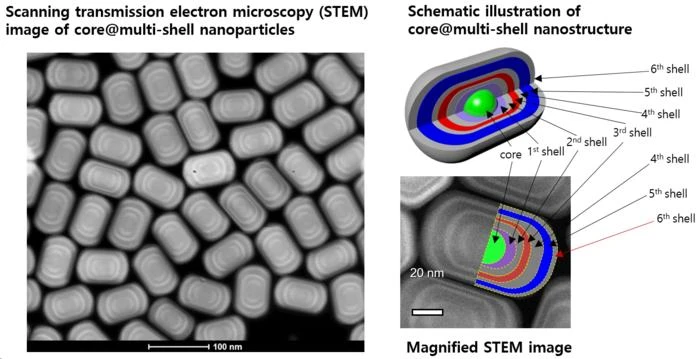
Dr. Ho Seong Jang and colleagues at the Extreme Materials Research Center at the Korea Institute of Science and Technology (KIST) have developed an upconversion nanoparticle technology that introduces a core@multi-shell nanostructure, a multilayer structure in which multiple layers of shells surround a central core particle, and enables high color purity RGB light emission from a single nanoparticle by adjusting the infrared wavelength.
Luminescent materials are materials that light up on their own and are used in a variety of display devices, including TVs, tablets, monitors, and smartphones, to allow us to view a variety of images and videos. However, conventional two-dimensional flat displays cannot fully convey the three-dimensional dimensionality of the real world, limiting the sense of depth. The movie "Avatar" attracted a lot of attention for its 3D images, but audiences had to wear special glasses to experience the sense of depth, and glasses-free 3D displays were developed to solve this inconvenience, but they have the disadvantage of causing eye fatigue.
To solve these problems, three-dimensional volumetric display technology is being researched. This is a next-generation display technology that implements three-dimensional image information in a three-dimensional space, which requires upconversion nanoparticles that absorb infrared light and emit visible light. In particular, upconversion nanoparticles that can emit all three primary colors of light-red (R), green (G), and blue (B)-from a single nanoparticle are required, but existing materials either emit only one color from a single nanoparticle or, even if R/G/B emission is possible, brightness is low or the range of color reproduction is limited due to a narrow color gamut.
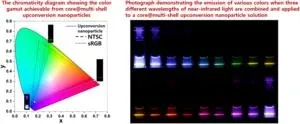
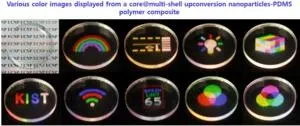
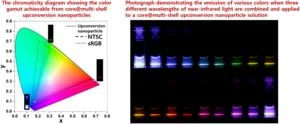
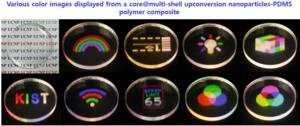
The KIST researchers controlled the material composition of the core and shell to induce R/G/B luminescence from a single nanoparticle, and applied three wavelengths of near-infrared light to produce R/G/B luminescence at different excitation wavelengths. In particular, they designed the core to emit green light, the inner shell to emit red light, and the outer shell to emit blue light, achieving high color purity and strong luminescence intensity of R/G/B luminescence in a single nanoparticle. The nanoparticles developed by the researchers can realize various colors by applying multiple wavelengths of near-infrared light simultaneously, achieving a wide color gamut of 94.2% of the NTSC color space and 133% of the sRGB color space. The researchers also demonstrated the possibility of realizing 3D volumetric displays using upconversion nanoparticles by fabricating transparent upconversion nanoparticle- polymer composites to display various color images.
"Upconversion nanoparticles that can absorb near-infrared light and produce high color reproduction full-color luminescence will enable the commercialization of 3D volumetric displays that can allow us to view true 3D images. These upconversion nanoparticles can be used not only in the display field but also as a security material to prevent counterfeiting and tampering," said Dr. Ho Seong Jang of KIST.
###
KIST was established in 1966 as the first government-funded research institute in Korea. KIST now strives to solve national and social challenges and secure growth engines through leading and innovative research. For more information, please visit KIST’s website at https://www.kist.re.kr/eng/
This research was supported by the KIST Institutional Program, Mid-Career Researcher Support Project (NRF-2022R1A2C2005943), funded by the Ministry of Science and ICT (Minister Yoo Sang-im), and the Technology Innovation Program (RS-2024-00433146) through the Korea Planning & Evaluation Institute of Industrial Technology (KEIT) and the Alchemist Project (20193091010240) through the Korea Institute of Energy Technology Evaluation and Planning (KETEP), funded by the Ministry of Trade, Industry and Energy (Minister Ahn Duk-geun). The research was published in the recent issue of the international journal Advanced Functional Materials (IF 18.5, JCR field 4.1%) and was selected as a Frontispiece.
END
Luminescent materials are materials that light up on their own and are used in a variety of display devices, including TVs, tablets, monitors, and smartphones, to allow us to view a variety of images and videos. However, conventional two-dimensional flat displays cannot fully convey the three-dimensional dimensionality of the real world, limiting the sense of depth. The movie "Avatar" attracted a lot of attention for its 3D images, but audiences had to wear special glasses to experience the sense of depth, and glasses-free 3D displays were developed to solve this inconvenience, but they have the disadvantage of causing eye fatigue.
To solve these problems, three-dimensional volumetric display technology is being researched. This is a next-generation display technology that implements three-dimensional image information in a three-dimensional space, which requires upconversion nanoparticles that absorb infrared light and emit visible light. In particular, upconversion nanoparticles that can emit all three primary colors of light-red (R), green (G), and blue (B)-from a single nanoparticle are required, but existing materials either emit only one color from a single nanoparticle or, even if R/G/B emission is possible, brightness is low or the range of color reproduction is limited due to a narrow color gamut.
The KIST researchers controlled the material composition of the core and shell to induce R/G/B luminescence from a single nanoparticle, and applied three wavelengths of near-infrared light to produce R/G/B luminescence at different excitation wavelengths. In particular, they designed the core to emit green light, the inner shell to emit red light, and the outer shell to emit blue light, achieving high color purity and strong luminescence intensity of R/G/B luminescence in a single nanoparticle. The nanoparticles developed by the researchers can realize various colors by applying multiple wavelengths of near-infrared light simultaneously, achieving a wide color gamut of 94.2% of the NTSC color space and 133% of the sRGB color space. The researchers also demonstrated the possibility of realizing 3D volumetric displays using upconversion nanoparticles by fabricating transparent upconversion nanoparticle- polymer composites to display various color images.
"Upconversion nanoparticles that can absorb near-infrared light and produce high color reproduction full-color luminescence will enable the commercialization of 3D volumetric displays that can allow us to view true 3D images. These upconversion nanoparticles can be used not only in the display field but also as a security material to prevent counterfeiting and tampering," said Dr. Ho Seong Jang of KIST.
###
KIST was established in 1966 as the first government-funded research institute in Korea. KIST now strives to solve national and social challenges and secure growth engines through leading and innovative research. For more information, please visit KIST’s website at https://www.kist.re.kr/eng/
This research was supported by the KIST Institutional Program, Mid-Career Researcher Support Project (NRF-2022R1A2C2005943), funded by the Ministry of Science and ICT (Minister Yoo Sang-im), and the Technology Innovation Program (RS-2024-00433146) through the Korea Planning & Evaluation Institute of Industrial Technology (KEIT) and the Alchemist Project (20193091010240) through the Korea Institute of Energy Technology Evaluation and Planning (KETEP), funded by the Ministry of Trade, Industry and Energy (Minister Ahn Duk-geun). The research was published in the recent issue of the international journal Advanced Functional Materials (IF 18.5, JCR field 4.1%) and was selected as a Frontispiece.
END
Attachments