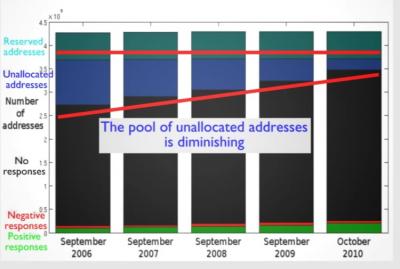
(Press-News.org) As Internet authorities prepare to announce that they have handed over all of the available addresses, a USC research group that monitors address usage has completed the latest in its series of Internet censuses.
There is some good news, according to computer scientist John Heideman, who heads a team at the USC Viterbi School of Engineering Information Sciences Institute that has just released its results in the form of a detailed outline, including a 10-minute video and an interactive web browser that allows users to explore the nooks and crannies of Internet space themselves.
video: http://www.isi.edu/ant/address/video/
browser: http://www.isi.edu/ant/address/browse/
Heidemann who is a senior project leader at ISI and a research associate professor in the USC Viterbi School of Engineering Department of Computer Science, says his group has found that while some of the already allocated address blocks (units of Internet real estate, ranging from 256 to more than 16 million addresses) are heavily used, many are still sparsely used. "Even allowing for undercount," the group finds, "probably only 14 percent of addresses are visible on the public Internet."
Nevertheless, "as full allocation happens, there will be pressure to improve utilization and eventually trade underutilized areas," the video shows. These strategies have limits, the report notes. Better utilization, trading, and other strategies can recover "twice or four times current utilization. But requests for address double every year, so trading will only help for two years. Four billion addresses are just not enough for 7 billion people."
The IPv6 protocol allows many, many more addresses – 1000 1000 trillion – but may involve transition costs.
Heideman's group report comes as the Number Resource Organization (NRO) and he Internet Assigned Numbers Authority (IANA) are preparing to make an announcement saying they have given out all the addresses, passing on most to regional authorities.
The ISI video offers a thorough background in the hows and whys of the current IPv4 Internet address system, in which each address is a number between zero and 2 to the 32nd power (4,294,967,295), usually written in "dotted-decimal notation" as four base-10 numbers separated by periods.
Heidemann, working with collaborator Yuri Pradkin and ISI colleagues, produced an earlier Internet census in 2007, following on previous work at ISI -- the first complete census since 1982. To do it, they sent a message ('ping') each to each possible Internet address. The video explains the pinging process.
At the time, some 2.8 million of the 4.3 million possible addresses had been allocated; today more than 3.5 million are allocated. The current effort, funded by Department of Homeland Security Science and Technology Directorate and the NSF, was carried out by Aniruddh Rao and Xue Cui of ISI, along with Heidemann. Peer-reviewed analysis of their approach appeared in ACM Internet Measurements Conference, 2008.
INFORMATION:
Internet addresses: An inevitable shortage, but an uneven one
'4 billion addresses are just not enough for 7 billion people' and the latest Internet census shows how
2011-02-02
ELSE PRESS RELEASES FROM THIS DATE:
New quartet of ant genomes advanced by international collaborative
2011-02-02
"Look to the ant thou sluggard and consider her ways and be wise." This proverbial wisdom was taken to heart recently by an international group of ant experts who have published the genome sequences of four ants in a series of coordinated releases in the journal Proceedings of the National Academy of Sciences (PNAS). The quartet includes the genomes of the red harvester ant Pogonomyrmex barbatus; the Argentine ant Linepithema humile; the fire ant Solenopsis invicta, and the leaf-cutter ant Atta cephalotes, whose genome will be published on Feb. 10 in Public Library of Science ...
Go green, give a boost to employee morale
2011-02-02
In a global recession, most people are thankful to have a job, but a new study published in Interdisciplinary Environmental Review suggests that employees are more likely to be satisfied with their jobs if they are working for a company that is perceived to be "green", whereas the financial performance of companies fails to correlate with employee happiness.
Cassandra Walsh and Adam Sulkowski, both of the Charlton College of Business at University of Massachusetts Dartmouth, wanted to know whether employee morale is typically affected when a company is perceived as taking ...
New test to study proteins involved in neurodegenerative diseases
2011-02-02
Researchers from the Institute of Biotechnology and Biomedicine and the UAB Department of Biochemistry and Molecular Biology have developed and patented a method using Saccharomyces cerevisiae yeast to detect in human proteins the formation of oligomers, small toxic aggregations of molecules which can initiate the assembly of amyloid fibres found in neurodegenerative diseases. The test allows validating the efficacy of compounds which could dissolve or inhibit these aggregates, as well as studying at basic level the therapeutic potentiality of a large number of molecules. ...
Home and away: How do invasive plant species dominate native species?
2011-02-02
Invasive plant species present a serious environmental, economic and social problem worldwide as their abundance can lead to lost native biodiversity and ecosystem functions, such as nutrient cycling. Despite substantial research, little is known about why some species can dominate new habitats over native plants that technically should have the advantage.
A common but rarely tested assumption is that these plants are more abundant in introduced versus native communities, because they are behaving in special way. If this true and introduced species are behaving in a special ...
Protracted abstinence revisited
2011-02-02
Philadelphia, PA, 1 February 2011 - Opiate abuse is a chronic disorder and maintaining abstinence represents a major challenge for addicts.
Individuals recovering from opiate dependence have long reported that while the acute withdrawal symptoms from opiates may pass relatively quickly, they do not feel quite right for several weeks or even months thereafter. Called the "protracted abstinence syndrome," this cluster of vague depressive-like symptoms can include reduced concentration, low energy level, poor sleep quality, and anhedonia.
New data in animals, reported ...
2 genes better than 1 for important plant pest
2011-02-02
Researchers funded by the Biotechnology and Biological Sciences Research Council (BBSRC) have revealed a novel molecular mechanism that triggers plant infection by Pseudomonas syringae, the bacteria responsible for bacterial speck in tomatoes. The scientists from the Department of Life Sciences at Imperial College London have revealed how two genes in the bacteria work together to launch the infection process that ultimately kills the plant's cells and causes disease, significantly reducing crop quality and yield.
Pseudomonas syringae is responsible for major disease ...
A new model for studying Parkinson's
2011-02-02
Evidence is steadily mounting that genetic factors play an important role in many cases of Parkinson's disease (PD). In a study published February 2, 2011, online in the Journal of Neuroscience, researchers from the Ecole Polytechnique Fédérale de Lausanne (EPFL) in Switzerland report a new mammalian model for studying a specific gene mutation commonly found in PD sufferers, opening the door to new drugs to fight the malady.
"This is a great step forward toward a more comprehensive understanding of how the disease works, and how it can be diagnosed and treated," explains ...
Temporary employment reduces productivity of technology and energy companies
2011-02-02
"Our study proves that one of the leading factors affecting progress in Spanish productivity is the high rate of temporary hiring among workers in highly technologically intense industries. These sectors are also those that most contribute to overall productivity growth (of all sectors) in the country's economy", Bienvenido Ortega, co-author of the study and a researcher at the UMA, tells SINC.
The 1984 overhaul of Spain's employment legislation led to the possibility of various forms of temporary contracting, and since further reforms in 1994, 1997 and 2001, the use ...
'Negative democratic gap' serves as predictor for instability such as in Egypt, say Hebrew University researchers
2011-02-02
Jerusalem, February 1, 2011-- Research carried out at the Hebrew University of Jerusalem shows that it was possible already in 2008 to predict that countries such as Egypt and Iran were headed for dangerous periods of instability because of citizens' demands for democratization.
The researchers were able to make this observation on the basis of a "democratic gap" scale of measurement between the level of freedom existing and the desire of citizens for more freedom, which was analyzed in about 90 countries around the world.
In their research, Prof. Tamir Sheafer ...
Scientists make key step in the development of a norovirus treatment
2011-02-02
With the number of norovirus infection cases rising across the country, scientists from the University of Southampton have successfully crystallised a key norovirus enzyme, which could help in the development of a norovirus treatment.
Noroviruses are recognised world-wide as the most important cause of epidemic nonbacterial gastroenteritis (stomach bugs) and pose a significant public health burden, with an estimated one million cases per year in the UK. In the past, noroviruses have also been called 'winter vomiting viruses'.
By crystallising the key protease enzyme, ...
LAST 30 PRESS RELEASES:
Non-opioid ‘pain sponge’ therapy halts cartilage degeneration and relieves chronic pain
AI can pick up cultural values by mimicking how kids learn
China’s ecological redlines offer fast track to 30 x 30 global conservation goal
Invisible indoor threats: emerging household contaminants and their growing risks to human health
Adding antibody treatment to chemo boosts outcomes for children with rare cancer
Germline pathogenic variants among women without a history of breast cancer
Tanning beds triple melanoma risk, potentially causing broad DNA damage
Unique bond identified as key to viral infection speed
Indoor tanning makes youthful skin much older on a genetic level
Mouse model sheds new light on the causes and potential solutions to human GI problems linked to muscular dystrophy
The Journal of Nuclear Medicine ahead-of-print tip sheet: December 12, 2025
Smarter tools for peering into the microscopic world
Applications open for funding to conduct research in the Kinsey Institute archives
Global measure underestimates the severity of food insecurity
Child survivors of critical illness are missing out on timely follow up care
Risk-based vs annual breast cancer screening / the WISDOM randomized clinical trial
University of Toronto launches Electric Vehicle Innovation Ontario to accelerate advanced EV technologies and build Canada’s innovation advantage
Early relapse predicts poor outcomes in aggressive blood cancer
American College of Lifestyle Medicine applauds two CMS models aligned with lifestyle medicine practice and reimbursement
Clinical trial finds cannabis use not a barrier to quitting nicotine vaping
Supplemental nutrition assistance program policies and food insecurity
Switching immune cells to “night mode” could limit damage after a heart attack, study suggests
URI-based Global RIghts Project report spotlights continued troubling trends in worldwide inhumane treatment
Neutrophils are less aggressive at night, explaining why nighttime heart attacks cause less damage than daytime events
Menopausal hormone therapy may not pose breast cancer risk for women with BRCA mutations
Mobile health tool may improve quality of life for adolescent and young adult breast cancer survivors
Acupuncture may help improve perceived breast cancer-related cognitive difficulties over usual care
Nerve block may reduce opioid use in infants undergoing cleft palate surgery
CRISPR primes goldenberry for fruit bowl fame
Mass General Brigham announces new AI company to accelerate clinical trial screening and patient recruitment
[Press-News.org] Internet addresses: An inevitable shortage, but an uneven one'4 billion addresses are just not enough for 7 billion people' and the latest Internet census shows how