Sewage sludge biochar, re-engineered with bacteria, boosts cabbage growth by 40%
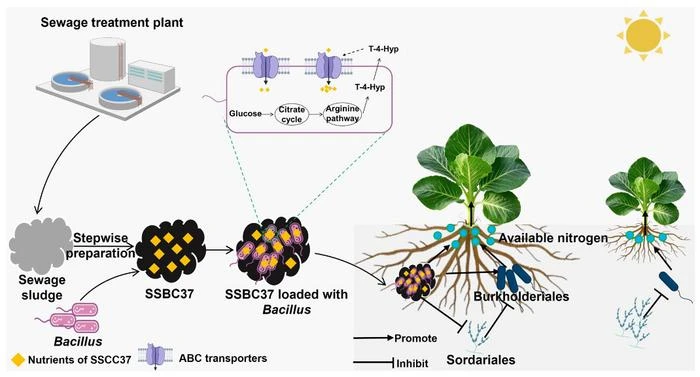
Sewage sludge is a problem most cities would prefer to forget. Wastewater treatment plants produce millions of tons of it annually, and disposal options range from landfilling to incineration — none of them cheap, none of them elegant. But a team of researchers decided to ask a different question: could this waste become the foundation for a biological fertilizer that actually outperforms its components?
The answer, based on their experiments with cabbage crops, appears to be yes — with an important caveat about how the material is prepared.
The problem with raw sewage sludge biochar
Biochar — the carbon-rich residue produced by heating organic material in low-oxygen conditions — has been applied to soils for years. It can improve water retention, sequester carbon, and provide a scaffold for microbial life. When made from sewage sludge, it also recycles nutrients that would otherwise be lost to disposal.
But raw sewage sludge biochar has limitations as a microbial carrier. Its surface chemistry and pore structure are often hostile to the very organisms it is meant to support. Beneficial bacteria loaded onto unmodified biochar tend to die off or fail to colonize plant roots effectively. The material had potential but lacked the engineering to realize it.
A three-step redesign called SSBC37
The research team developed a novel material they designated SSBC37 using a stepwise process that fundamentally altered the biochar's properties. First, they produced a low-temperature biochar from sewage sludge and extracted its nutrient-rich dissolved compounds. Then they reprocessed the remaining solid at a higher temperature, creating a more stable, porous structure. Finally, they reintroduced the extracted nutrients onto this improved scaffold.
The result was a material that combined structural integrity with biochemical richness — a habitat designed to keep microbes alive, fed, and functional in real soil conditions.
The team then loaded this engineered biochar with Bacillus velezensis, a bacterium well-documented for promoting plant growth. B. velezensis produces plant hormones, solubilizes phosphorus, and helps plants access nitrogen — but like most beneficial microbes, it needs a foothold in the soil to do its work.
Nearly 40% more biomass in cabbage trials
When the loaded biochar was applied to cabbage plants, the results were striking. Aboveground dry biomass increased by up to nearly 40% compared to untreated controls. The combined treatment also outperformed biochar alone and bacteria alone, confirming that the interaction between the two was synergistic, not merely additive.
The mechanism centered on nitrogen. The biochar-bacteria combination increased soil ammonium nitrogen — the form most readily taken up by plant roots — and boosted the activity of soil enzymes involved in nitrogen cycling. The plants responded with greater nitrogen uptake and visibly improved growth.
Reshaping the underground community
Below the soil surface, the treatment reshaped the microbial landscape of the rhizosphere — the narrow zone around plant roots where most nutrient exchange occurs. The introduced B. velezensis did not simply persist alongside native organisms. It actively altered community composition.
Certain fungal groups were suppressed. Beneficial bacterial populations expanded. The net effect was a rhizosphere more favorable to plant nutrition. Specific compounds in the engineered biochar — nutrients reintroduced during the third step of the manufacturing process — stimulated the bacterium's metabolism, enabling it to grow more efficiently and colonize roots more aggressively than it would in unmodified soil.
This is an important nuance. Many biofertilizer studies demonstrate that an organism can help plants in a petri dish. Showing that it can establish itself, compete with native soil organisms, and deliver measurable benefits in a pot trial with real soil is a higher bar. The engineered biochar appears to have given B. velezensis the advantage it needed to clear that bar.
Sewage sludge as agricultural input
The waste-to-resource angle is significant. Global sewage sludge production is rising as more communities build wastewater treatment capacity. Landfilling is expensive and emits methane. Incineration destroys nutrients and produces ash that still needs disposal. Converting sludge into an engineered biochar that improves crop yields offers a more circular pathway — though one that requires quality control to manage contaminants like heavy metals that can concentrate in biochar.
The study did not focus on contaminant risk, which is a gap worth noting. Sewage sludge composition varies widely by source, and the safety of long-term soil application depends on feedstock quality and pyrolysis conditions. Regulatory frameworks for sludge-derived biochar remain inconsistent across countries.
Pot trials, not field proof
This was a controlled experiment with cabbage plants grown in pots. The conditions were optimized, the soil was standardized, and the results — while clear — come with the usual asterisk that attaches to greenhouse work. Field performance could differ. Soil variability, weather, competing organisms, and application logistics all introduce complexity that pot trials cannot replicate.
The 40% biomass increase is also specific to a single crop species under specific conditions. Whether the same material and bacterium combination works for other crops, other soil types, or other climates is an open question. And scale-up of the three-step manufacturing process has not been demonstrated.
But the mechanistic story is coherent. The engineered biochar provides habitat and nutrition for the introduced bacterium. The bacterium reshapes the soil microbiome to favor nitrogen availability. The plant grows better. Each step is supported by data, and the synergy between biochar and microbe is real, not assumed.
For a field that has long struggled with inconsistency — biochar works spectacularly in one study and not at all in the next — the emphasis on material engineering and microbe-material interaction is a step toward more predictable, more reliable results.