Crushed pork bones cut cadmium in rice by 68% and nearly doubled yields
Published in Biochar, Shenyang Agricultural University
Half the world eats rice. And in parts of China, Southeast Asia, and sub-Saharan Africa, the paddies that produce it sit in soil laced with cadmium -- a heavy metal that rice plants absorb with troubling efficiency. Even when soil concentrations look modest on paper, the grain that reaches a kitchen can carry cadmium levels that exceed food safety thresholds. The health consequences accumulate quietly: kidney damage, weakened bones, elevated cancer risk. For decades, the challenge has been finding a soil treatment that locks cadmium in place without strangling the crop.
A team of researchers in China may have found one in an unlikely material: the leftover bones from pork processing plants.
From slaughterhouse waste to nano-engineered soil additive
The idea of using bone char -- charred animal bone -- as a soil amendment is not new. Bone is rich in calcium and phosphorus, two elements plants need. But conventional bone char particles are relatively large and offer limited surface area for chemical reactions. The research team, led by scientists publishing in the journal Biochar, took a different approach. They heated waste pork bones under controlled pyrolysis conditions, then milled the resulting char into micro- and nanoscale particles, some measuring just a few hundred nanometers across.
The milling transformed the material. Crushing bone char to that scale dramatically increased its reactive surface area and exposed more of the functional chemical groups -- hydroxyl, phosphate, carbonate -- that can grab and hold cadmium ions. The result was a fine powder engineered to do two things at once: immobilize a toxic metal and feed a rice plant.
A 140-day trial with striking numbers
The team grew rice through its full life cycle -- 140 days, seed to harvest -- in cadmium-contaminated greenhouse soil. They tested multiple application rates of the micro-nano bone char against untreated controls.
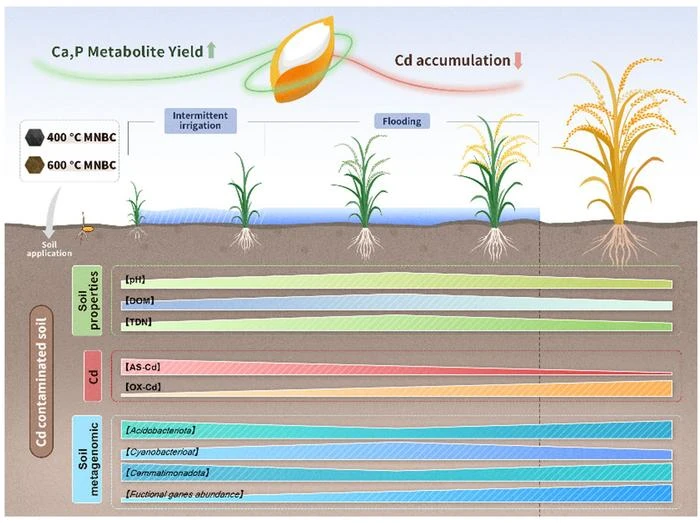
The results were hard to dismiss. Under the best-performing treatment, rice yield climbed by nearly 50%. Productive tillers -- the stems that actually bear grain -- increased by more than 20%. But the headline finding concerned cadmium itself: concentrations in polished rice grains dropped by up to 68% compared to untreated soil. That reduction brought cadmium levels substantially closer to international food safety limits.
These are not modest gains. A 50% yield bump in contaminated soil, paired with a two-thirds cut in grain contamination, would change the economics of farming on marginal land.
Multiple mechanisms working in concert
The bone char did not work through a single pathway. In the soil, it directly bound cadmium through surface adsorption and chemical precipitation, reducing the fraction of cadmium available for root uptake -- what soil chemists call bioavailability. Simultaneously, the calcium and phosphate released from the bone char raised soil pH, shifting conditions further against cadmium mobility. In acidic soils, cadmium moves freely; push the pH up, and it locks into less soluble mineral phases.
The phosphorus release also directly benefited the plants, supplying a critical macronutrient that is often limiting in degraded or contaminated soils.
But the researchers found something more subtle happening underground. Using metagenomic sequencing -- a technique that captures the collective DNA of all microorganisms in a soil sample -- they mapped shifts in the microbial community around rice roots. The bone char promoted the growth of bacteria involved in carbon cycling, nitrogen transformation, and phosphorus solubilization. Genes associated with phosphorus availability were significantly more abundant in treated soils. In short, the amendment was not just a chemical fix. It was reshaping the living ecosystem in the root zone to favor plant nutrition.
Changes inside the grain itself
The team also analyzed the metabolic profile of harvested rice grains using metabolomics techniques. They found that the bone char treatment slowed the breakdown of key carbohydrates and amino acids within the grain. While the full nutritional implications require more study, the finding hints that the amendment may preserve grain quality -- not just quantity.
That distinction matters. A soil treatment that boosts yield but degrades nutritional content would be a pyrrhic victory. The metabolomic data, while preliminary, suggest this is not the case here.
What the approach still needs to prove
There are honest gaps between a greenhouse pot trial and broad agricultural deployment. The 140-day experiment used controlled conditions -- consistent temperature, managed irrigation, a single soil type. Field soils vary enormously in texture, organic matter content, background chemistry, and microbial populations. Whether the bone char performs as well in a flooded paddy in Hunan province or a rain-fed field in Bangladesh remains an open question.
The study also did not track cadmium fate over multiple growing seasons. Soil amendments can lose effectiveness as their reactive surfaces become saturated or as chemical conditions shift. Long-term field trials, spanning at least several crop cycles, would be needed before anyone could recommend this as a standard practice.
The milling process itself adds cost and energy input. A preliminary cost-benefit analysis included in the study suggests economic viability -- the increased yield and reduced grain losses from contamination appear to outweigh production costs -- but that analysis has not been tested against real market conditions or farmer economics in low-income settings where cadmium contamination is most acute.
Circular logic that actually works
Still, the raw material itself is cheap and abundant. The global meat processing industry generates millions of tons of bone waste annually, most of which goes to low-value uses like animal feed supplements or landfill. Converting that waste stream into a high-performance soil amendment fits the definition of circular economy: turning a disposal problem into a functional product.
The research team, led by Liang, Hao, Cai, and colleagues, positions micro-nano bone char as a tool that simultaneously addresses food safety, soil health, and agricultural waste -- three problems that are usually treated in isolation. Whether that integration holds up beyond the greenhouse remains the critical next step. But the numbers from this first full trial are strong enough to warrant serious field-scale testing.