Maintaining high piezoelectric performance at porosity of 92%: Three-dimensionally interconnected porous ceramics enables highly sensitive piezoelectric response
Published 2026-03-24 · Original archive entry · Explore research explainers
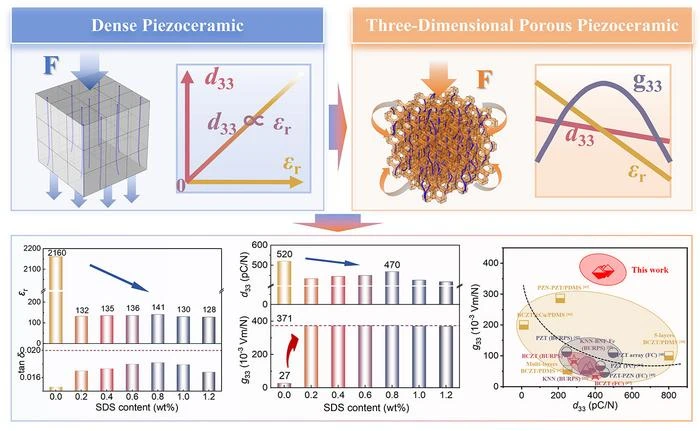
With the rapid development of the Internet of Things (IoT) and intelligent sensing technologies, high-sensitivity sensing materials have become critical for next-generation electronic systems. However, conventional piezoelectric ceramics face a long-standing challenge: the strong intrinsic coupling between the piezoelectric charge coefficient (d₃₃) and the dielectric constant (εᵣ). Although various strategies can enhance d₃₃, they are typically accompanied by a simultaneous increase in εᵣ, thereby limiting improvements in the piezoelectric voltage coefficient (g₃₃) and overall sensing sensitivity. This fundamental trade-off has significantly constrained the application of piezoelectric materials in weak-signal detection, wearable electronics, and self-powered systems.
To address this issue, a research team from Northwestern Polytechnical University and collaborators has proposed a novel structural design strategy: three-dimensionally interconnected porous piezoceramics (3D-PPCs). Using an innovative foam-gelcasting approach, the team successfully fabricated PZT-PZN-PNN-based porous ceramics with fully open-cell, three-dimensional interconnected architectures.
The key to this method lies in the precise control of slurry rheology and foam stability. By introducing surfactants to modify particle wettability, ceramic particles self-assemble at the gas–liquid interface to form stable foams. Meanwhile, a temperature-responsive gelatin network is employed to solidify the structure, enabling the retention of complex three-dimensional architectures. During sintering, this framework evolves into a highly interconnected ceramic skeleton, while suppressing abnormal grain growth and promoting the formation of multiscale domain structures.
“We are not simply reducing the dielectric constant by introducing porosity,” said the project leader. “Instead, we use the three-dimensional interconnected architecture to actively regulate local stress and electric field distributions, fundamentally altering the electromechanical coupling mechanism. This provides a new pathway to break the conventional performance trade-off.”
The team published their work in Journal of Advanced Ceramics on March 11, 2026.
Experimental results demonstrate that the material maintains a high d₃₃ of approximately 470 pC/N even at an ultrahigh porosity of 92%, which is about 90% of that of dense ceramics. At the same time, the dielectric constant is significantly reduced to ~140 (a decrease of ~94%), resulting in an approximately 14-fold enhancement in g₃₃. Multiscale characterization and finite element simulations reveal that this performance originates from synergistic effects: stress concentration within the interconnected skeleton enhances load transfer, electric field distortion at air–ceramic interfaces promote polarization, and multiscale domain structures combined with reduced oxygen vacancy concentration improve domain wall mobility.
In terms of performance validation, the material exhibits outstanding sensing capability. Under low-frequency, weak mechanical excitation, it generates output voltages up to 200 V—an order-of-magnitude improvement over dense ceramics—and achieves a sensitivity of 38.7 V/kPa, about 18 times higher than the reference sample. Moreover, stable output is maintained over 5000 loading cycles, demonstrating good preliminary reliability.
Importantly, comparative analysis with other porous architectures (e.g., 3–0, 2–2, and 3–1 types) shows that the three-dimensional interconnected structure achieves a superior balance between stress transfer and polarization efficiency, overcoming performance degradation caused by phase discontinuity or mechanical clamping in conventional systems.
From an application perspective, this novel porous piezoceramic shows great promise in health monitoring, environmental sensing, precision positioning, and self-powered microelectromechanical systems (MEMS). Its high sensitivity and high output make it particularly suitable for detecting weak signals, such as human pulse monitoring or micro-vibration sensing in structures.
Overall, this work not only introduces a scalable strategy for designing three-dimensional porous architectures but also reveals the active role of structural engineering in tuning piezoelectric performance. It provides important insights for the development of next-generation high-performance piezoelectric sensing materials.
END
To address this issue, a research team from Northwestern Polytechnical University and collaborators has proposed a novel structural design strategy: three-dimensionally interconnected porous piezoceramics (3D-PPCs). Using an innovative foam-gelcasting approach, the team successfully fabricated PZT-PZN-PNN-based porous ceramics with fully open-cell, three-dimensional interconnected architectures.
The key to this method lies in the precise control of slurry rheology and foam stability. By introducing surfactants to modify particle wettability, ceramic particles self-assemble at the gas–liquid interface to form stable foams. Meanwhile, a temperature-responsive gelatin network is employed to solidify the structure, enabling the retention of complex three-dimensional architectures. During sintering, this framework evolves into a highly interconnected ceramic skeleton, while suppressing abnormal grain growth and promoting the formation of multiscale domain structures.
“We are not simply reducing the dielectric constant by introducing porosity,” said the project leader. “Instead, we use the three-dimensional interconnected architecture to actively regulate local stress and electric field distributions, fundamentally altering the electromechanical coupling mechanism. This provides a new pathway to break the conventional performance trade-off.”
The team published their work in Journal of Advanced Ceramics on March 11, 2026.
Experimental results demonstrate that the material maintains a high d₃₃ of approximately 470 pC/N even at an ultrahigh porosity of 92%, which is about 90% of that of dense ceramics. At the same time, the dielectric constant is significantly reduced to ~140 (a decrease of ~94%), resulting in an approximately 14-fold enhancement in g₃₃. Multiscale characterization and finite element simulations reveal that this performance originates from synergistic effects: stress concentration within the interconnected skeleton enhances load transfer, electric field distortion at air–ceramic interfaces promote polarization, and multiscale domain structures combined with reduced oxygen vacancy concentration improve domain wall mobility.
In terms of performance validation, the material exhibits outstanding sensing capability. Under low-frequency, weak mechanical excitation, it generates output voltages up to 200 V—an order-of-magnitude improvement over dense ceramics—and achieves a sensitivity of 38.7 V/kPa, about 18 times higher than the reference sample. Moreover, stable output is maintained over 5000 loading cycles, demonstrating good preliminary reliability.
Importantly, comparative analysis with other porous architectures (e.g., 3–0, 2–2, and 3–1 types) shows that the three-dimensional interconnected structure achieves a superior balance between stress transfer and polarization efficiency, overcoming performance degradation caused by phase discontinuity or mechanical clamping in conventional systems.
From an application perspective, this novel porous piezoceramic shows great promise in health monitoring, environmental sensing, precision positioning, and self-powered microelectromechanical systems (MEMS). Its high sensitivity and high output make it particularly suitable for detecting weak signals, such as human pulse monitoring or micro-vibration sensing in structures.
Overall, this work not only introduces a scalable strategy for designing three-dimensional porous architectures but also reveals the active role of structural engineering in tuning piezoelectric performance. It provides important insights for the development of next-generation high-performance piezoelectric sensing materials.
END