A much more sensitive fentanyl detection strip, thanks to physics
Researchers created a method for predicting the sensitivity of lateral flow assay test strips, allowing for a hundredfold improvement.
Published 2026-03-24 · Original archive entry · Explore research explainers
WASHINGTON, March 24, 2026 — Following the beginning of the COVID-19 outbreak, lateral flow assays (LFAs) — the category of test strips in which the presence or lack of a pink line indicates whether a specific molecule, like a drug or a virus, has been detected — became household items. Yet despite their ubiquity and decades of development, there has not been a quantitative, physics-grounded method for explaining the sensitivity and limits of LFAs to help guide their design.
In Biophysics Reviews, by AIP Publishing, researchers from the University of California, San Diego developed a physics-based model for explaining performance gaps and providing actionable guidance for a category of LFAs called competitive LFAs (cLFAs). They applied their guidance to improve commercially available fentanyl test strips.
“This limitation became especially apparent during the COVID-19 pandemic,” said author Yuhwa Lo. “Antigen LFAs were used at an unprecedented scale, but there was still no clear, quantitative way to explain the sensitivity ceiling or to answer practical questions, such as whether — and under what conditions — LFAs could realistically approach the sensitivity of laboratory nucleic acid tests.”
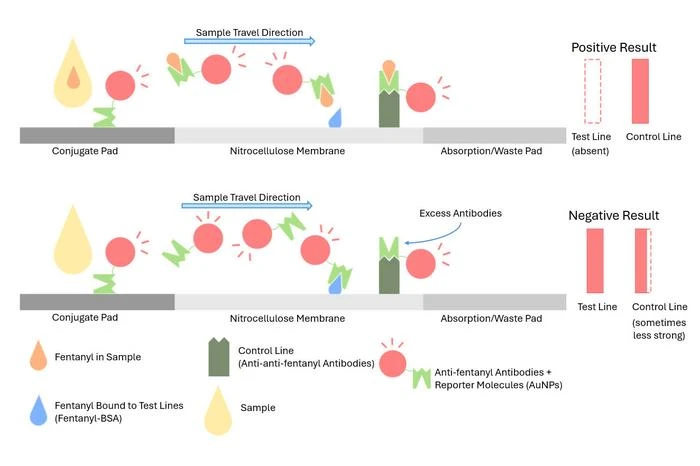
In cLFAs, the lack of a test line is associated with a positive test. Antibodies of the test molecule attached to gold nanoparticles wait for the test to arrive. If the antibodies do not find target molecules to bind to, they bind with molecules at the test line instead, and the gold nanoparticles produce a visible signal, which indicates a negative result. However, if the tested sample contains the target molecule, these target molecules bind with the antibody, preventing the gold nanoparticles from producing a visible pattern at the test line.
The concentration of target molecules, antibodies, and gold nanoparticles, and the particles’ willingness to bind, all affect a cLFA’s limit of detection. The researchers came up with a mathematical relationship between these factors that works for all cLFAs.
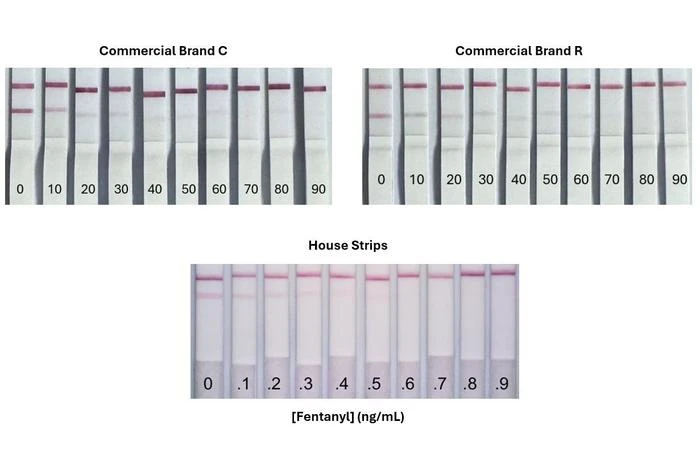
By optimizing this relationship, the group developed cFLA fentanyl test strips that are about 100 times more sensitive than their commercial counterparts.
“This kind of universality is powerful,” Lo said. “A single, unified framework can provide clear, actionable guidance for sensitivity optimization across many cLFAs, helping accelerate development and improve performance throughout the field.”
Competitive LFAs represent only a fraction of LFAs. Sandwiched LFAs target larger molecules and are read in the opposite way — that is, a visible line indicates a positive test. The researchers hope to extend their methods to sandwiched LFAs, which include pregnancy and COVID-19 tests.
“This could strengthen the reliability of existing point-of-care tests and expand what can be detected outside centralized laboratories, potentially enabling rapid screening for clinically important targets that currently rely on lab-based methods, including certain sexually transmitted infections and other low-abundance disease biomarkers,” Lo said.
###
The article “Analytical physics framework for competitive binding and transport in lateral flow assays: Application to fentanyl detection” is authored by Chuan Hsin Lin, Edward Wang, George Luka, and Yu-Hwa Lo. It will appear in Biophysics Reviews on March 24, 2026 (DOI: 10.1063/5.0313042). After that date, it can be accessed at https://doi.org/10.1063/5.0313042.
ABOUT THE JOURNAL
Biophysics Reviews publishes research studies and comprehensive review articles of new and emerging areas of interest to the biophysics community. The journal’s focus includes experimental and theoretical research of fundamental issues in biophysics in addition to the application of biophysics in other branches of science, medicine, and engineering. See https://pubs.aip.org/aip/bpr.
###
END
In Biophysics Reviews, by AIP Publishing, researchers from the University of California, San Diego developed a physics-based model for explaining performance gaps and providing actionable guidance for a category of LFAs called competitive LFAs (cLFAs). They applied their guidance to improve commercially available fentanyl test strips.
“This limitation became especially apparent during the COVID-19 pandemic,” said author Yuhwa Lo. “Antigen LFAs were used at an unprecedented scale, but there was still no clear, quantitative way to explain the sensitivity ceiling or to answer practical questions, such as whether — and under what conditions — LFAs could realistically approach the sensitivity of laboratory nucleic acid tests.”
In cLFAs, the lack of a test line is associated with a positive test. Antibodies of the test molecule attached to gold nanoparticles wait for the test to arrive. If the antibodies do not find target molecules to bind to, they bind with molecules at the test line instead, and the gold nanoparticles produce a visible signal, which indicates a negative result. However, if the tested sample contains the target molecule, these target molecules bind with the antibody, preventing the gold nanoparticles from producing a visible pattern at the test line.
The concentration of target molecules, antibodies, and gold nanoparticles, and the particles’ willingness to bind, all affect a cLFA’s limit of detection. The researchers came up with a mathematical relationship between these factors that works for all cLFAs.
By optimizing this relationship, the group developed cFLA fentanyl test strips that are about 100 times more sensitive than their commercial counterparts.
“This kind of universality is powerful,” Lo said. “A single, unified framework can provide clear, actionable guidance for sensitivity optimization across many cLFAs, helping accelerate development and improve performance throughout the field.”
Competitive LFAs represent only a fraction of LFAs. Sandwiched LFAs target larger molecules and are read in the opposite way — that is, a visible line indicates a positive test. The researchers hope to extend their methods to sandwiched LFAs, which include pregnancy and COVID-19 tests.
“This could strengthen the reliability of existing point-of-care tests and expand what can be detected outside centralized laboratories, potentially enabling rapid screening for clinically important targets that currently rely on lab-based methods, including certain sexually transmitted infections and other low-abundance disease biomarkers,” Lo said.
###
The article “Analytical physics framework for competitive binding and transport in lateral flow assays: Application to fentanyl detection” is authored by Chuan Hsin Lin, Edward Wang, George Luka, and Yu-Hwa Lo. It will appear in Biophysics Reviews on March 24, 2026 (DOI: 10.1063/5.0313042). After that date, it can be accessed at https://doi.org/10.1063/5.0313042.
ABOUT THE JOURNAL
Biophysics Reviews publishes research studies and comprehensive review articles of new and emerging areas of interest to the biophysics community. The journal’s focus includes experimental and theoretical research of fundamental issues in biophysics in addition to the application of biophysics in other branches of science, medicine, and engineering. See https://pubs.aip.org/aip/bpr.
###
END
Attachments