Biochar-based nanotechnology cleans toxic herbicide from soil while protecting crops
Published 2026-03-24 · Original archive entry · Explore research explainers
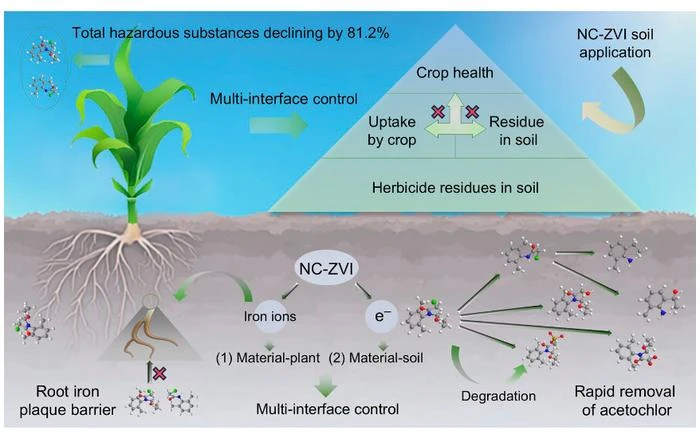
A new study has developed an innovative biochar-based nanomaterial that can rapidly remove harmful herbicides from soil while simultaneously protecting crops from contamination. The research offers a promising solution to one of agriculture’s most persistent challenges: balancing soil remediation with food safety.
“Traditional methods often focus only on removing pollutants from soil, but they overlook how these chemicals and their byproducts still enter crops,” said the study’s corresponding author. “Our approach addresses both problems at once, ensuring cleaner soil and safer food.”
Herbicides such as acetochlor are widely used worldwide but pose serious environmental and health risks. Classified as a possible carcinogen, acetochlor can persist in soil and be absorbed by crops, reducing yields and threatening food safety. Even more concerning, its breakdown products can be more mobile and easily taken up by plants.
To tackle this issue, researchers designed a nitrogen-doped biochar-modified zero-valent iron nanocomposite, known as NC-ZVI. This material combines biochar with iron nanoparticles to create a highly reactive system capable of interacting with soil, pollutants, and plant roots simultaneously.
In laboratory and greenhouse experiments, NC-ZVI removed about 90 percent of acetochlor from soil within just seven days, and up to 96.7 percent after three weeks. This performance significantly outpaced conventional materials, which showed much lower degradation efficiency.
But the innovation goes beyond pollutant removal. The material also triggered the formation of a natural protective layer on plant roots known as iron plaque. This layer acts as a barrier that captures contaminants before they can enter the plant.
As a result, the total amount of acetochlor and its byproducts inside maize plants was reduced by more than 80 percent. At the same time, crop health improved dramatically. Maize biomass increased by over 200 percent compared with plants grown in contaminated soil without treatment.
“This dual function is the key breakthrough,” the authors explained. “We are not only cleaning the soil but also actively preventing pollutants from entering the food chain.”
The study further revealed how the material works at a microscopic level. The engineered biochar and nitrogen doping enhance electron transfer and catalytic activity, allowing the material to break down herbicides more efficiently. Meanwhile, its unique surface properties help pull pollutants out of soil particles, making them easier to degrade.
Importantly, the technology also supports soil health. The researchers found that microbial communities disrupted by herbicide contamination were partially restored after treatment. This suggests the material can help rebuild ecological balance rather than harm it.
Cost and scalability are also promising. The production cost of NC-ZVI is estimated to be less than one tenth that of conventional nano iron materials, making it a practical option for large-scale agricultural use.
The researchers emphasize that this approach represents a new direction in environmental remediation. Instead of treating soil and crops as separate systems, it integrates both into a single solution.
“This work provides a new strategy for sustainable agriculture,” the authors noted. “By combining material innovation with plant-soil interactions, we can improve environmental quality and ensure food safety at the same time.”
While further field studies are needed to evaluate long-term impacts, the findings highlight the potential of biochar-based nanotechnology to transform how contaminated soils are managed worldwide.
===
Journal Reference: Zhang, X., Zhang, P., Jiao, L. et al. Novel multi-interface regulation of acetochlor fate in a soil-plant system using N-doped biochar-modified zero-valent iron nanocomposites for enhanced degradation and protective root iron plaque formation. Biochar 8, 48 (2026).
https://doi.org/10.1007/s42773-025-00567-8
===
About Biochar
Biochar (e-ISSN: 2524-7867) is the first journal dedicated exclusively to biochar research, spanning agronomy, environmental science, and materials science. It publishes original studies on biochar production, processing, and applications—such as bioenergy, environmental remediation, soil enhancement, climate mitigation, water treatment, and sustainability analysis. The journal serves as an innovative and professional platform for global researchers to share advances in this rapidly expanding field.
Follow us on Facebook, X, and Bluesky.
END
“Traditional methods often focus only on removing pollutants from soil, but they overlook how these chemicals and their byproducts still enter crops,” said the study’s corresponding author. “Our approach addresses both problems at once, ensuring cleaner soil and safer food.”
Herbicides such as acetochlor are widely used worldwide but pose serious environmental and health risks. Classified as a possible carcinogen, acetochlor can persist in soil and be absorbed by crops, reducing yields and threatening food safety. Even more concerning, its breakdown products can be more mobile and easily taken up by plants.
To tackle this issue, researchers designed a nitrogen-doped biochar-modified zero-valent iron nanocomposite, known as NC-ZVI. This material combines biochar with iron nanoparticles to create a highly reactive system capable of interacting with soil, pollutants, and plant roots simultaneously.
In laboratory and greenhouse experiments, NC-ZVI removed about 90 percent of acetochlor from soil within just seven days, and up to 96.7 percent after three weeks. This performance significantly outpaced conventional materials, which showed much lower degradation efficiency.
But the innovation goes beyond pollutant removal. The material also triggered the formation of a natural protective layer on plant roots known as iron plaque. This layer acts as a barrier that captures contaminants before they can enter the plant.
As a result, the total amount of acetochlor and its byproducts inside maize plants was reduced by more than 80 percent. At the same time, crop health improved dramatically. Maize biomass increased by over 200 percent compared with plants grown in contaminated soil without treatment.
“This dual function is the key breakthrough,” the authors explained. “We are not only cleaning the soil but also actively preventing pollutants from entering the food chain.”
The study further revealed how the material works at a microscopic level. The engineered biochar and nitrogen doping enhance electron transfer and catalytic activity, allowing the material to break down herbicides more efficiently. Meanwhile, its unique surface properties help pull pollutants out of soil particles, making them easier to degrade.
Importantly, the technology also supports soil health. The researchers found that microbial communities disrupted by herbicide contamination were partially restored after treatment. This suggests the material can help rebuild ecological balance rather than harm it.
Cost and scalability are also promising. The production cost of NC-ZVI is estimated to be less than one tenth that of conventional nano iron materials, making it a practical option for large-scale agricultural use.
The researchers emphasize that this approach represents a new direction in environmental remediation. Instead of treating soil and crops as separate systems, it integrates both into a single solution.
“This work provides a new strategy for sustainable agriculture,” the authors noted. “By combining material innovation with plant-soil interactions, we can improve environmental quality and ensure food safety at the same time.”
While further field studies are needed to evaluate long-term impacts, the findings highlight the potential of biochar-based nanotechnology to transform how contaminated soils are managed worldwide.
===
Journal Reference: Zhang, X., Zhang, P., Jiao, L. et al. Novel multi-interface regulation of acetochlor fate in a soil-plant system using N-doped biochar-modified zero-valent iron nanocomposites for enhanced degradation and protective root iron plaque formation. Biochar 8, 48 (2026).
https://doi.org/10.1007/s42773-025-00567-8
===
About Biochar
Biochar (e-ISSN: 2524-7867) is the first journal dedicated exclusively to biochar research, spanning agronomy, environmental science, and materials science. It publishes original studies on biochar production, processing, and applications—such as bioenergy, environmental remediation, soil enhancement, climate mitigation, water treatment, and sustainability analysis. The journal serves as an innovative and professional platform for global researchers to share advances in this rapidly expanding field.
Follow us on Facebook, X, and Bluesky.
END