Dual solidification mechanisms of liquid ternary Fe-Cu-Sn alloy
Published 2012-03-12 · Original archive entry · Explore research explainers
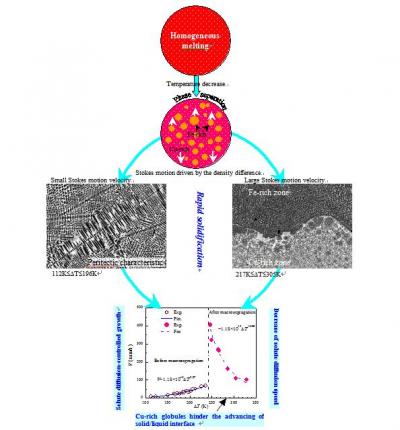
Peritectic solidification involves the nucleation and growth of the primary phase, the peritectic reaction of the primary phase with the remnant liquid phase, and the microstructural evolution of the product peritectic phase. It provides an effective approach for the synthesis or processing of various kinds of advanced materials. Professor WEI Bingbo and his group from the Department of Applied Physics, Northwestern Polytechnical University (NPU), in Xi'an, China, have demonstrated novel dual solidification mechanisms for a ternary Fe47.5Cu47.5Sn5 peritectic-type alloy. Their work, entitled "Dual Solidification Mechanisms of Liquid Ternary Fe-Cu-Sn Alloy", was published in SCIENCE CHINA Physics, Mechanics & Astronomy. 2012; 55 (3): 450-459.
A ternary Fe47.5Cu47.5Sn5 alloy was rapidly solidified under bulk undercooling conditions. Two distinct solidification mechanisms for a ternary Fe47.5Cu47.5Sn5 alloy were noted under these conditions: peritectic solidification at moderate undercoolings below 196K, and macroscopic phase separation at greater undercoolings, which is shown in Fig.1. The alloy's microstructures consisted of an aFe solid solution, a (Cu) solid solution, and a b-Cu5.6Sn intermetallic compound. At small undercoolings such as DT=112K, a homogeneous macrostructure and only about 0.1% volume of a Cu-rich zone at the sample bottom were formed. As the bulk undercooling increased to 196K, liquid phase separation proceeded to a larger extent; this resulted in the Cu-rich zone taking up about 7% of sample volume.
Macrosegregation took place when undercooling exceeded 196K. In this case, the homogeneous alloy was separated into an Fe-rich zone floating up to the sample top and a Cu-rich zone descending down to the sample bottom. The Cu-rich zone maintained a slightly decreasing volume fraction of (from 53% down to -47%) in the still greater undercooling range of 246�K. The progression of macrosegregation was found to depend also on the time interval allowed for phase separation. When the phase separation time Dtps
A ternary Fe47.5Cu47.5Sn5 alloy was rapidly solidified under bulk undercooling conditions. Two distinct solidification mechanisms for a ternary Fe47.5Cu47.5Sn5 alloy were noted under these conditions: peritectic solidification at moderate undercoolings below 196K, and macroscopic phase separation at greater undercoolings, which is shown in Fig.1. The alloy's microstructures consisted of an aFe solid solution, a (Cu) solid solution, and a b-Cu5.6Sn intermetallic compound. At small undercoolings such as DT=112K, a homogeneous macrostructure and only about 0.1% volume of a Cu-rich zone at the sample bottom were formed. As the bulk undercooling increased to 196K, liquid phase separation proceeded to a larger extent; this resulted in the Cu-rich zone taking up about 7% of sample volume.
Macrosegregation took place when undercooling exceeded 196K. In this case, the homogeneous alloy was separated into an Fe-rich zone floating up to the sample top and a Cu-rich zone descending down to the sample bottom. The Cu-rich zone maintained a slightly decreasing volume fraction of (from 53% down to -47%) in the still greater undercooling range of 246�K. The progression of macrosegregation was found to depend also on the time interval allowed for phase separation. When the phase separation time Dtps