THE ORIGINAL COLLECTION · SINCE 2010

Space
press releases.

Research announcements from universities, hospitals and scientific institutions. Explore the stories, people and discoveries behind the headlines.

Original publication datesPage 37
FIND A STORY

Find a past release.

Dates and source material belong to the original release.

Read our research explainers

Browse the collection · original publication order

Heterogeneity of Earth’s mantle may be relics of Moon formation
Space

Heterogeneity of Earth’s mantle may be relics of Moon formation

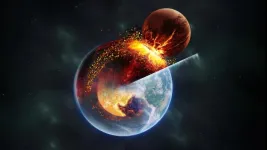
An interdisciplinary international research team has recently discovered that a massive anomaly deep within the Earth’s interior may be a remnant of the collision about 4.5 billion years ago that formed the Moon. This research offers important new insights not only into Earth’s internal structure but also its long-term evolution and the formation of the inner solar system. The study, which relied on computational fluid dynamics methods pioneered by Prof. DENG Hongping of the Shanghai Astronomical Observatory (SHAO) of ...

Read the release
Dr. Jennifer Lotz appointed Space Telescope Science Institute Director
Space

Dr. Jennifer Lotz appointed Space Telescope Science Institute Director

The Association of Universities for Research in Astronomy (AURA) is pleased to announce the appointment of Dr. Jennifer Lotz as the Director of the Space Telescope Science Institute (STScI). Dr. Lotz will begin her five-year appointment as STScI Director starting February 12, 2024. Previously, Dr. Lotz was the Director of the International Gemini Observatory which is operated by NSF’s NOIRLab, and managed by AURA. “Dr. Lotz is a science driven, accomplished leader,” said Dr. Matt Mountain, President of AURA, which manages STScI on behalf of NASA. “Jen’s passion for the Institute’s mission, to enable the ...

Read the release
Giant planets cast a deadly pall
Space

Giant planets cast a deadly pall

Giant gas planets can be agents of chaos, ensuring nothing lives on their Earth-like neighbors around other stars. New studies show, in some planetary systems, the giants tend to kick smaller planets out of orbit and wreak havoc on their climates. Jupiter, by far the biggest planet in our solar system, plays an important protective role. Its enormous gravitational field deflects comets and asteroids that might otherwise hit Earth, helping create a stable environment for life. However, giant planets elsewhere in the universe do not necessarily protect life on their smaller, rocky planet neighbors. A new Astronomical Journal paper details how the pull of massive ...

Read the release
The Crab Nebula seen in new light by NASA's Webb
Space

The Crab Nebula seen in new light by NASA's Webb

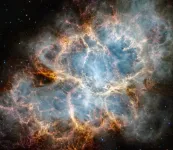
NASA’s James Webb Space Telescope has gazed at the Crab Nebula, a supernova remnant located 6,500 light-years away in the constellation Taurus. Since the recording of this energetic event in 1054 CE by 11th-century astronomers, the Crab Nebula has continued to draw attention and additional study as scientists seek to understand the conditions, behavior, and after-effects of supernovae through thorough study of the Crab, a relatively nearby example. Using Webb’s NIRCam (Near-Infrared Camera) and MIRI (Mid-Infrared Instrument), a team led by Tea Temim at Princeton University is searching for answers about the Crab Nebula’s ...

Read the release
The importance of the Earth’s atmosphere in creating the large storms that affect satellite communications
Space

The importance of the Earth’s atmosphere in creating the large storms that affect satellite communications

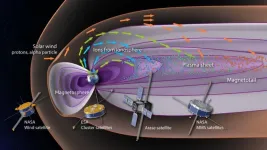
A study from an international team led by researchers from Nagoya University in Japan and the University of New Hampshire in the United States has revealed the importance of the Earth’s upper atmosphere in determining how large geomagnetic storms develop. Their findings reveal the previously underestimated importance of the Earth’s atmosphere. Understanding the factors that cause geomagnetic storms is important because they can have a direct impact on the Earth’s magnetic field such ...

Read the release
Cold War spy satellite imagery reveals Ancient Roman forts
Space

Cold War spy satellite imagery reveals Ancient Roman forts

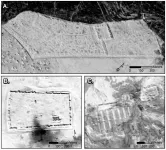
Two-thousand years ago, forts were constructed by the Roman Empire across the northern Fertile Crescent, spanning from what is now western Syria to northwestern Iraq. In the 1920s, 116 forts were documented in the region by Father Antoine Poidebard, who conducted one of the world's first aerial surveys using a WWI-era biplane. Poidebard reported that the forts were constructed from north to south to establish an eastern boundary of the Roman Empire. A new Dartmouth study analyzing declassified Cold War satellite ...

Read the release
Space

NASA rocket to see sizzling edge of star-forming supernova

A new sounding rocket mission is headed to space to understand how explosive stellar deaths lay the groundwork for new star systems. The Integral Field Ultraviolet Spectroscopic Experiment, or INFUSE, sounding rocket mission, will launch from the White Sands Missile Range in New Mexico on Oct. 29, 2023, at 9:35 p.m. MDT. For a few months each year, the constellation Cygnus (Latin for “swan”) swoops through the northern hemisphere’s night sky. Just above its wing is a favorite target ...

Read the release
Space

RIT’s Campanelli receives award for work in gravitational wave science

Rochester Institute of Technology distinguished professor and founding director of the Center for Computational Relativity and Gravitation Manuela Campanelli has been honored with the American Physical Society’s (APS) 2024 Richard A. Isaacson Award in Gravitational-Wave Science for her extraordinary contributions to and leadership in the understanding and simulation of merging binaries of compact objects in strong-field gravity. The annual honor is granted to esteemed scientists for their remarkable achievements in the fields of gravitational-wave physics, gravitational wave astrophysics, and associated ...

Read the release
SETI Institute artist-in-residence Daniela De Paulis to receive 2023 Europlanet Prize for Public Engagement
Space

SETI Institute artist-in-residence Daniela De Paulis to receive 2023 Europlanet Prize for Public Engagement

SETI Institute Artist-in-Residence Daniela De Paulis to Receive 2023 Europlanet Prize for Public Engagement Daniela de Paulis is honored for her work bringing space and planetary science to international audiences. October 26, 2023, Mountain View, CA -- The SETI Institute is thrilled to announce that Daniela De Paulis, a SETI Artist-in-Residence (SETI AIR), will be honored with the prestigious 2023 Europlanet Prize for Public Engagement. De Paulis’ groundbreaking project, ‘A Sign in Space,’ invited a global audience to participate in decoding a simulated message from an extraterrestrial ...

Read the release
Analysis finds diversity on the smallest scales in sulfur-cycling salt marsh microbes
Space

Analysis finds diversity on the smallest scales in sulfur-cycling salt marsh microbes

WOODS HOLE, Mass.— At the surface, salt marshes and their windswept grasses can look deceptively simple. But those marshes are teeming with biodiversity, from the insects and migrating birds in the air all the way down to the microbes that live in the soil. Scientists from the Marine Biological Laboratory (MBL) have discovered that even among the sulfur-cycling microbes that are responsible for the “rotten egg gas” smell in salt marsh air, diversity extends all the way to genomes and even to individual nucleotides. To ...

Read the release
NSF awards up to $21.4M for design of next-gen telescopes to capture earliest moments of universe
Space

NSF awards up to $21.4M for design of next-gen telescopes to capture earliest moments of universe

The National Science Foundation has awarded $3.7 million to the University of Chicago for the first year of a grant that may provide up to $21.4 million for the final designs for a next-generation set of telescopes to map the light from the earliest moments of the universe—the Cosmic Microwave Background. Led by the University of Chicago and Lawrence Berkeley National Laboratory, the collaboration seeks to build telescopes and infrastructure in both Antarctica and Chile to search for what are known as “primordial” gravitational waves—the vibrations from the Big Bang itself. It would also map the microwave light ...

Read the release
NASA's Webb makes first detection of heavy element from star merger
Space

NASA's Webb makes first detection of heavy element from star merger

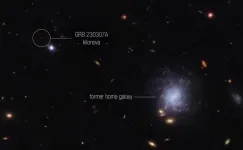
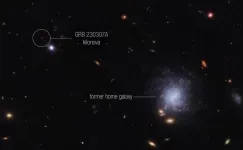
A team of scientists has used multiple space and ground-based telescopes, including NASA’s James Webb Space Telescope, NASA’s Fermi Gamma-ray Space Telescope, and NASA’s Neil Gehrels Swift Observatory, to observe an exceptionally bright gamma-ray burst, GRB 230307A, and identify the neutron star merger that generated an explosion that created the burst. Webb also helped scientists detect the chemical element tellurium in the explosion’s aftermath. Other elements near tellurium on the periodic table – like iodine, which is needed ...

Read the release
Massive space explosion observed creating elements needed for life
Space

Massive space explosion observed creating elements needed for life

Scientists have observed the creation of rare chemical elements in the second-brightest gamma-ray burst ever seen – casting new light on how heavy elements are made. Researchers examined the exceptionally bright gamma-ray burst GRB 230307A, which was caused by a neutron star merger. The explosion was observed using an array of ground and space-based telescopes, including NASA’s James Webb Space Telescope, Fermi Gamma-ray Space Telescope, and Neil Gehrels Swift Observatory. Publishing their findings today in Nature (25 Oct), ...

Read the release
Sediment core analysis supports new epoch characterized by human impact on planet
Space

Sediment core analysis supports new epoch characterized by human impact on planet

Scientists have long debated the Anthropocene Epoch, a proposed unit of geologic time corresponding to the most recent period in history. It’s characterized by substantial human impact on the planet. Are we living in the Anthropocene? And if we are, then when did it start? In a research article published this month in The Proceedings of the National Academy of Sciences, The University of Toledo’s Dr. Trisha Spanbauer and Stanford University’s Dr. M. Allison Stegner lend credence to the argument for its existence. The pair analyzed open-source data to track vegetation ...

Read the release
UC Davis, Mars researchers discover scalable production technique for low-calorie sugar substitute
Space

UC Davis, Mars researchers discover scalable production technique for low-calorie sugar substitute

Scientists at the University of California, Davis, in partnership with the Mars Advanced Research Institute, have announced a significant breakthrough in the production of low-calorie sugar substitutes, such as allulose. This discovery could help address one of the primary obstacles to the widespread adoption of these alternatives: production costs. Allulose, also known as D-psicose, is a naturally occurring rare sugar that provides a viable alternative to sucrose (table sugar). It has a similar taste, texture and functionality, making it an attractive option for those seeking to reduce their sugar intake. By activating a natural process in a microorganism, researchers have developed ...

Read the release
Diffraction-limited visible imaging for large aperture telescopes: development and application of piezoelectric deformable secondary mirror
Space

Diffraction-limited visible imaging for large aperture telescopes: development and application of piezoelectric deformable secondary mirror

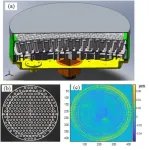
A new publication from Opto-Electronic Advances, 10.29026/oea.2023.230039 discusses diffraction-limited visible imaging for large aperture telescopes. The deformable mirror used in adaptive optics can change its surface to instantly correct the static wavefront aberration of the optical system and atmospheric turbulence wavefront disturbance. This allows the optical system to automatically adapt to changes in the environment and maintain optimal performance. High-resolution astronomical observation, laser atmospheric transmission, and biomedical imaging all make extensive use ...

Read the release
Space

Texas A&M joins multimillion-dollar moon orbit tracking project

Texas A&M University is joining a multi-university team on a major research project to track objects orbiting the moon. The Air Force Research Laboratory is awarding up to $5 million over five years for the Space University Research Initiative (SURI). “The SURI is an outstanding initiative to train our next-generation workforce. We look forward to carrying out creative research aimed at addressing astronautical challenges in cislunar space,” said Dr. Manoranjan Majji, an associate professor and Josey Family Foundation Faculty Fellow in the Department of Aerospace Engineering at ...

Read the release
UArizona researchers probe how a piece of the moon became a near-Earth asteroid
Space

UArizona researchers probe how a piece of the moon became a near-Earth asteroid

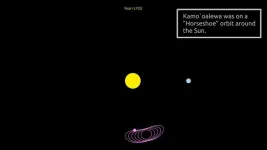
In 2021, a team of University of Arizona astronomers suggested that a recently discovered near-Earth asteroid, Kamo`oalewa, could be a chunk of the moon. Two years after the striking discovery, another UArizona research group has found that a rare pathway could have enabled this to happen. So far, only distant asteroids from beyond the orbit of Mars have been considered a source of near-Earth asteroids, said Renu Malhotra, Regents Professor of Planetary Sciences and a senior author on the paper. "We are now establishing that the moon is a more likely source ...

Read the release
New exoplanet-informed research sets clearer bounds on the search for radio technosignatures
Space

New exoplanet-informed research sets clearer bounds on the search for radio technosignatures

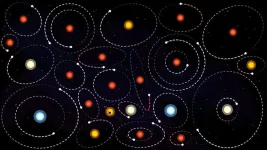
A new study leverages the NASA Exoplanet Archive and planetary system simulations to make narrowband SETI searches more efficient. October 23, 2023, Mountain View, CA -- In a new study published in the Astronomical Journal, researchers used the known population of exoplanets and extrapolated to the much larger, unknown population of exoplanets to set better thresholds for planetary effects on signals from ETIs (extraterrestrial intelligences). The prior recommendation for the threshold “drift rate” contribution, caused by a planet’s motion around its host star, was 200 nHz. In this work, lead ...

Read the release
Crystals brought back by astronauts show that the Moon is 40 million years older than scientists thought
Space

Crystals brought back by astronauts show that the Moon is 40 million years older than scientists thought

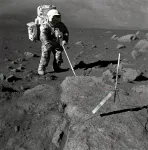
More than 4 billion years ago, when the Solar System was still young and the Earth was still growing, a giant object the size of Mars crashed into the Earth. The biggest piece that broke off of the early Earth formed our Moon. But precisely when this happened has remained a mystery. In a new study in the journal Geochemical Perspectives Letters, researchers used crystals brought back from the Moon by Apollo astronauts in 1972 to help pinpoint the time of the Moon’s formation. Their discovery pushes back the age of the Moon by 40 million years, to at least 4.46 billion years old. “These ...

Read the release
NASA's Webb discovers new feature in Jupiter’s atmosphere
Space

NASA's Webb discovers new feature in Jupiter’s atmosphere

NASA’s James Webb Space Telescope has discovered a new, never-before-seen feature in Jupiter’s atmosphere. The high-speed jet stream, which spans more than 3,000 miles (4,800 kilometers) wide, sits over Jupiter’s equator above the main cloud decks. The discovery of this jet is giving insights into how the layers of Jupiter’s famously turbulent atmosphere interact with each other, and how Webb is uniquely capable of tracking those features. “This is something that totally surprised us,” said Ricardo Hueso of the University of the Basque Country in Bilbao, Spain, lead author on the paper ...

Read the release
Record-breaking fast radio burst offers path to weigh the Universe
Space

Record-breaking fast radio burst offers path to weigh the Universe

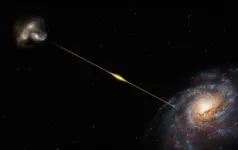
In a paper published today in Science, a global team led by Macquarie University’s Dr Stuart Ryder and Swinburne University of Technology’s Associate Professor Ryan Shannon, report on their discovery of the most ancient and distant fast radio burst located to date, about eight billion years old. The discovery smashes the team’s previous record by 50 per cent. It confirms that fast radio bursts (FRBs) can be used to measure the “missing” matter between galaxies. The source of the burst was shown to be a group of two or three galaxies that are ...

Read the release
Space

Observations from a bright fast radio burst probe the distant universe

An unusually high-energy fast radio burst (FRB) from a high-redshift galaxy has offered new insights into the distant universe, challenging current models of FRB emission. The findings also help constrain key attributes of these astrophysical phenomena. FRBs are brief pulses of radio emission originating from distant extragalactic sources. Although the astrophysical processes that cause FRBs aren’t fully understood, the signals they produce can be used to infer information about the cosmic environments they pass through as they travel across the universe, including the nature of ...

Read the release
Astronomers detect most distant fast radio burst to date
Space

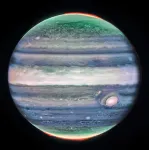
Astronomers detect most distant fast radio burst to date

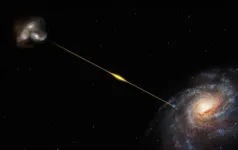
An international team has spotted a remote blast of cosmic radio waves lasting less than a millisecond. This 'fast radio burst' (FRB) is the most distant ever detected. Its source was pinned down by the European Southern Observatory’s (ESO) Very Large Telescope (VLT) in a galaxy so far away that its light took eight billion years to reach us. The FRB is also one of the most energetic ever observed; in a tiny fraction of a second it released the equivalent of our Sun’s total emission over 30 years. The discovery of the burst, named FRB 20220610A, was made in June last year by the ASKAP radio telescope in Australia ...

Read the release
SwRI’s Dr. Alan Stern will conduct research and experiment training in space aboard Virgin Galactic’s VSS Unity this November
Space

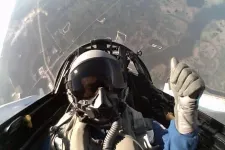
SwRI’s Dr. Alan Stern will conduct research and experiment training in space aboard Virgin Galactic’s VSS Unity this November

SAN ANTONIO — October 18, 2023 —On November 2, Dr. Alan Stern, planetary scientist and associate vice president of Southwest Research Institute’s Space Science Division, will fly aboard the Virgin Galactic commercial spaceship VSS Unity on a suborbital space mission to train for a future NASA-funded Virgin Galactic suborbital flight in which he will perform two NASA experiments in space. “When I was a kid, human spaceflight was only available to NASA astronauts and Russian cosmonauts. Now that’s changing, and SwRI is pioneering a new era of space research being conducted in space, by space scientists,” Stern ...

Read the release
From the original Press-News collection. Issuers of news releases are responsible for the accuracy of their content.