THE ORIGINAL COLLECTION · SINCE 2010

Space
press releases.

Research announcements from universities, hospitals and scientific institutions. Explore the stories, people and discoveries behind the headlines.

Original publication datesPage 38
FIND A STORY

Find a past release.

Dates and source material belong to the original release.

Read our research explainers

Browse the collection · original publication order

Space

NASA September 2023 temperature data shows continued record warming

Continuing the temperature trend from this summer, September 2023 was the hottest September on record, according to scientists at NASA’s Goddard Institute for Space Studies (GISS). The month also set the record for the highest temperature anomaly – the largest difference from the long-term average. This visualization shows global temperature anomalies along with the underlying seasonal cycle. Temperatures advance from January through December left to right, rising during warmer months and falling during cooler months. The color of each line represents the year, with colder purples for the 1960s and warmer oranges and yellows for more recent ...

Read the release
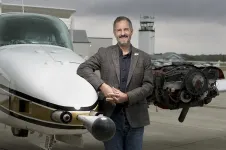
Signatures of the Space Age: Spacecraft metals left in the wake of humanity’s path to the stars
Space

Signatures of the Space Age: Spacecraft metals left in the wake of humanity’s path to the stars

WEST LAFAYETTE, Ind. – The Space Age is leaving fingerprints on one of the most remote parts of the planet — the stratosphere — which has potential implications for climate, the ozone layer and the continued habitability of Earth. Using tools hitched to the nose cone of their research planes and sampling more than 11 miles above the planet’s surface, researchers have discovered significant amounts of metals in aerosols in the atmosphere, likely from increasingly frequent launches and returns of spacecraft and satellites. That mass of metal is changing atmospheric chemistry in ways that ...

Read the release
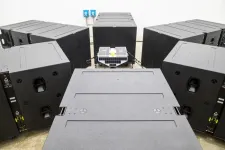
SwRI’s new aerospace acoustic testing system can simulate the deafening noise of a rocket launch
Space

SwRI’s new aerospace acoustic testing system can simulate the deafening noise of a rocket launch

SAN ANTONIO — October 16, 2023 —Southwest Research Institute’s aerospace acoustic test chamber can now simulate the complex and harsh acoustic environment associated with the thunderous noise of a rocket launch to ensure that space systems can endure blastoff conditions. The test chamber is the newest addition to SwRI’s 74,000-square-foot Space System Spacecraft and Payload Processing Facility, created to rapidly respond to customers needing to design, assemble and test spacecraft, ...

Read the release
Space

Astronomy: One small step towards lunar roads

It may be possible to create paved roads and landing pads on the Moon by using lasers to melt lunar soil into a more solid, layered substance, reports a proof-of-concept study in Scientific Reports. Although these experiments were carried out on Earth using a substitute for lunar dust, these findings demonstrate the viability of the technique and suggest it could be replicated on the Moon. However, further work may be needed to refine the process, according to the authors. Moon dust poses a significant challenge to lunar rovers as, due to the low levels of gravity, ...

Read the release
NASA’s Webb captures an ethereal view of NGC 346
Space

NASA’s Webb captures an ethereal view of NGC 346

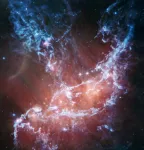
Filaments of dust and gas festoon this star-forming region in a new infrared image from MIRI. One of the greatest strengths of NASA’s James Webb Space Telescope is its ability to give astronomers detailed views of areas where new stars are being born. The latest example, showcased here in a new image from Webb’s Mid-Infrared Instrument (MIRI), is NGC 346 – the brightest and largest star-forming region in the Small Magellanic Cloud. The Small Magellanic Cloud (SMC) is a satellite galaxy of the Milky Way, visible to the unaided eye in the southern constellation Tucana. This ...

Read the release
Researchers capture first-ever afterglow of huge planetary collision in outer space
Space

Researchers capture first-ever afterglow of huge planetary collision in outer space

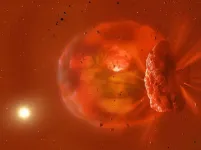
The study, published today in Nature, reports the sighting of two ice giant exoplanets colliding around a sun-like star, creating a blaze of light and plumes of dust. Its findings show the bright heat afterglow and resulting dust cloud, which moved in front of the parent star dimming it over time. The international team of astronomers was formed after an enthusiast viewed the light curve of the star and noticed something strange. It showed the system doubled in brightness at infrared wavelengths some three years before the star started to fade in visible light. Co-lead author Dr Matthew Kenworthy, from Leiden University, ...

Read the release
Space

Pulsars may make dark matter glow

The central question in the ongoing hunt for dark matter is: what is it made of? One possible answer is that dark matter consists of particles known as axions. A team of astrophysicists, led by researchers from the universities of Amsterdam and Princeton, has now shown that if dark matter consists of axions, it may reveal itself in the form of a subtle additional glow coming from pulsating stars. Dark matter may be the most sought-for constituent of our universe. Surprisingly, this mysterious form of matter, ...

Read the release
Astronomers discover first step toward planet formation
Space

Astronomers discover first step toward planet formation

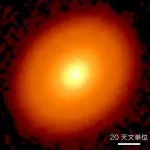
Astronomers have gotten very good at spotting the signs of planet formation around stars. But for a complete understanding of planet formation, we also need to study examples where planet formation has not yet started. Looking for something and not finding it can be even more difficult than finding it sometimes, but new detailed observations of the young star DG Taurus show that it has a smooth protoplanetary disk without signs of planet formation. This successful non-detection of planet formation may indicate ...

Read the release
Space

USTC researchers revolutionize understanding of supermassive black hole accretion radiation in quasars

Associate Professor CAI Zhenyi and Professor WANG Junxian from the Department of Astronomy at the University of Science and Technology of China (USTC) of the Chinese Academy of Sciences (CAS), through the study of the optical to extreme ultraviolet radiation generated by the accretion of supermassive black holes at the centers of quasars, have discovered that their spectral energy distribution is independent to the intrinsic brightness of quasars, overturning the traditional ...

Read the release
Plot thickens in hunt for ninth planet
Space

Plot thickens in hunt for ninth planet

CLEVELAND—A pair of theoretical physicists are reporting that the same observations inspiring the hunt for a ninth planet might instead be evidence within the solar system of a modified law of gravity originally developed to understand the rotation of galaxies. Researchers Harsh Mathur, a professor of physics at Case Western Reserve University, and Katherine Brown, an associate professor of physics at Hamilton College, made the assertion after studying the effect the Milky Way galaxy would have on objects in the outer solar system—if the laws of gravity were governed by a theory known as Modified ...

Read the release
Study quantifies satellite brightness, challenges ground-based astronomy
Space

Study quantifies satellite brightness, challenges ground-based astronomy

The ability to have access to the Internet or use a mobile phone anywhere in the world is taken more and more for granted, but the brightness of Internet and telecommunications satellites that enable global communications networks could pose problems for ground-based astronomy. University of Illinois Urbana-Champaign aerospace engineer Siegfried Eggl coordinated an international study confirming recently deployed satellites are as bright as stars seen by the unaided eye. “From our observations, we learned that AST Space Mobile’s BlueWalker 3—a constellation prototype satellite featuring a ...

Read the release
Bursts of star formation explain mysterious brightness at cosmic dawn
Space

Bursts of star formation explain mysterious brightness at cosmic dawn

When scientists viewed the James Webb Space Telescope’s (JWST) first images of the universe’s earliest galaxies, they were shocked. The young galaxies appeared too bright, too massive and too mature to have formed so soon after the Big Bang. It would be like an infant growing into an adult within just a couple years. The startling discovery even caused some physicists to question the standard model of cosmology, wondering whether or not it should be upended. Using new simulations, a Northwestern University-led ...

Read the release
Massive low earth orbit communications satellites could disrupt astronomy
Space

Massive low earth orbit communications satellites could disrupt astronomy

Observations of the BlueWalker 3 prototype satellite show it is one of the brightest objects in the night sky, outshining all but the brightest stars. Astronomers have raised concerns that without mitigation, groups of large satellites could disrupt our ability to observe the stars from Earth and perform radio astronomy. Several companies are planning ‘constellations’ of satellites – groups of potentially hundreds of satellites that can deliver mobile or broadband services anywhere in the world. However, these satellites need to be in ‘low-Earth’ orbit and can be relatively large, ...

Read the release
Space

Global team recommends ethical rules for human research in commercial spaceflight

The first ethical framework for conducting human research on commercial spaceflight was proposed today in an article in Science by an international team that included Hastings Center president Vardit Ravitsky. Ravitsky’s contribution focused on promoting diversity among the researchers and participants, which is essential to ensuring the research benefits society at large. Human research on commercial spaceflight is expected to expand significantly in the near future, and yet there are no rules for ...

Read the release
Ethics rules needed for human research on commercial spaceflights, panel says
Space

Ethics rules needed for human research on commercial spaceflights, panel says

New guidelines are needed to assure that research on human subjects performed on commercial spaceflights is conducted ethically, a panel of experts say in a commentary appearing in the September 28 issue of the journal Science. Their paper is titled Ethically cleared to launch? Private companies are expected to fly thousands of people into space in the coming decades. Those aboard will include workers and passengers who will have the opportunity to participate in research studies. Such research is not only essential to assure the safety of future space travelers but often also addresses critical issues of human health in general. Buț ...

Read the release
Space

Cleared to launch? Ethical guidelines needed for human research in commercial spaceflight

HOUSTON – (Sept. 28, 2023) – The commercial spaceflight industry is expanding opportunities for scientific research in space, but the industry needs clear ethical guidelines before human research is ready for liftoff. In a new policy paper published in Science, a global, multidisciplinary team of bioethicists, health policy experts, space health researchers, commercial spaceflight professionals and government regulators outlines potential ethical concerns facing the future of commercial space research and provides guiding principles ...

Read the release
Space

Ethical guidelines needed before human research in commercial spaceflight is ready for liftoff

A global, multidisciplinary team of bioethicists, health policy experts, commercial spaceflight professionals and space health researchers, including Rachael Seidler from the University of Florida, has developed guiding principles and best practices to help ensure human research conducted in space is safe and inclusive. The proposed ethical guidelines were released Friday in a policy paper published in Science and are the result of a workshop held at the Banbury Center of Cold Spring Harbor Laboratory funded by the Translational ...

Read the release
Space

JWST's first spectrum of a TRAPPIST-1 planet

Image In a solar system called TRAPPIST-1, 40 light years from the sun, seven Earth-sized planets revolve around a cold star. Astronomers obtained new data from the James Webb Space Telescope (JWST) on TRAPPIST-1 b, the planet in the TRAPPIST-1 solar system closest to its star. These new observations offer insights into how its star can affect observations of exoplanets in the habitable zone of cool stars. In the habitable zone, liquid water can still exist on the orbiting planet's surface. The ...

Read the release
New proof for black hole spin
Space

New proof for black hole spin

The supermassive black hole at the heart of galaxy M87, made famous by the first picture of a black hole shadow, has yielded another first: the jet shooting out from the black hole has been confirmed to wobble, providing direct proof that the black hole is spinning. Super massive black holes, monsters up to billions of times heavier than the Sun that eat everything around them including light, are difficult to study because no information can escape from within. Theoretically, there are very few properties that we can even hope to measure. One property that might possibly be observed is spin, but due to the difficulties involved there have been no direct ...

Read the release
Monitoring of radio galaxy M87 confirms black hole spin
Space

Monitoring of radio galaxy M87 confirms black hole spin

The nearby radio galaxy M87, located 55 million light-years from the Earth and harboring a black hole 6.5 billion times more massive than the Sun, exhibits an oscillating jet that swings up and down with an amplitude of about 10 degrees, confirming the black hole's spin. The study, which was headed by Chinese researcher Dr. CUI Yuzhu and published in Nature on Sept. 27, was conducted by an international team using a global network of radio telescopes. Through extensive analysis of telescope data from 2000­–2022, the research team revealed a recurring 11-year cycle in the precessional motion of the jet base, as predicted ...

Read the release
Extreme weight loss: Star sheds unexpected amounts of mass just before going supernova
Space

Extreme weight loss: Star sheds unexpected amounts of mass just before going supernova

Cambridge, Mass. — A newly discovered nearby supernova whose star ejected up to a full solar mass of material in the year prior to its explosion is challenging the standard theory of stellar evolution. The new observations are giving astronomers insight into what happens in the final year prior to a star’s death and explosion. SN 2023ixf is a new Type II supernova discovered in May 2023 by amateur astronomer Kōichi Itagaki of Yamagata, Japan shortly after its progenitor, or origin star, ...

Read the release
The Giant Magellan Telescope’s final mirror fabrication begins
Space

The Giant Magellan Telescope’s final mirror fabrication begins

PASADENA, CA — September 26, 2023 — The Giant Magellan Telescope begins the four-year process to fabricate and polish its seventh and final primary mirror, the last required to complete the telescope’s 368 square meter light collecting surface, the world’s largest and most challenging optics ever produced. Together, the mirrors will collect more light than any other telescope in existence, allowing humanity to unlock the secrets of the Universe by providing detailed chemical analyses of celestial objects and their origin. Last week, the University of Arizona Richard F. Caris Mirror Lab closed the lid on nearly 20 tons of the ...

Read the release
NASA’s Interstellar Mapping and Acceleration Probe passes system integration review
Space

NASA’s Interstellar Mapping and Acceleration Probe passes system integration review

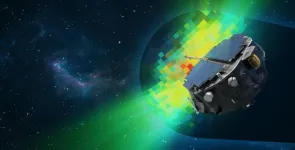
The Interstellar Mapping and Acceleration Probe (IMAP) marked the completion of an important step on the path to spacecraft assembly, test, and launch operations this week at Johns Hopkins Applied Physics Laboratory (APL) in Maryland. The IMAP team met with a review panel to evaluate the plan for integrating all systems onto the spacecraft, such as the scientific instrumentation, electrical and communication systems, and navigation systems. Successful completion of this System Integration Review (SIR) means that the project can proceed with assembling and testing the spacecraft in preparation ...

Read the release
Systemic cooling poverty: A new facet of deprivation emerging in a warming planet
Space

Systemic cooling poverty: A new facet of deprivation emerging in a warming planet

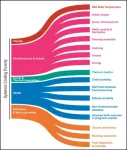
OXFORD - 25/09/2023 - A new study in Nature Sustainability - published today by researchers from Oxford University, Ca’ Foscari University of Venice, the Euro-Mediterranean Center on Climate Change, the European Institute on Economics and the Environment and the London School of Hygiene & Tropical Medicine - brings attention to a new relevant dimension of deprivation which is clearly emerging in a warming world: cooling poverty. The study highlights the multidimensional nature of cooling poverty and introduces the new concept of systemic cooling ...

Read the release
Scientists reveal marvellous x-ray mask absorber in the active galaxy NGC 6814
Space

Scientists reveal marvellous x-ray mask absorber in the active galaxy NGC 6814

A research team led by Prof. WANG Junxian from the University of Science and Technology of China (USTC) of the Chinese Academy of Sciences (CAS) revealed a clumped, multi-component eclipsing absorber in a study of X-ray occultation events in the active galaxy NGC 6814. The results were published in Monthly Notices of the Royal Astronomical Society on Aug. 23. Active galactic nuclei have strong X-ray emission originating in a compact region near the supermassive black hole, the so-called corona region. When an absorbing ...

Read the release
From the original Press-News collection. Issuers of news releases are responsible for the accuracy of their content.