Muscle-fiber inspired pneumatic artificial muscles for multiple-mode actuations
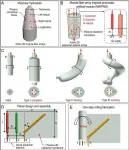
Biological organisms (such as elephant trunks, octopus tentacles, and human tongues) show remarkable dexterity and self-adaptation in unstructured environments, relying on the multiple-mode actuations of the skeleton-free muscular hydrostats. In general, muscular hydrostats mainly consist of well-ranged active 3D muscle-fiber arrays bundled by passive connective tissues (Fig. 1A). By selectively actuating the active 3D muscle-fiber arrays, muscular hydrostats can generate elongation, bending, contraction and twisting. Producing such multiple-mode actuation of muscular hydrostats is an interesting but long-lasting challenge in the field of robotics. During past decades, many artificial muscles (such ...
Read the release