PRESS-NEWS.org - Press Release Distribution
PRESS RELEASES DISTRIBUTION

Pusan National University researchers develop a novel 3D adipose tissue bioprinting method
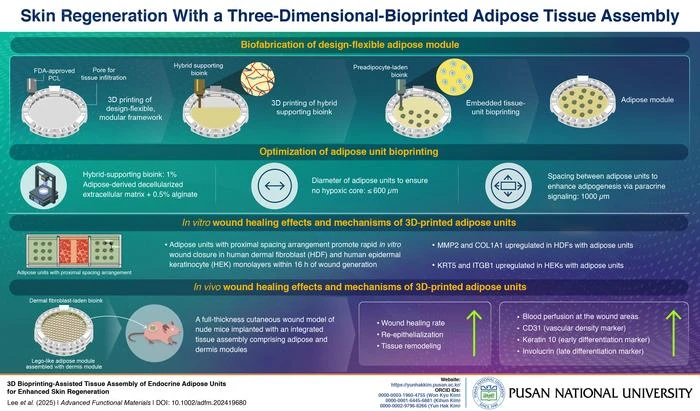
Optimization of three-dimensional adipose tissue bioprinting enabled its application in skin regeneration

Pusan National University researchers develop a novel 3D adipose tissue bioprinting method
2025-03-03
(Press-News.org) The adipose tissue, which serves as an endocrine organ, releases various molecules that regulate the repair of other damaged tissues, including the skin. Hence, adipose tissues can potentially be reengineered to regenerate the damaged organs. Three-dimensional (3D) bioprinting technology has revolutionized regenerative medicine by enabling the generation of engineered and functional 3D organs or tissues, including adipose tissues. However, the currently used tissue biofabrication methods cannot replicate the native structure and densely packed lipid droplets of adipose tissues, hindering the therapeutic application of 3D-printed adipose tissues.

To overcome this limitation, a research team led by Assistant Professor Byoung Soo Kim from the Pusan National University, Korea, has developed a novel adipose tissue biofabrication approach. This paper was made available online on February 02, 2025 in Advanced Functional Materials. The highlight of this study was the development of a hybrid bioink, which is a combination of 1% adipose-derived decellularized extracellular matrix and 0.5% alginate. This hybrid bioink limited the migration of preadipocytes , the fat cell precursors, while promoting their differentiation. Dr. Kim states that “Under standard culture conditions, preadipocytes tend to proliferate and migrate, preventing the formation of lipid droplets that are essential for adipose tissue functions. The hybrid bioink developed in this study maintains the physiological properties of the adipose tissue.” Additionally, a diameter of ≤ 600 µm was deemed to ensure sufficient nutrient and oxygen delivery for the fabricated adipose tissue. Furthermore, bioprinted adipose tissues arranged with a spacing of ≤ 1000 µm promoted adipogenesis via paracrine signaling. The optimized 3D bioprinted adipose tissues rapidly promoted the migration of skin cells in vitro by modulating the expression levels of cell migration-related proteins (MMP2, COL1A1, KRT5, and ITGB1).

To examine the in vivo effects of bioprinted adipose tissues, the authors prepared a tissue assembly comprising adipose and dermis modules. This tissue assembly was implanted into mice with skin wounds. The findings revealed that the tissue assembly promoted wound healing in mice by inducing re-epithelialization, tissue remodeling, and blood vessel formation and regulated the expression of skin cell differentiation-related proteins.

These results demonstrate bioprinting's potential as a core technology in precision medicine and regenerative healthcare, driving a new wave of medical innovation. With the commercialization of 3D bioprinting technology expected to fuel significant market growth in customized tissue manufacturing, hospitals and research institutes are likely to increasingly adopt personalized bioprinting systems for patient treatments and medical studies.

The method developed in this study has various implications. According to the lead author Jae-Seong Lee, “The 3D bioprinted endocrine tissues enhanced skin regeneration, indicating their potential applications in regenerative medicine. While current fat grafting procedures suffer from low survival rates and gradual resorption, our hybrid bioinks enhance endocrine function and cell viability, potentially overcoming these limitations. This approach could be particularly valuable for treating chronic wounds such as diabetic foot ulcers, pressure sores, and burns.”


***


Reference
DOI: 10.1002/adfm.202419680


About the institute
Pusan National University, located in Busan, South Korea, was founded in 1946 and is now the No. 1 national university of South Korea in research and educational competency. The multi-campus university also has other smaller campuses in Yangsan, Miryang, and Ami. The university prides itself on the principles of truth, freedom, and service, and has approximately 30,000 students, 1200 professors, and 750 faculty members. The university is composed of 14 colleges (schools) and one independent division, with 103 departments in all.
Website: https://www.pusan.ac.kr/eng/Main.do


About the author
Byong Soo Kim is an Assistant Professor at the School of Biomedical Convergence Engineering, Pusan National University. He received his PhD in Mechanical Engineering in 2019. His research interests are 3D printing for biomedical applications, functionalized biomaterials and their applications to 3D bioprinting, biomimetic organ-on-a-chip/in vitro models, and functional artificial tissue/organ.
Website: https://sites.google.com/view/3pab-lab/welcome?authuser=0
ORCID Id: https://orcid.org/0000-0002-6693-0003

END


[Attachments] See images for this press release:
Pusan National University researchers develop a novel 3D adipose tissue bioprinting method

ELSE PRESS RELEASES FROM THIS DATE:

Scientists use AI to better understand nanoparticles

Scientists use AI to better understand nanoparticles
2025-03-03
A team of scientists has developed a method to illuminate the dynamic behavior of nanoparticles, which are foundational components in the creation of pharmaceuticals, electronics, and industrial and energy-conversion materials. The advance, reported in the journal Science, combines artificial intelligence with electron microscopy to render visuals of how these tiny bits of matter respond to stimuli.  “Nanoparticle-based catalytic systems have a tremendous impact on society,” explains Carlos Fernandez-Granda, director of NYU’s Center for Data Science and a professor of mathematics and data science, one of the paper’s authors. “It is estimated that 90 percent ...

We feed gut microbes sugar, they make a compound we need

We feed gut microbes sugar, they make a compound we need
2025-03-03
Gut microbes that were thought to feed exclusively on dietary fiber also get fed sugar from our guts, from which they produce short-chain fatty acids that are crucial to many body functions. The Kobe University discovery of this symbiotic relationship also points the way to developing novel therapeutics. Gut microbes produce many substances that our body needs but cannot produce itself. Among them are short-chain fatty acids that are the primary energy source for the cells lining our guts but have other important roles, too, and ...

One of the largest psychotherapy trials in the world has implications for transforming mental health care during pregnancy and after birth

2025-03-03
Approximately one in five of pregnant and postpartum individuals experience depression and anxiety, yet less than 10 per cent receive proper treatment. To address this problem, a team of interdisciplinary researchers from Canada and the United States investigated if talk therapy can be effectively delivered by non-mental health specialists and telemedicine to increase access. In a paper published today in Nature Medicine, they share results from the Scaling Up Maternal Mental health care by Increasing access to Treatment (SUMMIT) Trial, which reveals promising strategies to provide the necessary support and treatment more effectively and inclusively ...

It’s not just what you say – it’s also how you say it

2025-03-03
EVANSTON, Ill. --- You’ve probably heard the phrase, “It’s not what you say, it’s how you say it,” and now, science backs it up. A first-of-its-kind study from Northwestern University’s School of Communication, the University of Pittsburgh and the University of Wisconsin-Madison reveals a region of the brain, long known for early auditory processing, plays a far greater role in interpreting speech than previously understood.  The multidisciplinary study being published Monday, March ...

Sleep patterns may reveal comatose patients with hidden consciousness

2025-03-03
NEW YORK, NY (March 3, 2025)--Several studies in the past decade have revealed that up to a quarter of unresponsive patients with recent brain injuries may possess a degree of consciousness that’s normally hidden from their families and physicians. New research from Columbia University and NewYork-Presbyterian may soon help physicians identify unresponsive brain-injury patients with hidden consciousness who are likely to achieve long-term recovery by looking for brain waves that are indicative of normal sleep patterns.  “We’re at an exciting crossroad in neurocritical care where we know that many patients appear to be unconscious, but some are recovering without ...

3D genome structure guides sperm development

2025-03-03
Two new landmark studies show how a seeming tangle of DNA is actually organized into a structure that coordinates thousands of genes to form a sperm cell. The work, published March 3 as two papers in Nature Structural and Molecular Biology, could improve treatment for fertility problems and developmental disorders.  “We are finding the 3D structure of the genome,” said Satoshi Namekawa, professor of microbiology and molecular genetics at the University of California, Davis and senior author on one of the papers. “This is really showing us how the genomic architecture guides development.” Although DNA is a long, stringy molecule, in living ...

Certain genetic alterations may contribute to the primary resistance of colorectal and pancreatic cancers to KRAS G12C inhibitors

2025-03-03
Bottom Line: Colorectal cancer and pancreatic ductal adenocarcinoma that harbored the KRAS G12C mutation often carried other genetic alterations that can be associated with resistance to KRAS G12C inhibitors, despite no prior treatment with this therapy, according to recent results from a large multidatabase analysis. Journal in Which the Study was Published: Clinical Cancer Research, a journal of the American Association for Cancer Research (AACR) Author: Hao Xie, MD, PhD, a medical oncologist at Mayo Clinic Comprehensive Cancer Center Background: “The KRAS pathway plays a crucial role in cell biology by regulating ...

Melting Antarctic ice sheets will slow Earth’s strongest ocean current

2025-03-03
Melting ice sheets are slowing the Antarctic Circumpolar Current (ACC), the world’s strongest ocean current, researchers have found.  This melting has implications for global climate indicators, including sea level rise, ocean warming and viability of marine ecosystems.  The researchers, from the University of Melbourne and NORCE Norway Research Centre, have shown the current slowing by around 20 per cent by 2050 in a high carbon emissions scenario.  This influx of fresh water into the Southern Ocean is expected to change ...

Hallucinogen use linked to 2.6-fold increase in risk of death for people needing emergency care

2025-03-03
People seeking emergency care for hallucinogen use were at 2.6-fold higher risk of death within 5 years than the general population, according to a new study published in CMAJ (Canadian Medical Association Journal) https://www.cmaj.ca/lookup/doi/10.1503/cmaj.241191. The use of hallucinogens, such as ketamine, psychedelics, psilocybin, LSD, ayahuasca, and MDMA (Ecstasy), has rapidly increased since the mid-2010s, especially in Canada and the United States. In the US, the percentage of people reporting they used hallucinogens more than doubled from 3.8% in 2016 to 8.9% in 2021. “In Canada, an estimated 5.9% of people used a psychedelic ...

Pathogenicity threshold of SCA6 causative gene CACNA1A was identified

Pathogenicity threshold of SCA6 causative gene CACNA1A was identified
2025-03-03
Niigata, Japan - The Department of Neurology at Niigata University and National Center of Neurology and Psychiatry(NCNP) has identified pathogenic thresholds for the CAG repeat units (RU) of the CACNA1A gene that causes SCA6. They investigated the SCA6 causative gene in 2,768 patients. They carefully examined the relationship between RU, age of onset, and family history. First, in cases with 18 or fewer RU, the proportion of family history was low. For 19 or more RU, the proportion of family history ...

LAST 30 PRESS RELEASES:

$3 million NIH grant funds national study of Medicare Advantage’s benefit expansion into social supports

Amplified Sciences achieves CAP accreditation for cutting-edge diagnostic lab

Fred Hutch announces 12 recipients of the annual Harold M. Weintraub Graduate Student Award

Native forest litter helps rebuild soil life in post-mining landscapes

Mountain soils in arid regions may emit more greenhouse gas as climate shifts, new study finds

Pairing biochar with other soil amendments could unlock stronger gains in soil health

Why do we get a skip in our step when we’re happy? Thank dopamine

UC Irvine scientists uncover cellular mechanism behind muscle repair

Platform to map living brain noninvasively takes next big step

Stress-testing the Cascadia Subduction Zone reveals variability that could impact how earthquakes spread

We may be underestimating the true carbon cost of northern wildfires

Blood test predicts which bladder cancer patients may safely skip surgery

Kennesaw State's Vijay Anand honored as National Academy of Inventors Senior Member

Recovery from whaling reveals the role of age in Humpback reproduction 

Can the canny tick help prevent disease like MS and cancer?

Newcomer children show lower rates of emergency department use for non‑urgent conditions, study finds

Cognitive and neuropsychiatric function in former American football players

From trash to climate tech: rubber gloves find new life as carbon capturers materials

A step towards needed treatments for hantaviruses in new molecular map

Boys are more motivated, while girls are more compassionate?

Study identifies opposing roles for IL6 and IL6R in long-term mortality

AI accurately spots medical disorder from privacy-conscious hand images

Transient Pauli blocking for broadband ultrafast optical switching

Political polarization can spur CO2 emissions, stymie climate action

Researchers develop new strategy for improving inverted perovskite solar cells

Yes! The role of YAP and CTGF as potential therapeutic targets for preventing severe liver disease

Pancreatic cancer may begin hiding from the immune system earlier than we thought

Robotic wing inspired by nature delivers leap in underwater stability

A clinical reveals that aniridia causes a progressive loss of corneal sensitivity

Fossil amber reveals the secret lives of Cretaceous ants

[Press-News.org] Pusan National University researchers develop a novel 3D adipose tissue bioprinting method
Optimization of three-dimensional adipose tissue bioprinting enabled its application in skin regeneration