Biochar from energy crops could remove CO2 at $9.60 per ton in China
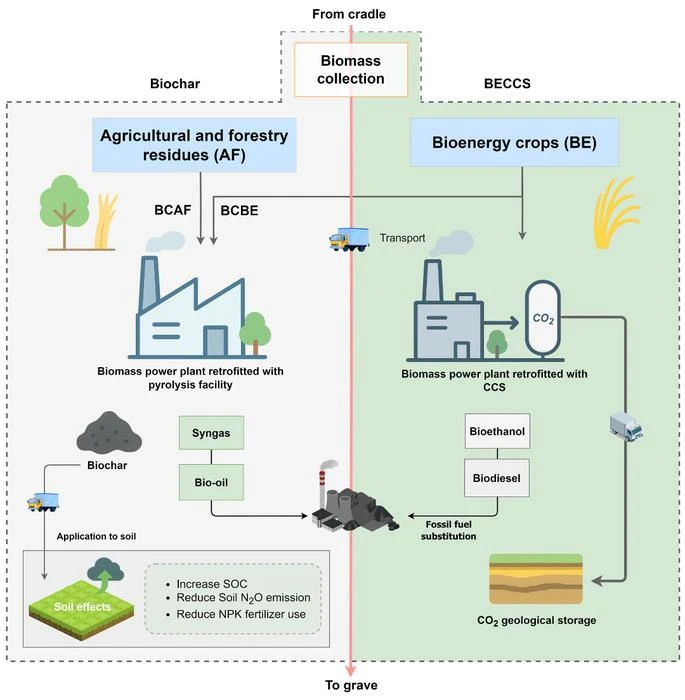
The carbon removal industry has a cost problem. Most technologies that pull CO2 out of the atmosphere and lock it away are expensive — often prohibitively so. Direct air capture runs into the hundreds of dollars per ton. Bioenergy with carbon capture and storage (BECCS), which burns biomass for energy and then buries the resulting CO2, costs roughly $90.90 per ton of CO2 removed. At those prices, removing the billions of tons of carbon needed to meet climate targets is economically implausible without massive subsidies.
Against that backdrop, a study published in the journal Biochar presents a notably different number: $9.60 per ton. That is the estimated cost of removing CO2 through biochar produced from dedicated bioenergy crops grown on abandoned farmland in China.
What makes biochar carbon removal different
Biochar is produced by pyrolysis — heating biomass in low-oxygen conditions. The process converts plant carbon into a stable, charcoal-like material that resists decomposition. When applied to soil, biochar can lock carbon away for decades to centuries, effectively removing it from the atmospheric cycle.
Unlike BECCS, which requires pipelines, geological storage sites, and continuous energy inputs to compress and inject CO2 underground, biochar production is relatively low-tech. The infrastructure demands are simpler. The end product is not just a carbon store — it is a soil amendment that can improve nutrient retention, water-holding capacity, and reduce emissions of nitrous oxide, a potent greenhouse gas.
The catch has always been feedstock. Where does all the biomass come from? Agricultural and forestry residues — crop stalks, wood waste, pruning debris — are the traditional answer, but supplies are limited by competing uses and seasonal availability. The new study proposes an additional source: purpose-grown bioenergy crops planted on land that is no longer used for food production.
Abandoned cropland as carbon removal infrastructure
China has substantial areas of abandoned cropland — farmland taken out of production due to urbanization, soil degradation, or economic shifts. The study's authors analyzed these areas alongside China's existing network of biomass power plants and transportation infrastructure to model a realistic supply chain for biochar production.
Growing bioenergy crops on this abandoned land, they calculated, could supply enough biomass to produce biochar with a carbon removal potential of about 25.8 million tons of CO2 per year. That figure is comparable to the removal potential of biochar made from conventional agricultural and forestry residues.
Taken together — bioenergy crops plus residues, with expanded pyrolysis facilities — the researchers estimate a total carbon removal ceiling of up to 1.88 billion tons of CO2 per year under optimized conditions. For context, China's total CO2 emissions in recent years have been around 11 billion tons annually. So even the optimistic scenario does not solve the problem alone, but it represents a meaningful fraction.
Why the cost gap with BECCS is so large
The roughly tenfold cost difference between biochar ($9.60/ton) and BECCS ($90.90/ton) comes down to infrastructure. BECCS requires energy-intensive CO2 compression, pipeline transport, injection wells, and long-term monitoring of geological storage sites. Each step adds cost and engineering complexity.
Biochar skips all of that. Pyrolysis plants are comparatively simple. The product is a solid that can be transported by truck and spread on fields using existing agricultural equipment. There are no underground reservoirs to certify, no compression stations to operate, no leakage risks to monitor for centuries.
BECCS does have a higher per-unit removal potential — it can capture a larger fraction of the carbon in each ton of biomass processed. But the study argues that biochar's cost advantage is so large that it delivers far more removal per dollar invested.
Regional variation across China
The analysis is not one-size-fits-all. Eastern and northeastern China, with their dense biomass resources and existing infrastructure, showed the highest potential for near-term deployment. These regions already have biomass power plants, road networks capable of handling feedstock transport, and agricultural systems that could integrate biochar application.
Other regions offer different advantages. Areas with large tracts of underutilized land could host bioenergy crop plantations without competing with food production — a critical concern in a country that feeds 1.4 billion people. The researchers were explicit that their model avoids displacing food crops, relying only on land already out of agricultural use.
The scale-up challenges
A cost of $9.60 per ton is attractive on paper. But scaling from analysis to deployment involves obstacles the study acknowledges without fully resolving.
Building new pyrolysis facilities requires capital investment. Establishing bioenergy crop plantations on abandoned land requires labor, seeds, water, and years of growth before the first harvest. Supply chains connecting dispersed cropland to centralized processing plants need to be built and optimized. None of this happens by itself.
Policy support is essential. Without carbon pricing mechanisms or direct subsidies, there is no economic incentive for farmers to grow bioenergy crops on marginal land or for investors to build pyrolysis capacity. China's carbon market is still maturing, and the price per ton of CO2 has generally been too low to drive large-scale negative emissions investment.
There are also technical uncertainties. Biochar's carbon permanence — how long it actually stays locked in soil — varies with soil type, climate, and biochar properties. The study uses estimates of multi-decade to multi-century stability, but field verification at scale remains limited. And the environmental effects of large-scale biochar application, including potential impacts on soil chemistry and microbial communities, are still being studied.
The math, honestly stated
The 1.88-billion-ton ceiling is an upper bound under optimized assumptions. Real-world deployment would face constraints — land-use conflicts, infrastructure bottlenecks, policy delays, feedstock quality variation — that would likely bring the actual number considerably lower. The 25.8-million-ton figure from bioenergy crops alone is more conservative and more plausible as a near-term target.
But even at the lower end, biochar from bioenergy crops adds a meaningful tool to China's carbon removal portfolio. At less than a tenth the cost of BECCS, it offers removal capacity that could be deployed without the massive infrastructure investments that have slowed other negative emissions technologies. Whether that potential translates into gigatons of actual removal depends on decisions that have not yet been made — in government ministries, carbon markets, and farm offices across the country.