Sea urchin spines generate electricity from water flow - and now 3D-printed copies do too
Engineers have spent decades building underwater sensors that need batteries, cables, and waterproof housings. Sea urchins have been doing something similar with porous calcium carbonate and no power source at all. A research team has now figured out how - and replicated it.
The study, published in Nature, reveals that the spines of the long-spined sea urchin (Diadema setosum) generate measurable electrical voltage when water flows through their internal structure. The mechanism has nothing to do with living cells. It works in dead spines. The secret is architecture: a gradient of pore sizes running from the base to the tip of each spine that amplifies the electrical signal produced when water moves through a porous material.
100 millivolts from a water droplet
The discovery started with a simple observation. When a seawater droplet strikes the tip of a sea urchin spine, the spine rotates rapidly - within a second. That reaction was known. What was not known was that the droplet simultaneously produces a voltage of about 100 millivolts inside the spine. When the spine is submerged and exposed to water flow, the stimulation triggers a voltage of several tens of millivolts.
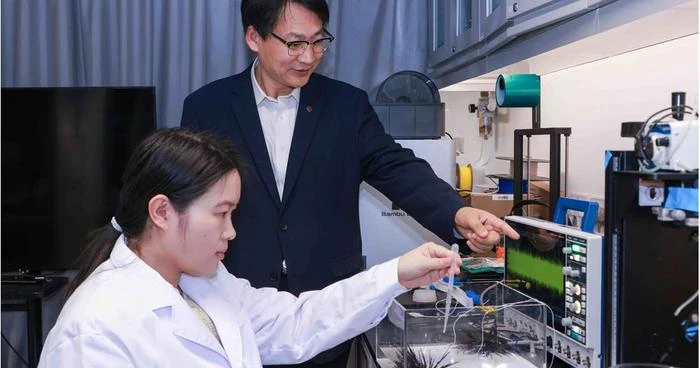
The research team, led by Prof. Wang Zuankai at The Hong Kong Polytechnic University (PolyU) with collaborators from City University of Hong Kong and Huazhong University of Science and Technology, confirmed that this mechanoelectrical response persists in spines removed from dead animals. Whatever generates the voltage does not depend on biological activity, nerve signals, or cellular metabolism. It is purely structural.
The gradient that amplifies the signal
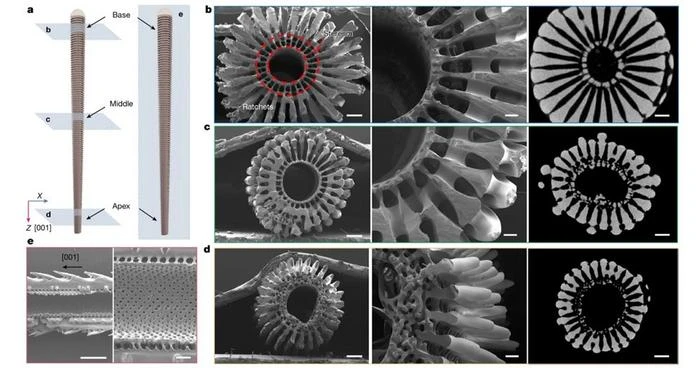
The key structure is the stereom - the porous internal skeleton of the spine, composed of interconnected pores with varying sizes and distributions. These pores are not uniform. At the base of the spine, pores are larger and the solid material is less dense. Toward the tip, pores become smaller and the solid density increases. This creates what the researchers call a bicontinuous gradient porous structure - a smooth transition from open and airy to compact and dense along the length of the spine.
When water flows through any porous material, it interacts with the surfaces of the pores. Specifically, the flow exerts shear force on the electric double layer - a thin region of separated charges that forms naturally at any solid-liquid interface. This shear separates and redistributes charges, generating a voltage difference. The phenomenon, called streaming potential, has been known for over a century.
What the sea urchin spine adds is amplification. The gradient structure means that water flowing through the spine encounters progressively changing pore geometry. The interaction between the flow and the pore surfaces intensifies along the gradient, producing a stronger net voltage difference than a uniform porous structure would. The spine is, in effect, a naturally optimized sensor - not because evolution selected for voltage production, but because the gradient structure that serves other mechanical functions happens to amplify an electrical effect.
3D-printed spines that outperform uniform designs
The researchers did not stop at understanding the biology. Using vat photopolymerisation 3D printing, they fabricated artificial structures from polymer and ceramic materials that mimic the spine's gradient pore architecture. They then tested whether the structure, rather than the specific biological material, was responsible for the enhanced electrical response.
It was. The spine-mimicking designs produced a voltage output approximately three times higher and a signal amplitude roughly eight times greater than non-gradient designs made from the same materials under the same water flow conditions. The gradient is the key. Swap the material, keep the gradient, and the amplified sensing effect persists.
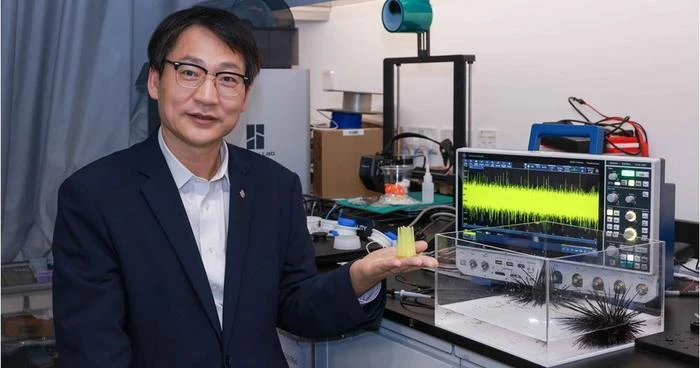
Building on this, the team constructed a bionic 3D metamaterial mechanoreceptor arranged in a 3 x 3 array, with each unit made of gradient porous material. This array can record electrical signals in real time underwater and precisely locate the position of water flow impact. It needs no external power source - the sensing mechanism generates its own voltage from the physical interaction between water flow and pore surfaces.
Self-powered sensing without batteries
The practical appeal is obvious. Underwater sensors typically require power supplies, which means batteries that need replacement, cables that need routing, or energy-harvesting systems that add complexity. A sensor that generates its own electrical signal from the very thing it is designed to detect - water flow - eliminates that dependency.
The research team points to several potential applications. Marine monitoring systems could use arrays of these sensors to track ocean currents, detect approaching underwater vehicles, or monitor conditions around subsea infrastructure. The sensors could also measure pressure and vibration, extending their utility beyond water flow detection.
More speculatively, the researchers suggest that the gradient porous architecture could be adapted for different signal types - including electromagnetic waves and neural signals. They mention brain-computer interfaces as a potential future application, where the enhanced sensitivity of gradient porous structures could improve detection of the weak electrical signals produced by neurons. That application is far from demonstrated, but the underlying principle - that gradient porosity amplifies solid-liquid electrical interactions - is material-agnostic and could be tested in different contexts.
A function evolution did not select for
One of the study's more interesting implications is conceptual rather than practical. Sea urchin spines evolved primarily for defense - they deter predators and protect the animal's body. The gradient porous structure likely arose through biomineralization processes that optimize mechanical properties like strength and flexibility, not electrical sensing. The mechanoelectrical response appears to be a by-product of a structure that evolved for entirely different reasons.
"For natural porous materials, mechanical properties such as strength may not be the primary function, but rather a by-product of complex biomineralisation," Wang said. "Uncovering previously unknown mechanisms that lie beyond a material's traditionally recognised function helps us to more comprehensively understand and fully utilise these natural resources."
This is a recurring theme in biomimetics: biological structures often have capabilities that their organisms never "use" in any adaptive sense. The spine's electrical response to water flow may play no role in the sea urchin's behavior. But the structure that produces it, once understood and replicated, can be put to uses that nature never anticipated.
From laboratory arrays to ocean deployments
The study demonstrates proof of concept, not a finished product. The 3D-printed sensors were tested under controlled laboratory conditions, not in open ocean environments where biofouling, corrosion, pressure, and turbulent flow would all challenge performance. The 3 x 3 array is small; scaling to the kinds of distributed sensor networks needed for marine monitoring would require significant engineering work.
The voltage signals generated - tens of millivolts - are small. In a noisy ocean environment, distinguishing signal from background would require careful electronic design. The durability of polymer and ceramic gradient structures under long-term submersion has not been established. And the claim that the architecture could be adapted for brain-computer interfaces, while conceptually interesting, remains entirely unvalidated.
Still, the core finding is solid: a biological structure generates electricity through a mechanism that can be replicated in synthetic materials, and the gradient architecture provides measurable amplification. That is a starting point for engineering, not a finished technology - but it is a starting point with clear physics behind it.