Half of South Africa's surveyed raptor species have declined sharply in 16 years
Africa's raptors are in trouble. Across the continent, birds of prey rank among the fastest-declining bird groups, pressured by land-use change, expanding infrastructure, illegal killing, and shifting climate patterns. But quantifying that decline with hard numbers - rather than anecdote and assumption - requires something unglamorous: years of consistent, repeatable survey work. A new study provides exactly that, and the picture it paints is bleak.
Fifteen years of counting from the roadside
Between 2009 and 2025, field researcher Ronelle Visagie of the Endangered Wildlife Trust drove survey routes across central South Africa, counting raptors and large terrestrial birds from the road. Year after year, same routes, same methods. The resulting dataset covers 18 raptor species and 8 large terrestrial bird species - one of the most comprehensive long-term monitoring efforts for African birds of prey.
The analysis, led by Dr. Santiago Zuluaga of the University of Cape Town and the National Museum of Natural Sciences of Spain, found that half of the 26 species experienced statistically significant declines. Many of those declines exceeded 50 percent. Only three species showed clear population increases over the study period.
"When I started these road counts over 15 years ago, I never expected that they would reveal such severe declines across so many species," Visagie said.
The Secretarybird's 68 percent drop
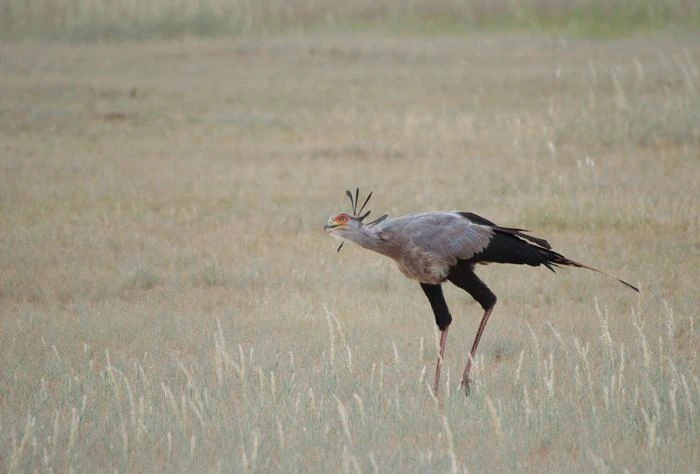
Among the hardest-hit species is the Secretarybird, already classified as Endangered. Its population fell 68 percent over the 16-year study period. The Secretarybird is a specialist - a ground-hunting raptor that needs vast, open landscapes to find food and breed. Sustained losses at this scale suggest that pressures across the landscape, not just localized threats, are driving the decline.
"These birds require vast areas to survive and reproduce, so sustained population losses at this scale suggest that pressures across the landscape are having real and lasting impacts," said Dr. Megan Murgatroyd of HawkWatch International, a co-author on the study.
The Secretarybird was not alone. Migratory raptors - species that depend on multiple regions across their annual cycle - also showed steep declines. Lesser Kestrel, Amur Falcon, and Steppe Buzzard all dropped significantly. For migratory species, the threats compound: habitat loss on African wintering grounds, dangers along migration corridors, and changing conditions on Eurasian breeding grounds all contribute. Fixing any one of these is not enough if the others remain.
Declines in species nobody was worried about
Perhaps the most unsettling finding involves species currently listed as Least Concern by the International Union for Conservation of Nature. Both Spotted Eagle-Owl and Jackal Buzzard showed sharp declines in the survey data, despite carrying the lowest level of conservation concern. This suggests that population changes may be well underway before they are reflected in formal conservation assessments - a lag that could delay protective action for species that are already sliding.
The mismatch between trend data and conservation status is not unique to South Africa, but it is particularly stark here. If species that are supposedly secure are declining at rates comparable to those that are already flagged as threatened, the conservation framework may be reacting too slowly to real-world changes.
Road counts versus citizen science atlases
To test whether their findings held up against other data sources, the researchers compared their road-survey results with trends from the Southern African Bird Atlas Project (SABAP2), a major citizen-science initiative that maps species distributions across the region. The comparison produced mixed results: for some species, both data sources pointed in the same direction, but for others, they diverged.
This is not a criticism of citizen science. Atlas projects like SABAP2 are indispensable for mapping where species occur and tracking broad distributional shifts. But they are designed differently from standardized road surveys. Atlas data reflect reporting rates - how often a species is recorded in a given grid cell - which can be influenced by observer effort, accessibility, and detection probability. Road surveys, by contrast, follow fixed routes under standardized conditions, making them better suited for detecting population trends over time.
"Citizen science atlas projects like SABAP2 are absolutely vital for bird conservation in Africa," said Associate Professor Arjun Amar of the University of Cape Town, senior author of the study. "Our findings underline the importance of combining multiple monitoring approaches, particularly for wide-ranging species such as raptors, to ensure we have the most accurate picture possible of how populations are changing."
What is driving the losses
The study does not isolate a single cause, and that is part of the problem. Raptors face a cocktail of threats that vary by species, region, and season. Land-use change - the conversion of grasslands and savannas to agriculture and development - reduces hunting habitat for species like the Secretarybird. Power line collisions and electrocution kill raptors across the landscape. Poisoning, both deliberate and incidental, remains a persistent threat, particularly for vultures and other scavengers. And climate change is altering the timing and availability of prey, with effects that are difficult to predict and harder to mitigate.
For migratory species, the threats multiply across borders. A kestrel that breeds in Central Asia and winters in South Africa faces habitat loss and persecution across a flyway spanning thousands of kilometers and dozens of countries. Conservation interventions that focus on a single country or a single threat are unlikely to reverse declines in these species.
The monitoring gap ahead
With human populations in Africa projected to grow substantially over the coming decades, the pressures on raptors are likely to intensify. More infrastructure, more land conversion, more human-wildlife conflict. Against that backdrop, the value of long-term monitoring data - the kind that requires someone driving the same routes for 15 years - becomes difficult to overstate.
But this kind of work is chronically underfunded. It lacks the excitement of a new species discovery or a high-tech tracking study. It produces results slowly. And it depends on individual dedication over timescales that do not align well with grant cycles or academic career incentives.
The study's limitations reflect these realities. The survey covers central South Africa, not the entire country. Some species may be shifting their ranges rather than declining absolutely, and a road-based survey cannot capture all habitats equally. The causes of decline remain correlational, not experimental. And 16 years, while long by ecological standards, may still be too short to distinguish true population trends from natural fluctuations for some species.
"Robust, long-term monitoring is essential if we are to detect declines early and implement conservation actions before populations reach critical levels," Zuluaga said. That sentence is easy to agree with and difficult to fund. The raptors, in the meantime, are not waiting.