A migration simulation changed how Swedish teenagers think about refugees - partially
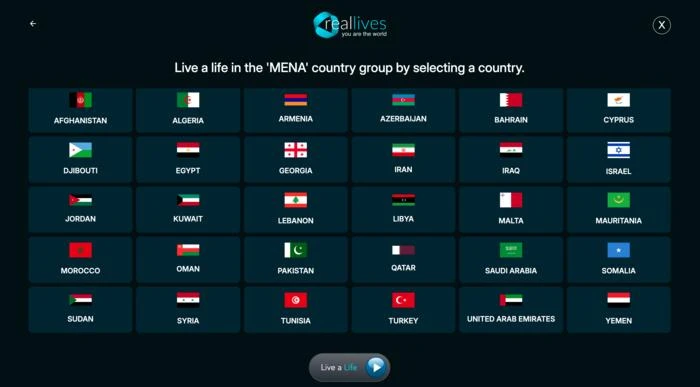
Markus Al-Afifi knew the simulation would be difficult. That was the point. Each of the 148 teenagers sitting in classrooms across five Swedish schools was about to be born as a randomly generated character somewhere in the Middle East or North Africa. They would live that character's life from birth, navigating wars, poverty, illness, and the bureaucratic machinery of international migration, trying to reach a country of their choosing somewhere else in the world.
About a quarter of them would never make it.
Born into someone else's constraints
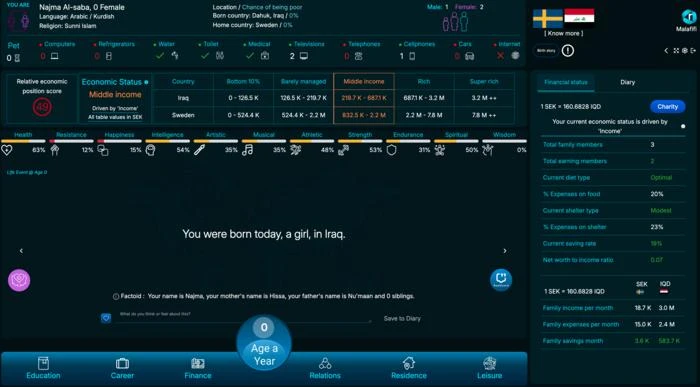
The digital simulation, developed using research-based data on global migration patterns, assigns each player a random starting country, socioeconomic status, health profile, and set of resources. Players do not choose their circumstances. They inherit them, the way real migrants do - born into a place and a situation not of their making, tasked with building a life from whatever they are given.
Over the course of the simulation, players encounter world events that affect their trajectory: conflicts, economic crises, health emergencies. They make decisions about when and whether to attempt migration, weighing financial resources against travel options and risks. The simulation runs through an entire lifespan, from birth to death in another country - or, for many, death without ever having left.
The 148 students, aged 14 to 19, played individually. Their journeys were randomized and unique. Some accumulated enough resources to migrate successfully. Others spent entire virtual lifetimes unable to afford passage, unable to obtain travel documents, or struck down by illness before they could move. Roughly 25% attempted to migrate but failed due to financial constraints, limited travel options, illness, or death.
"It's not really surprising that many students were unable to migrate their characters," said Al-Afifi, the study's lead author at Uppsala University. "In reality, migration is often difficult to achieve, particularly from certain parts of the Middle East and North Africa, where many people live in great economic deprivation. You need favourable conditions, such as money and good health."
Measuring what shifted and what did not
Before and after the simulation, the researchers measured the students' attitudes on two dimensions: social understanding (empathy toward immigrants, awareness of their circumstances) and political understanding (views on immigrants' rights, policy positions on migration). The design drew on intergroup contact theory, which holds that meaningful contact between groups - even indirect or simulated contact - can reduce prejudice.
The social dimension moved. Students showed statistically significant increases in social understanding following the simulation. They reported greater empathy toward immigrants and a deeper appreciation of the structural barriers that constrain migration decisions. The experience of failing to migrate a character despite best efforts appeared to be particularly affecting.
"This game is likely to be an eye-opener for many students who believe that the opportunity to migrate is wide open to everyone, regardless of their circumstances," Al-Afifi said.
The political dimension, however, barely shifted. Students' views on immigrants' rights, immigration policy, and related political questions showed no statistically significant change. Whatever the simulation did to their empathy, it did not translate into altered policy preferences.
Why empathy moved but politics did not
The divergence is instructive. Social understanding - the capacity to recognize another person's situation and feel something about it - is relatively malleable. A vivid, first-person experience, even a simulated one, can create the cognitive and emotional conditions for perspective-taking. When a teenager spends forty-five minutes trying to get a virtual character out of a war zone and fails because of money, health, or bureaucratic barriers, the abstraction of "refugee experience" becomes concrete.
Political attitudes, by contrast, are anchored in identity, values, and social context. They are shaped over years by family, media, peer groups, and political culture. A single classroom intervention, however powerful, is unlikely to dislodge them. The researchers were not surprised by this finding, and they do not frame it as a failure. Political views on migration are legitimately complex, and a simulation that shifted them dramatically after one session would raise its own concerns about manipulation.
"Political views on immigrants' rights are more stable and do not change so easily as a result of a single intervention of this kind," Al-Afifi noted.
Fact-based gameplay in an era of polarized debate
The simulation occupies an interesting position in the landscape of migration education. Traditional teaching methods rely heavily on statistics - how many refugees, from where, going where. Those numbers are important but abstract. They do not create the experiential understanding that drives empathy. Role-playing exercises can create emotional engagement but often lack empirical grounding, risking oversimplification or emotional manipulation.
This simulation attempts to thread both needles. Its mechanics are built on real demographic, economic, and geopolitical data. The probabilities that shape each character's life reflect actual conditions in the countries represented. The financial constraints, health risks, and travel barriers are calibrated to reality, not drama. At the same time, the first-person gameplay creates the kind of experiential engagement that statistics alone cannot.
Thomas Nygren, a professor at Uppsala University and co-author, positioned the approach in the context of evidence-based education: "At a time of polarised debate on migration and widespread disinformation, this offers new opportunities to address attitudes in an evidence-based manner."
How prior knowledge shaped the response
Not all students responded equally. The researchers found that the simulation's impact on social understanding was moderated by prior knowledge, baseline attitudes, and perceived learning. Students who entered the simulation with more existing knowledge about migration causes showed different patterns of attitude change than those with less background. The interaction between pre-existing beliefs and the simulation experience was complex and not reducible to a simple narrative of "ignorance corrected by experience."
The analysis used three statistical methods - the Wilcoxon signed-rank test, hierarchical regression analysis, and interaction analysis - to parse these effects. The methodological rigor helps, but the sample size of 148 students across five schools limits the generalizability of subgroup findings.
Constraints on what the study can claim
Several limitations are important. The 148-student sample, while adequate for detecting main effects, is not large enough to draw confident conclusions about how the simulation works differently for different subgroups. The students were all Swedish, and attitudes toward migration are deeply shaped by national context - a simulation that works in Sweden might produce different results in Hungary, Greece, or the United States.
The study measured attitudes immediately after the simulation. Whether the increased social understanding persists over weeks or months is unknown. Short-term attitude shifts often fade without reinforcement, and the study does not include a delayed follow-up assessment.
There is also no control group that received an alternative intervention. The comparison is between pre-simulation and post-simulation attitudes in the same students. It is possible that any engaging classroom activity about migration - a documentary, a guest speaker, a group discussion - would produce similar effects. Without a head-to-head comparison, the specific contribution of the simulation format remains uncertain.
What the study does establish is that a carefully designed, data-driven migration simulation can shift social empathy among teenage students in a measurable direction. It also demonstrates, honestly, what such an intervention cannot do: it does not change political attitudes after a single session. For educators working in the space between information and empathy, between data and understanding, that is a useful and realistic set of expectations.