Via Ferrata is booming across North America - and research can't keep up
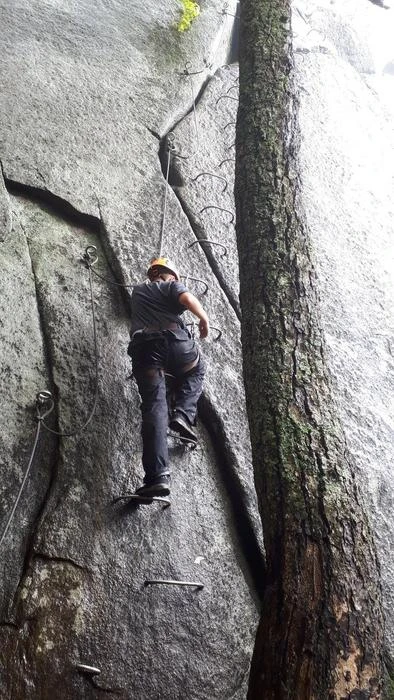
Somewhere between a hiking trail and a rock climb, bolted to a cliff face with steel cables and iron rungs, Via Ferrata has quietly become one of the fastest-growing outdoor recreation activities in North America. The Italian phrase means "iron path," and the concept is simple: engineered climbing routes that use fixed infrastructure - cables, ladders, bridges, metal steps - to give people access to vertical terrain that would otherwise require technical climbing skills.
The appeal is obvious. Via Ferrata offers the thrill of exposed mountain terrain without the years of training that traditional climbing demands. It is structured enough to be commercially guided, dramatic enough to draw tourists, and accessible enough to attract participants who would never tie into a climbing rope. During and after the COVID-19 pandemic, demand surged as people sought outdoor adventure close to home.
But according to the first comprehensive academic review of the sector, that growth is running well ahead of the research needed to manage it responsibly.
A sport without its own research base
The scoping review, published in the Journal of Outdoor Recreation and Tourism by researchers at the University of Eastern Finland and Lakehead University, examined the existing academic literature on Via Ferrata and found it scattered, thin, and almost entirely folded into broader studies of mountaineering, climbing, or adventure tourism. Via Ferrata has been treated as a subcategory of other activities rather than as a distinct pursuit with its own characteristics.
"Our findings show that Via Ferrata has often been treated as a sub-category of mountaineering or climbing," said Kelsey Johansen, a postdoctoral researcher at the University of Eastern Finland. "In reality, it represents a distinct hybrid activity with its own participation pathways, risk profiles, and destination impacts."
That distinction matters for practical reasons. Via Ferrata participants are typically less experienced than rock climbers or mountaineers. They rely on fixed infrastructure rather than personal skill to manage risk. The routes themselves are engineered structures that require maintenance, inspection, and replacement on timelines determined by weather, use intensity, and material degradation. None of these characteristics align neatly with the research frameworks developed for traditional climbing or hiking.
North America's post-pandemic expansion
In Europe, Via Ferrata has deep roots. The Dolomites, the Austrian Alps, and ranges across France, Switzerland, and Spain have hosted established route networks for decades, with corresponding infrastructure, regulatory frameworks, and cultural familiarity. European terminology reflects this maturity: Italian routes are distinguished as Sentiero Attrezzato (equipped paths), while German-speaking regions use Klettersteig (climbing path), each term carrying specific expectations about difficulty, infrastructure, and management.
North America's Via Ferrata landscape is different. Most routes are recent constructions, many built during or after the pandemic. They are often developed by private operators or resort companies seeking to diversify outdoor recreation offerings. The regulatory environment is fragmented. Some routes cross public land managed by federal or state agencies; others are on private property with minimal oversight. Standards for route construction, maintenance intervals, and safety equipment vary widely.
"Via Ferrata is no longer a niche alpine curiosity," said Harvey Lemelin, professor at Lakehead University's School of Outdoor Recreation, Parks and Tourism. "It is becoming a structured, commercialised gateway to vertical terrain. Yet the sport's development is outpacing the research needed to support evidence-informed route planning, environmental management and industry standards."
Environmental access and its complications
Via Ferrata routes, by design, open previously inaccessible terrain to a broader public. That includes alpine environments, canyon walls, and cliff systems that may harbor fragile ecosystems - lichen communities, raptor nesting sites, rare plant populations, and geological features sensitive to physical disturbance. The same infrastructure that makes the terrain accessible also channels foot traffic along fixed corridors, concentrating impact in ways that dispersed mountaineering does not.
Climate change compounds these pressures. Warming temperatures are altering seasonal access windows, affecting permafrost stability in high-altitude settings, and increasing the frequency of rockfall events that can damage fixed infrastructure. Long-term planning for route maintenance and safety must now account for environmental conditions that are changing faster than historical experience would predict.
The economic opportunities are real. Via Ferrata routes attract tourists, extend the season for mountain destinations, and create employment for guides, equipment rental operators, and hospitality businesses. But capturing those benefits sustainably requires planning frameworks that do not yet exist in most North American jurisdictions.
What the review calls for
The study stops short of prescribing specific management guidelines - the research base is too thin for that. Instead, it establishes a research agenda and calls for collaboration among the stakeholders who will need to build that base: Via Ferrata operators and guiding services, professional mountaineering and climbing associations, land management agencies, destination management organizations, and industry bodies in both North America and the European Union.
The next phase of the research program, led by Johansen and Lemelin, will collect data and industry perspectives to develop applied management guidelines. They are actively seeking participation from operators, associations, and land managers on both continents.
Gaps in the current evidence
The limitations of a scoping review are inherent to the format. The study maps what research exists; it does not generate new empirical data. And what it maps is sparse. Much of the existing Via Ferrata literature comes from European contexts with established regulatory and cultural frameworks that may not transfer directly to North American settings. The safety data, in particular, is limited - accident rates, injury patterns, and near-miss reporting for Via Ferrata are not systematically collected in most jurisdictions.
The review also cannot assess the quality of existing route infrastructure or the adequacy of current safety practices. Those assessments require on-the-ground engineering inspections and operational audits that are beyond the scope of a literature review. Whether the rapid expansion of North American Via Ferrata has created routes that meet appropriate safety standards is an open and urgent question.
The economic dimensions are similarly understudied. How much revenue Via Ferrata generates for mountain communities, how that revenue is distributed, and whether it displaces other outdoor recreation uses are questions the current literature does not answer. The environmental impacts - on cliff ecosystems, on wildlife, on water quality in canyon settings - are even less documented.
The timing of the review is significant. Via Ferrata development is occurring in the context of broader shifts in outdoor recreation - rising participation across nearly all categories, growing commercial interest from resort operators and tourism developers, and increasing attention to the environmental and social impacts of recreation on public lands. These trends create both opportunity and pressure. The economic case for new Via Ferrata routes is strong; the regulatory and environmental case requires research that does not yet exist in sufficient depth.
What the study does accomplish is naming the gap. Via Ferrata has grown from a European alpine tradition into a global outdoor recreation industry without developing a corresponding research infrastructure. The steel cables are in place on the cliff faces. The evidence base for managing them responsibly is still being assembled.