Ants continually relearn who belongs in the colony - but never forget their own kind
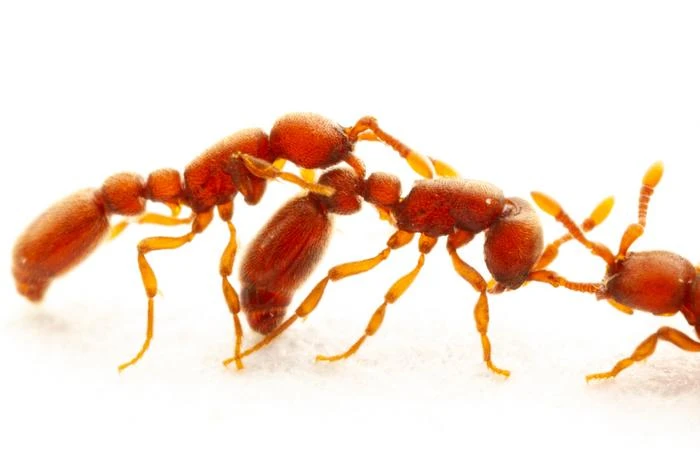
Drop a foreign ant into a colony, and it will be bitten within seconds. The residents do not deliberate. They do not investigate. They detect a chemical signature that does not match their own, and they attack. This ability to instantly distinguish nestmate from intruder is fundamental to ant colony life - without it, parasites would infiltrate nests, steal resources, and hijack the colony's labor force.
But how rigid is that recognition system? Can it change? Can an outsider ever become an insider? A study published in Current Biology by researchers at Rockefeller University shows that the answer is more nuanced than the biting might suggest.
The same molecules, different ratios
Ants identify each other through cuticular hydrocarbons - waxy chemical compounds that coat their exoskeletons. Every ant colony uses the same basic set of compounds, but each colony blends them in a unique ratio, creating a chemical signature as distinctive as a fingerprint. Ants learn this signature early in life and use it as the template for friend-or-foe decisions.
The system works remarkably well. But it faces a challenge: colony odors are not static. The genetic makeup of a colony can shift as queens die and are replaced. Environmental factors - diet, nesting material, surrounding vegetation - can alter the chemical profile. Neighboring colonies may change, requiring different discrimination thresholds. If the recognition template were locked in at birth and never updated, it would gradually become useless.
"Ants must have some way of updating this system," said Daniel Kronauer, head of the Laboratory of Social Evolution and Behavior at Rockefeller.
Clonal ants as a controlled experiment
Studying nestmate recognition in most ant species is complicated by genetic diversity within colonies. Tiphaine Bailly, a postdoctoral associate in Kronauer's lab, turned instead to the clonal raider ant (Ooceraea biroi). This unusual species reproduces asexually - every individual is a genetic clone of its mother. Different clonal lineages are genetically distinct from one another but internally uniform, allowing researchers to build colonies of known genetic composition and test recognition with precision that would be impossible in sexually reproducing species.
Chemical analysis confirmed the setup: colonies of different clonal lineages shared the same set of cuticular hydrocarbons but combined them in different ratios, producing distinct colony-specific scent profiles. Baseline aggression tests confirmed that ants reliably attacked individuals from foreign lineages.
One month to acceptance
The researchers then asked whether prolonged exposure could change the rules. They placed young ants - whose chemical profiles were still faint and developing - into colonies of a foreign genotype. After one month of continuous contact, these transplanted ants had chemically assimilated. Their hydrocarbon profiles now resembled their foster colony, not their birth colony. And when tested separately, they showed no aggression toward foster colony members - behaving as if they belonged.
The chemical assimilation makes sense: cuticular hydrocarbons are partly absorbed from nestmates and the shared environment, so living among foreign ants gradually shifts an individual's scent. But the behavioral tolerance was more interesting. The transplanted ants did not merely smell like their foster colony; they were treated as members of it. The colony's recognition system had accepted them.
The limits of learned tolerance
But the acceptance had boundaries. Even ants that had been separated from their own genotype since the egg stage - individuals that had never lived among genetic relatives - still accepted ants of their own genotype when tested. Experience could broaden the recognition template to include foreigners, but it could not erase the intrinsic recognition of self. Something about an ant's own genotype was recognized without learning, without exposure, without any prior contact.
This is not unlike how the vertebrate immune system distinguishes self from non-self. Immune cells learn to tolerate the body's own proteins through exposure during development, but they also carry innate receptors that recognize broad categories of foreign molecules. The ant system appears to combine learned and innate components in a similar way - though, as Kronauer was careful to note, the molecular mechanisms are entirely different.
Tolerance fades without contact
The learned tolerance was also fragile. When transplanted ants were separated from their foster colony, aggression returned within about a week. Over time, the separated ants' chemical profiles drifted back toward their original genotype-specific composition, eventually causing their former foster nestmates to attack them as well. The acceptance was maintained by ongoing contact, not by a permanent change in the recognition template.
But the decay was not instantaneous. Even after five days of complete separation, ants that had been periodically re-exposed to their foster colony maintained tolerance. This time course - days, not minutes or hours - suggests that the tolerance involves longer-lasting olfactory memory rather than short-lived sensory adaptation, which typically fades within minutes.
Brief, occasional encounters were enough to sustain tolerance, which has practical implications for understanding how mixed colonies persist in nature. Ant colonies are not sealed units. Foragers leave and return. Workers move between nest chambers. The recognition system does not need constant reinforcement - just periodic reminders.
Parallels to immune tolerance
The researchers drew an explicit comparison to immune desensitization therapy, in which patients receive small, controlled doses of an allergen - pollen, for example - until their immune system stops treating it as a threat. The principle is similar: repeated, low-level exposure to a foreign signal gradually dampens the defensive response.
For ant colonies, this mechanism could serve an adaptive function. Colonies occasionally merge, absorb orphaned workers, or encounter closely related neighbors. A recognition system rigid enough to attack any outsider would make such social flexibility impossible. A system that can gradually accommodate foreign scent profiles through sustained exposure, while retaining an innate recognition of genetic self, allows the colony to adapt to changing social circumstances without losing its ability to defend against true intruders.
"The evolution of an ant colony is similar to the transition from a single-celled to a multicellular organism, and it is interesting to think about the parallels between major transitions in evolution," Kronauer said. "These parallels may run deeper than we thought."
Toward the neural circuits of social recognition
The study was designed as behavioral groundwork. The researchers deliberately used a species and experimental framework that are compatible with neurobiological tools - miniature brain imaging, genetic manipulation of neural circuits, optogenetics - that can probe where and how recognition decisions are made in the ant brain.
"Now we can combine the neurobiological tools with this behavioral system and image neural activity while an ant encounters a nestmate or a non-nestmate," Kronauer said. "With this foundation, we can finally begin to ask where learning and adaptation happens in the brain."
What the study cannot tell us
The experiments were conducted under controlled laboratory conditions with clonal ants - a species that reproduces asexually and forms relatively small colonies. Whether the same dynamics of learned tolerance and innate self-recognition apply to the enormous, genetically diverse colonies of species like leafcutter ants or army ants is an open question. The controlled environment also eliminates many variables present in nature: predators, resource competition, parasites, and the complex chemical environments of natural nesting sites.
The molecular basis of the innate self-recognition remains unknown. How an ant that has never encountered its own genotype still recognizes and accepts it is a puzzle the study poses but does not solve. The answer likely involves genetically determined components of the cuticular hydrocarbon profile that persist regardless of social environment, but the specific compounds and the neural mechanisms that detect them have not been identified.
The study also does not address how these recognition dynamics interact with the broader ecology of ant colonies - how tolerance thresholds shift during periods of resource scarcity, how queen number or reproductive status affects nestmate recognition, or how recognition systems evolve when colonies face persistent threats from social parasites. These are questions for future work, now informed by a clearer behavioral framework.