Pathways for the sustainable development of polymeric materials
Published 2026-03-24 · Original archive entry · Explore research explainers
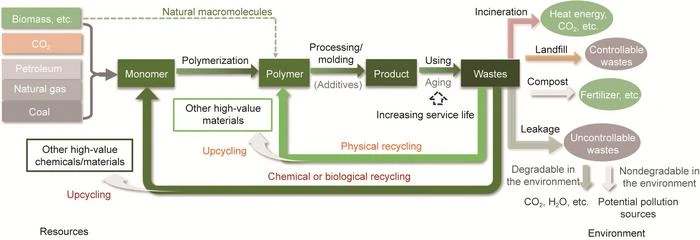
The resource waste and ecological pressure caused by waste polymeric materials have made exploring sustainable development pathways a global consensus. In a opinion article titled “Pathways Toward the Sustainable Development of Polymeric Materials” published in Engineering, Prof. Yu-Zhong Wang from Sichuan University systematically outlines multiple routes for the green development of polymeric materials and provides strategic recommendations for establishing a circular system covering the entire material lifecycle.
The article discusses the topic from two dimensions: resources and the environment. Regarding feedstocks, utilizing renewable biomass resources to synthesize biomass-based polymeric materials can effectively reduce dependence on fossil resources and lower carbon emissions. However, the large-scale application of biomass-based materials faces challenges due to the well-established industrial chain and cost advantages of petroleum-based polymers. The author notes that biomass-based materials must achieve functional substitutability or superiority to promote their widespread adoption. Furthermore, using carbon dioxide as a feedstock for preparing polymeric materials not only contributes to achieving carbon peak and carbon neutrality goals but also helps mitigate fossil resource consumption. Nevertheless, the thermodynamic stability and kinetic inertness of carbon dioxide pose technical challenges for its efficient conversion, necessitating the development of novel, more low-carbon and energy-efficient transformation methods.
Regarding the recycling of waste polymeric materials, the article proposes three fundamental criteria that an ideal recycling method should satisfy:
(1) Waste-to-product volume alignment: To ensure recycled output matches waste volume in quantity and value for closed-loop recycling or upcycling.
(2) Efficiency and sustainability: To achieve high-yield, separable, and fully utilizable products via green management with a low-carbon footprint.
(3) Economic viability: To remain market-competitive without subsidies or policy incentives.
For the design of future recyclable polymers, the article summarizes two main strategies. The first involves designing and synthesizing novel polymers that combine excellent service performance with complete depolymerization capability. The second focuses on modifying existing polymers by introducing small amounts of co-monomer units into the main chain, aiming to maintain or enhance original performance or add new functionalities while endowing the polymer with the ability to fully depolymerize into monomers, thereby enabling closed-loop chemical recycling.
Addressing the challenge of disposing of single-use polymeric materials in scenarios where collection is difficult, the article emphasizes biodegradation as an important supplementary approach. Yu-Zhong Wang first proposed the concept of repeatedly chemically recyclable and biodegradable polymers in 2011, which has gained increasing attention in recent years. The article outlines five conditions that ideal polymers for single-use applications should satisfy: (1) high-yield monomer recovery under mild conditions and repolymerization of these monomers without separation or purification, establishing a closed-loop chemical cycle; (2) complete biodegradation in natural environments such as soil, freshwater, and seawater, and ultimate conversion into carbon dioxide, water or substances harmless to human health and the environment; (3) comparable cost and comprehensive properties to traditional polymeric materials used in the same applications; (4) tunable degradation rate to align service life with disposal; and (5) whenever possible, their monomers are derived from renewable biomass-based feedstocks with sustainable sources, offering lower carbon emissions and environmental superiority.
Furthermore, the article notes that crosslinked polymers constructed through non-covalent interactions and dynamic covalent bonds exhibit dynamic reversibility, endowing them with reprocessability and chemical recyclability. This opens up important new avenues for addressing plastic pollution and waste polymeric material problems.
The sustainable development pathway proposed by Yu-Zhong Wang constructs a green circular system covering the entire material lifecycle from three levels: resource substitution, recycling of end-of-life polymeric materials, and design of new recyclable polymeric materials. This opinion article provides a systematic and instructive framework for the field of polymeric materials to address environmental and resource challenges.
The article, titled “Pathways Toward the Sustainable Development of Polymeric Materials,” was authored by Yu-Zhong Wang. It was published in the journal Engineering. Full text of the open access paper: https://doi.org/10.1016/j.eng.2025.12.031. For more information about Engineering, visit the website at https://www.sciencedirect.com/journal/engineering.
END
The article discusses the topic from two dimensions: resources and the environment. Regarding feedstocks, utilizing renewable biomass resources to synthesize biomass-based polymeric materials can effectively reduce dependence on fossil resources and lower carbon emissions. However, the large-scale application of biomass-based materials faces challenges due to the well-established industrial chain and cost advantages of petroleum-based polymers. The author notes that biomass-based materials must achieve functional substitutability or superiority to promote their widespread adoption. Furthermore, using carbon dioxide as a feedstock for preparing polymeric materials not only contributes to achieving carbon peak and carbon neutrality goals but also helps mitigate fossil resource consumption. Nevertheless, the thermodynamic stability and kinetic inertness of carbon dioxide pose technical challenges for its efficient conversion, necessitating the development of novel, more low-carbon and energy-efficient transformation methods.
Regarding the recycling of waste polymeric materials, the article proposes three fundamental criteria that an ideal recycling method should satisfy:
(1) Waste-to-product volume alignment: To ensure recycled output matches waste volume in quantity and value for closed-loop recycling or upcycling.
(2) Efficiency and sustainability: To achieve high-yield, separable, and fully utilizable products via green management with a low-carbon footprint.
(3) Economic viability: To remain market-competitive without subsidies or policy incentives.
For the design of future recyclable polymers, the article summarizes two main strategies. The first involves designing and synthesizing novel polymers that combine excellent service performance with complete depolymerization capability. The second focuses on modifying existing polymers by introducing small amounts of co-monomer units into the main chain, aiming to maintain or enhance original performance or add new functionalities while endowing the polymer with the ability to fully depolymerize into monomers, thereby enabling closed-loop chemical recycling.
Addressing the challenge of disposing of single-use polymeric materials in scenarios where collection is difficult, the article emphasizes biodegradation as an important supplementary approach. Yu-Zhong Wang first proposed the concept of repeatedly chemically recyclable and biodegradable polymers in 2011, which has gained increasing attention in recent years. The article outlines five conditions that ideal polymers for single-use applications should satisfy: (1) high-yield monomer recovery under mild conditions and repolymerization of these monomers without separation or purification, establishing a closed-loop chemical cycle; (2) complete biodegradation in natural environments such as soil, freshwater, and seawater, and ultimate conversion into carbon dioxide, water or substances harmless to human health and the environment; (3) comparable cost and comprehensive properties to traditional polymeric materials used in the same applications; (4) tunable degradation rate to align service life with disposal; and (5) whenever possible, their monomers are derived from renewable biomass-based feedstocks with sustainable sources, offering lower carbon emissions and environmental superiority.
Furthermore, the article notes that crosslinked polymers constructed through non-covalent interactions and dynamic covalent bonds exhibit dynamic reversibility, endowing them with reprocessability and chemical recyclability. This opens up important new avenues for addressing plastic pollution and waste polymeric material problems.
The sustainable development pathway proposed by Yu-Zhong Wang constructs a green circular system covering the entire material lifecycle from three levels: resource substitution, recycling of end-of-life polymeric materials, and design of new recyclable polymeric materials. This opinion article provides a systematic and instructive framework for the field of polymeric materials to address environmental and resource challenges.
The article, titled “Pathways Toward the Sustainable Development of Polymeric Materials,” was authored by Yu-Zhong Wang. It was published in the journal Engineering. Full text of the open access paper: https://doi.org/10.1016/j.eng.2025.12.031. For more information about Engineering, visit the website at https://www.sciencedirect.com/journal/engineering.
END