THE ORIGINAL COLLECTION · SINCE 2010

Space
press releases.

Research announcements from universities, hospitals and scientific institutions. Explore the stories, people and discoveries behind the headlines.

Original publication datesPage 18
FIND A STORY

Find a past release.

Dates and source material belong to the original release.

Read our research explainers

Browse the collection · original publication order

NTU Singapore-led discovery poised to help detect dark matter and pave the way to unravel the universe’s secrets
Space

NTU Singapore-led discovery poised to help detect dark matter and pave the way to unravel the universe’s secrets

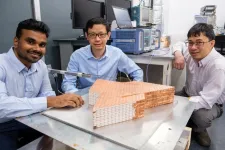
Researchers led by Nanyang Technological University, Singapore (NTU Singapore) have developed a breakthrough technique that could lay the foundations for detecting the universe’s “dark matter” and bring scientists closer than before to uncovering the secrets of the cosmos. The things we can see on Earth and in space – visible matter like rocks and stars – make up only a small portion of the universe, as scientists believe that 85 per cent of matter in the cosmos comprises invisible dark matter. This mysterious substance ...

Read the release
Discovering hidden wrinkles in spacecraft membrane with a single camera
Space

Discovering hidden wrinkles in spacecraft membrane with a single camera

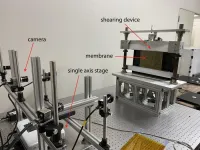
Exiting Earth’s gravity takes an enormous amount of fuel and power. Due to this, spacecraft strapped to rockets are limited in their carry capacity and every gram must be accounted for. To lighten the load, thin membranes are being researched as alternative materials, but their plastic wrap property causes wrinkling that can affect operational performance. For this reason, there is a need to develop measurement technology that can accurately detect deformations. Professor Takashi Iwasa at Osaka Metropolitan University’s Graduate School of Engineering led a team in developing a method for measuring the size of wrinkles ...

Read the release
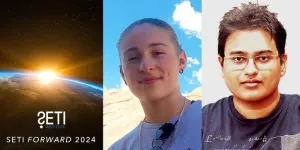
SETI Forward recognizes tomorrow’s cosmic pioneers
Space

SETI Forward recognizes tomorrow’s cosmic pioneers

January 7, 2025, Mountain View, CA -- The SETI Institute announces the 2024 SETI Forward Award recipients: Gabriella Rizzo and Pritvik Sinhadc. This year's recipients worked on research projects to understand extremophiles in deep-sea hydrothermal vents and to analyze gravitational wave signals for potential extraterrestrial technosignatures. Established by Lew Levy, SETI Forward committee founder and member of the SETI Institute’s Council of Advisors, this award is a beacon for promising young scientists. The goal is to connect students with opportunities that foster their ...

Read the release
SwRI models Pluto-Charon formation scenario that mimics Earth-Moon system
Space

SwRI models Pluto-Charon formation scenario that mimics Earth-Moon system

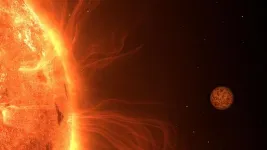
SAN ANTONIO — January 7, 2025 —A NASA postdoctoral researcher at Southwest Research Institute has used advanced models that indicate that the formation of Pluto and Charon may parallel that of the Earth-Moon system. Both systems include a moon that is a large fraction of the size of the main body, unlike other moons in the solar system. The scenario also could support Pluto’s active geology and possible subsurface ocean, despite its location at the frozen edge of the solar system. “We ...

Read the release
Space

Physicists explain a stellar stream’s distinctive features

RIVERSIDE, Calif. -- Physicists have proposed a solution to a long-standing puzzle surrounding the GD-1 stellar stream, one of the most well-studied streams within the galactic halo of the Milky Way, known for its long, thin structure, and unusual spur and gap features. The team of researchers, led by Hai-Bo Yu at the University of California, Riverside, proposed that a core-collapsing self-interacting dark matter (SIDM) “subhalo” — a smaller, satellite halo within the galactic halo — is responsible for the peculiar spur and gap features observed in the GD-1 stellar stream. Study ...

Read the release
Newly discovered 'kiss and capture' mechanism explains the formation of Pluto and its largest moon
Space

Newly discovered 'kiss and capture' mechanism explains the formation of Pluto and its largest moon

Billions of years ago, in the frigid outer reaches of our solar system, two icy worlds collided. Rather than destroying each other in a cosmic catastrophe, they spun together like a celestial snowman, finally separating while remaining forever linked in orbit. This is how Pluto and its largest moon, Charon, originated, according to a new University of Arizona study that challenges decades of scientific assumptions. A study led by Adeene Denton, a NASA postdoctoral fellow who conducted the research at the U of A Lunar and Planetary Laboratory, has revealed this unexpected "kiss and capture" mechanism, which could help scientists better ...

Read the release
New UVA professor’s research may boost next-generation space rockets
Space

New UVA professor’s research may boost next-generation space rockets

Go faster, farther, more efficiently. That’s the goal driving spacecraft propulsion engineers like Chen Cui, a new assistant professor at the University of Virginia School of Engineering and Applied Science. Cui is exploring ways to improve electric propulsion thrusters — a key technology for future space missions. “In order to ensure the technology remains viable for long-term missions, we need to optimize EP integration with spacecraft systems,” Cui said. Working with his former adviser, University of Southern California professor Joseph Wang, ...

Read the release
NASA’s LEXI will provide X-ray vision of Earth’s magnetosphere
Space

NASA’s LEXI will provide X-ray vision of Earth’s magnetosphere

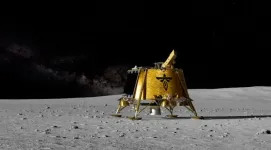
A NASA X-ray imager is heading to the Moon as part of NASA's Artemis campaign, where it will capture the first global images of the magnetic field that shields Earth from solar radiation. The Lunar Environment Heliospheric X-ray Imager, or LEXI, instrument is one of 10 payloads aboard the next lunar delivery through NASA’s CLPS (Commercial Lunar Payload Services) initiative, set to launch from the agency's Kennedy Space Center in Florida no earlier than mid-January, with Firefly Aerospace’s Blue Ghost Lander. The instrument will support ...

Read the release
The nose knows: Nasal swab detects asthma type in kids
Space

The nose knows: Nasal swab detects asthma type in kids

Researchers at the University of Pittsburgh have developed a nasal swab test for kids that diagnoses specific asthma subtype, or endotype. This non-invasive approach could help clinicians prescribe medications more precisely and pave the way for research toward better treatments for lesser-studied asthma types, which have been difficult to diagnose accurately until now. Published today in JAMA, the findings are based on data from three independent U.S.-based studies that focused on Puerto Rican and African American youths, who have higher rates of asthma and are more likely to die from the disease than their non-Hispanic white counterparts. “Asthma ...

Read the release
A novel disturbance rejection optimal guidance method for enhancing precision landing performance of reusable rockets
Space

A novel disturbance rejection optimal guidance method for enhancing precision landing performance of reusable rockets

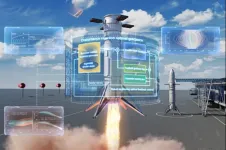
Powered descent guidance (PDG) is a key technology for reusable rockets to accomplish high-precision landing on Earth. Different from the well-established PDG for lunar landing and planetary landing, endoatmospheric powered descent guidance is required to accommodate nonlinear dynamics and more disturbing flight conditions, including engine thrust fluctuation, aerodynamic uncertainty, and winds. For example, the winds can produce a persistent aerodynamic force disturbance on the rocket, resulting in ...

Read the release
Space

First results from 2021 rocket launch shed light on aurora’s birth

Newly published results from a 2021 experiment led by a University of Alaska Fairbanks scientist have begun to reveal the particle-level processes that create the type of auroras that dance rapidly across the sky. The Kinetic-scale Energy and momentum Transport experiment — KiNET-X — lifted off from NASA’s Wallops Flight Facility in Virginia on May 16, 2021, in the final minutes of the final night of the nine-day launch window. UAF professor Peter Delamere’s analysis of the experiment’s results was published Nov. 19 in Physics of Plasmas. “The ...

Read the release
Massive black hole in the early universe spotted taking a ‘nap’ after overeating
Space

Massive black hole in the early universe spotted taking a ‘nap’ after overeating

Scientists have spotted a massive black hole in the early universe that is ‘napping’ after stuffing itself with too much food. Like a bear gorging itself on salmon before hibernating for the winter, or a much-needed nap after Christmas dinner, this black hole has overeaten to the point that it is lying dormant in its host galaxy. An international team of astronomers, led by the University of Cambridge, used the NASA/ESA/CSA James Webb Space Telescope to detect this black hole in the early universe, just 800 million years after the Big Bang. The black hole is huge – ...

Read the release
Survey of 26,000 dead stars confirms key details of extreme stellar behavior
Space

Survey of 26,000 dead stars confirms key details of extreme stellar behavior

A study of more than 26,000 white dwarf stars has confirmed a long-predicted but elusive effect in these ultra-dense, dying stars: Hotter white dwarfs are slightly puffier than cooler ones, even when they have the same mass. The findings bring scientists one step closer to using these stellar objects as natural laboratories to probe the effects of extreme gravity and hunt for exotic dark matter particles. Details about the research, led by Johns Hopkins University, are published in The Astrophysical Journal. “White dwarfs are one of the best characterized stars that we can work with ...

Read the release
Young exoplanet’s atmosphere unexpectedly differs from its birthplace
Space

Young exoplanet’s atmosphere unexpectedly differs from its birthplace

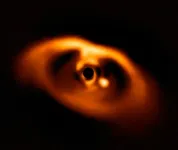
Just as some children physically resemble their parents, many scientists have long thought that developing planets should resemble the swirling disk of gas and dust that births them. But, in a new study, a Northwestern University-led team of astrophysicists discovered the resemblance might be looser than previously thought. By studying a still-forming exoplanet and its surrounding natal disk, the researchers uncovered a mismatched composition of gases in the planet’s atmosphere compared to gases within the disk. The surprising finding potentially confirms long-held skepticism that scientists’ current model of planet formation is too simplified. The ...

Read the release
No cavity, no party: Free-space atoms give superradiant transition a pass
Space

No cavity, no party: Free-space atoms give superradiant transition a pass

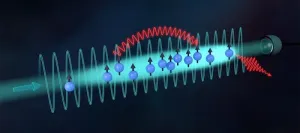
Isolated atoms in free space radiate energy at their own individual pace. However, atoms in an optical cavity interact with the photons bouncing back and forth from the cavity mirrors, and by doing so, they coordinate their photon emission and radiate collectively, all in sync. This enhanced light emission before all the atoms reach the ground state is known as superradiance. Interestingly, if an external laser is used to excite the atoms inside the cavity moderately, the absorption of light by the atoms and the collective emission can ...

Read the release
Space

Astrophysics: Mystery of the ‘missing’ binary stars solved

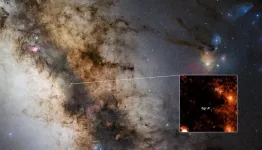
An international team of researchers led by PD Dr Florian Peißker has found the first binary star in the immediate vicinity of the supermassive black hole Sgr A* (Sagittarius A star) at the centre of our galaxy. Although it is known that most stars in the universe do not form alone, so far there are only five confirmed binary stars at a greater distance from the black hole. None of the systems are so close. The researchers assume that the binary star system they found, named D9, will merge into a single star in the near future. The discovery was published in Nature Communications under the title ‘A binary ...

Read the release
First ever binary star found near our galaxy’s supermassive black hole
Space

First ever binary star found near our galaxy’s supermassive black hole

An international team of researchers has detected a binary star orbiting close to Sagittarius A*, the supermassive black hole at the centre of our galaxy. It is the first time a stellar pair has been found in the vicinity of a supermassive black hole. The discovery, based on data collected by the European Southern Observatory’s Very Large Telescope (ESO’s VLT), helps us understand how stars survive in environments with extreme gravity, and could pave the way for the detection of planets close to Sagittarius A*. “Black holes are not as destructive as we thought,” says Florian Peißker, a researcher at the University of Cologne, Germany, and lead author of the ...

Read the release
Space

Event Horizon Telescope: Moving towards a close-up of a black hole and its jets

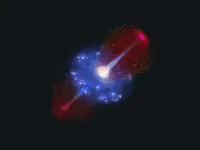
After taking the first images of black holes, the ground-breaking Event Horizon Telescope (EHT) is poised to reveal how black holes launch powerful jets into space. Now, a research team led by Anne-Kathrin Baczko from Chalmers University of Technology in Sweden has shown that the EHT will be able to make exciting images of a supermassive black hole and its jets in the galaxy NGC 1052. The measurements, made with interconnected radio telescopes, also confirm strong magnetic fields close to the black hole’s edge. The main research question for the project’s ...

Read the release
Genomic Press transforms scientific publishing, inspired by moon-bound color story
Space

Genomic Press transforms scientific publishing, inspired by moon-bound color story

SAN BERNARDINO, California, USA, 17 December 2024 - In a compelling Genomic Press Interview, Editor-in-Chief Dr. Julio Licinio reveals how a children's book about a lonely color has shaped the innovative vision of scientific publisher Genomic Press. The story of Flicts, penned by renowned Brazilian artist Ziraldo Alves Pinto, has become more than just a brand element – it represents a revolutionary approach to academic publishing. "Sometimes the ideas that don't fit anywhere else are precisely the ones that help us reach the stars," explains Dr. Licinio, highlighting the publisher's mission to support ...

Read the release
New paper examines the elusive nature of liquid brines on Mars
Space

New paper examines the elusive nature of liquid brines on Mars

More than a hundred years ago, astronomer Percival Lowell made the case for the existence of canals on Mars designed to redistribute water from the Martian ice caps to its lower, drier latitudes. This necessarily meant the existence of Martians to build the canals. While Lowell was proven wrong by better telescopes, the question of whether there’s liquid water on Mars continues to tantalize researchers. Liquid water is a critical precondition for a habitable planet. Yet the combination of low temperature, atmospheric pressure and water vapor pressure on Mars means any liquid water found there would ...

Read the release
Space

Wedel studying how transnational networks shape non-Western offshore spaces

Wedel Studying How Transnational Networks Shape Non-Western Offshore Spaces Janine Wedel, Distinguished University Professor, Schar School of Policy and Government, received money for a project on the growing non-Western offshore system used by transnational networks emanating from autocratic regimes such as Russia to skirt international checks and balances. Wedel and her colleagues are investigating these informal networks and how they enable “weaponized corruption” — the use of corruption for geopolitical ends — and the evasion of Western sanctions. They are ...

Read the release
Anthropologists call for tracking and preservation of human artifacts on Mars
Space

Anthropologists call for tracking and preservation of human artifacts on Mars

LAWRENCE — Are human spacecraft, landers, rovers and other space-exploration debris little more than trash littering the surface of Mars, or the modern equivalent of Clovis points — treasured artifacts marking Homo sapiens’ lust for new frontiers? New scholarship by University of Kansas anthropologist Justin Holcomb argues physical artifacts of human Martian exploration deserve cataloging, preservation and care in order to chronicle humanity’s first attempts at interplanetary exploration. The ...

Read the release
Does the exoplanet Trappist-1 b have an atmosphere after all?
Space

Does the exoplanet Trappist-1 b have an atmosphere after all?

Trappist-1 b is one of seven rocky planets orbiting the star Trappist-1, located 40 light-years away. The planetary system is unique because it allows astronomers to study seven Earth-like planets from relatively close range, with three of them in the so-called habitable zone. This is the area in a planetary system where a planet could have liquid water on the surface. To date, ten research programmes have targeted this system with the James Webb Space Telescope (JWST) for 290 hours. The current study, in which researchers from the Max Planck Institute for Astronomy (MPIA) ...

Read the release
Space

The light of the planet TRAPPIST-1 b measured in two color reveals new insights on the planet’s nature

New TRAPPIST-1 observations with JWST underscore the complexities of confirming a planet's atmosphere using only broadband thermal emission data. This insight takes on added significance with the newly approved "Rocky Worlds" observation program by Space Telescope Science Institute (STScI) which plans to apply this very method to study numerous rocky exoplanets orbiting cool stars. The James Webb Space Telescope (JWST) is revolutionizing the study of exoplanets (planets orbiting stars other than the Sun), notably by enabling detailed spectroscopic studies of small rocky planets, but only if ...

Read the release
Space

Astrophysicists capture astonishing images of gamma-ray flare from supermassive black hole M87

Key takeaways The galaxy M87, located in the Virgo constellation, provided the first-ever photo of a black hole in 2019, when the Event Horizon Telescope captured an image of the supermassive black hole at the galaxy’s center. An international research team including UCLA has observed a teraelectronvolt gamma-ray flare seven orders of magnitude — tens of millions of times — larger than the event horizon, or surface of the black hole itself. A flare of this intensity — which has not been observed in over a decade — can offer crucial insights ...

Read the release
From the original Press-News collection. Issuers of news releases are responsible for the accuracy of their content.