THE ORIGINAL COLLECTION · SINCE 2010

Space
press releases.

Research announcements from universities, hospitals and scientific institutions. Explore the stories, people and discoveries behind the headlines.

Original publication datesPage 17
FIND A STORY

Find a past release.

Dates and source material belong to the original release.

Read our research explainers

Browse the collection · original publication order

A super-Earth laboratory for searching life elsewhere in the Universe
Space

A super-Earth laboratory for searching life elsewhere in the Universe

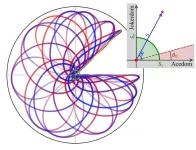
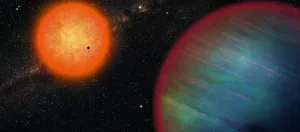
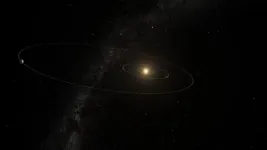
Thirty years after the discovery of the first exoplanet, we detected more than 7000 of them in our Galaxy. But there are still billions more to be discovered! At the same time, exoplanetologists have begun to take an interest in their characteristics, with the aim of finding life elsewhere in the Universe. This is the background to the discovery of super-Earth HD 20794 d by an international team including the University of Geneva (UNIGE) and the NCCR PlanetS. The new planet lies in an eccentric orbit, so that it oscillates in and out of its ...

Read the release

Space

Follow the water: Searching for a lunar oasis

As humankind imagines living off-planet — on the moon, Mars and beyond — the question of how to sustain life revolves around the physical necessities of oxygen, food and water. We know there is water on the moon, but how do we find it? Is it in the craters? The shadowed regions? The poles? Knowing where to look gives astronauts the best chance at successfully living on the moon, something that has, heretofore, remained the stuff of science fiction. Researchers from the University of California ...

Read the release
Australian innovation ‘sifts’ space for mysteries
Space

Australian innovation ‘sifts’ space for mysteries

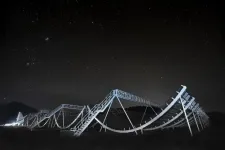
The first trial of an Australian-developed technology has detected mysterious objects by sifting through signals from space like sand on a beach. Astronomers and engineers at CSIRO, Australia’s national science agency, developed the specialised system, CRACO, for their ASKAP radio telescope to rapidly detect mysterious fast radio bursts and other space phenomena. The new technology has now been put to the test by researchers led by the Curtin University node of the International Centre for Radio Astronomy ...

Read the release
Approaching the red planet from the kitchen
Space

Approaching the red planet from the kitchen

Niigata, Japan - Rootless cones are small volcanic landforms ranging from several to several hundred meters in diameter, formed by continuous explosions resulting from the interaction between surface lava and water bodies like lakes and rivers (Figure 1). Unlike regular volcanoes originating from magma rising from deep underground, rootless cones form when lava covers a water-containing layer, triggering explosive reactions. Due to this process, they are also called pseudocraters. While Iceland hosts many rootless cones, they ...

Read the release
Space

Ohio State astronomy professor awarded Henry Draper Medal

COLUMBUS, Ohio – Adam Leroy, a professor of astronomy at The Ohio State University, has been named the recipient of the 2025 Henry Draper Medal. The oldest medal awarded by the National Academy of Sciences, the Henry Draper Medal celebrates those who have made “a recent, original investigation in astronomical physics, of sufficient importance and benefit to science to merit such recognition.” It is awarded every four years. Leroy’s work was selected for pathbreaking efforts that have characterized, “in unprecedented detail, the physical ...

Read the release
Imagining the physics of George R.R. Martin’s fictional universe
Space

Imagining the physics of George R.R. Martin’s fictional universe

WASHINGTON, Jan. 23, 2025 – Many science fiction authors try to incorporate scientific principles into their work, but Ian Tregillis, who is a contributing author of the Wild Cards book series when he’s not working as a physicist at Los Alamos National Laboratory, took it one step further: He derived a formula to describe the dynamics of the fictional universe’s viral system. In independent research published in the American Journal of Physics, from AIP Publishing, Tregillis and George R.R. Martin derive a formula for viral behavior in the Wild Cards universe. Wild Cards is a science fiction series written by a collection of authors and ...

Read the release
SwRI-led PUNCH spacecraft make final pit stop before launch
Space

SwRI-led PUNCH spacecraft make final pit stop before launch

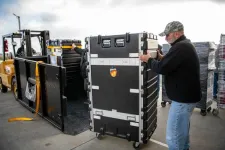
SAN ANTONIO — January 22, 2025 —Four small suitcase-sized spacecraft, designed and built by Southwest Research Institute, have made a final Earth-side pit stop at Vandenberg Space Force Base in California. NASA’s Polarimeter to Unify the Corona and Heliosphere, or PUNCH, mission is sharing a ride to space with the Spectro-Photometer for the History of the Universe, Epoch of Reionization and Ices Explorer (SPHEREx) observatory. “The PUNCH mission will integrate our understanding of the Sun’s corona, the outer atmosphere ...

Read the release
Space

Three rockets will ignite Poker Flat’s 2025 launch season

Three NASA sounding rockets are set to launch from Poker Flat Research Range as early as Tuesday to learn more about three types of aurora — black, flickering and fast-pulsating. The launch window is Jan. 21 through Feb. 5. The University of Alaska Fairbanks Geophysical Institute owns Poker Flat, located at Mile 30 Steese Highway, and operates it under a contract with NASA’s Wallops Flight Facility, part of the agency’s Goddard Space Flight Center. The launches will be the first of the season. As of April 2024, Poker Flat had launched 350 major sounding rockets and ...

Read the release
Astronomers thought they understood fast radio bursts. A recent one calls that into question.
Space

Astronomers thought they understood fast radio bursts. A recent one calls that into question.

Astronomer Calvin Leung was excited last summer to crunch data from a newly commissioned radio telescope to precisely pinpoint the origin of repeated bursts of intense radio waves — so-called fast radio bursts (FRBs) — emanating from somewhere in the northern constellation Ursa Minor. Leung, a Miller Postdoctoral Fellowship recipient at the University of California, Berkeley, hopes eventually to understand the origins of these mysterious bursts and use them as probes to trace the large-scale structure of the universe, a key to its origin and evolution. He had written most of the computer code that allowed ...

Read the release
First fast radio burst traced to old, dead, elliptical galaxy
Space

First fast radio burst traced to old, dead, elliptical galaxy

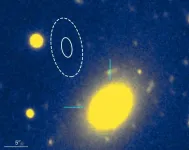
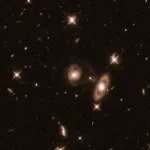
For the first time, astronomers have traced a fast radio burst (FRB) to the outskirts of an ancient, dead, elliptical galaxy — an unprecedented home for a phenomenon previously associated with much younger galaxies. Detailed in two complementary studies led by Northwestern University and McGill University, the discovery shatters assumptions that FRBs solely emanate from regions of active star formation. The new observational evidence, instead, hints that the origins of these mysterious cosmic events might be more diverse than ...

Read the release
U of A astronomers capture unprecedented view of supermassive black hole in action
Space

U of A astronomers capture unprecedented view of supermassive black hole in action

Active galactic nuclei are supermassive black holes at the center of certain galaxies. As matter falls into these black holes, enormous amounts of energy are released, making active galactic nuclei, or AGN, one of the most energetic phenomena that can be observed in space. University of Arizona astronomers have now produced the highest resolution direct images ever taken of an AGN in the infrared, using the Large Binocular Telescope Interferometer. Researchers from the Max Planck Institute for Astronomy in Germany were also involved in the study. The findings are published in the journal Nature Astronomy. "The ...

Read the release
Astrophysicists reveal structure of 74 exocomet belts orbiting nearby stars in landmark survey
Space

Astrophysicists reveal structure of 74 exocomet belts orbiting nearby stars in landmark survey

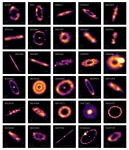
Astrophysicists led by a team from Trinity College Dublin have – for the first time – imaged a large number of exocomet belts around nearby stars, and the tiny pebbles within them. The crystal-clear images show light being emitted from these millimetre-sized pebbles within the belts that orbit 74 nearby stars of a wide variety of ages – from those that are just emerging from birth to those in more mature systems like our own Solar System. The REASONS (REsolved ALMA and SMA Observations of Nearby Stars) study ...

Read the release
Research on performance optimization of virtual data space across WAN
Space

Research on performance optimization of virtual data space across WAN

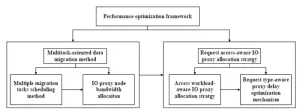
For the high-performance computing in a WAN environment, the geographical locations of national supercomputing centers are scattered and the network topology is complex, so it is difficult to form a unified view of resources. To aggregate the widely dispersed storage resources of national supercomputing centers in China, the team led by Zhisheng Huo have previously proposed a global virtual data space named GVDS. However, the GVDS suffers from performance bottlenecks in data migration and access across WANs. To solve the problems, ...

Read the release
Flexible electronics integrated with paper-thin structure for use in space
Space

Flexible electronics integrated with paper-thin structure for use in space

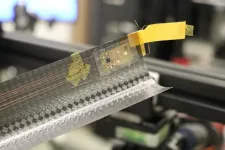
Being lightweight is essential for space structures, particularly for tools used on already small, lightweight satellites. The ability to perform multiple functions is a bonus. To address these characteristics in a new way, researchers at the University of Illinois Urbana-Champaign successfully integrated flexible electronics with a three-ply, self-deployable boom that weighs only about 20 grams. “It's difficult to get commercial electronics integrated into these super thin structures,” said Xin Ning, an aerospace professor in The Grainger College of Engineering at U. of ...

Read the release
NASA scientists find new human-caused shifts in global water cycle
Space

NASA scientists find new human-caused shifts in global water cycle

In a recently published paper, NASA scientists use nearly 20 years of observations to show that the global water cycle is shifting in unprecedented ways. The majority of those shifts are driven by activities such as agriculture and could have impacts on ecosystems and water management, especially in certain regions. “We established with data assimilation that human intervention in the global water cycle is more significant than we thought,” said Sujay Kumar, a research scientist at NASA’s Goddard Space Flight Center in Greenbelt, Maryland, and a co-author ...

Read the release
This tiny galaxy is answering some big questions
Space

This tiny galaxy is answering some big questions

Leo P, a small galaxy and a distant neighbor of the Milky Way, is lighting the way for astronomers to better understand star formation and how a galaxy grows. In a study published in the Astrophysical Journal, a team of researchers led by Kristen McQuinn, a scientist at the Space Telescope Science Institute and an associate professor in the Department of Physics and Astronomy at the Rutgers University-New Brunswick School of Arts and Sciences, has reported finding that Leo P “reignited,” reactivating during a significant period on the timeline of the universe, producing stars when many other small galaxies didn’t. By ...

Read the release
Space

Asteroid impact sulfur release less lethal in dinosaur extinction

Approximately 66 million years ago, the Chicxulub asteroid, estimated to be 10-15 kilometer in diameter, struck the Yucatán Peninsula (in current-day Mexico), creating a 200-kilometer-wide impact crater. This impact triggered a chain reaction of destructive events including a rapid climate change that eventually led to the extinction of the non-avian dinosaurs and in total about 75% of species on Earth. The main culprit is most likely the “impact winter”, which was caused by massive release of dust, soot, and sulfur into the atmosphere, leading to extreme cold, darkness, and a collapse ...

Read the release
Not all Hot Jupiters orbit solo
Space

Not all Hot Jupiters orbit solo

Hot Jupiters are giant planets initially known to orbit alone close to their star. During their migration towards their star, these planets were thought to accrete or eject any other planets present. However, this paradigm has been overturned by recent observations, and the final blow could come from a new study led by the University of Geneva (UNIGE). A team including the National Centre of Competence in Research (NCCR) PlanetS, the Universities of Bern (UNIBE) and Zurich (UZH) and several foreign universities has just announced the existence of a planetary system, WASP-132, ...

Read the release
Discovery of two planets sheds new light on the formation of planetary systems
Space

Discovery of two planets sheds new light on the formation of planetary systems

The discovery of two new planets beyond our solar system by a team of astronomers from The University of Warwick and the University of Geneva (UNIGE), is challenging scientific understanding of how planetary systems form. The existence of these two exoplanets - an inner super-Earth and an outer icy giant planet - within the WASP-132 system is overturning accepted paradigms of how ‘hot Jupiter’ planetary systems form and evolve. Hot Jupiters are planets with masses similar to those of Jupiter, but which orbit closer to their star than Mercury orbits the Sun. There is not enough gas and dust for these giant planets to form ...

Read the release
Hubble reveals surprising spiral shape of galaxy hosting young jet
Space

Hubble reveals surprising spiral shape of galaxy hosting young jet

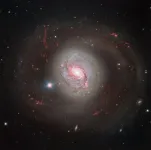
The night sky has always played a crucial role in navigation, from early ocean crossings to modern GPS. Besides stars, the United States Navy uses quasars as beacons. Quasars are distant galaxies with supermassive black holes, surrounded by brilliantly hot disks of swirling gas that can blast off jets of material. Following up on the groundbreaking 2020 discovery of newborn jets in a number of quasars, aspiring naval officer Olivia Achenbach of the United States Naval Academy has used NASA’s Hubble Space Telescope to reveal surprising properties of one of them, quasar J0742+2704. "The biggest surprise was seeing the distinct ...

Read the release
X-ray flashes from a nearby supermassive black hole accelerate mysteriously
Space

X-ray flashes from a nearby supermassive black hole accelerate mysteriously

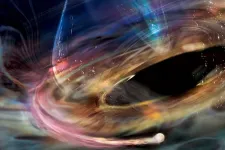
One supermassive black hole has kept astronomers glued to their scopes for the last several years. First came a surprise disappearance, and now, a precarious spinning act. The black hole in question is 1ES 1927+654, which is about as massive as a million suns and sits in a galaxy that is 100 million light-years away. In 2018, astronomers at MIT and elsewhere observed that the black hole’s corona — a cloud of whirling, white-hot plasma — suddenly disappeared, before reassembling months later. The brief though dramatic shut-off was a first in black hole astronomy. Members of the MIT team have now caught the same black hole exhibiting ...

Read the release
The new age of infrastructure maintenance using data from space
Space

The new age of infrastructure maintenance using data from space

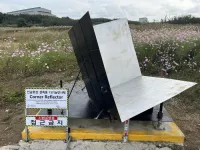
The concentration of the population in cities is accelerating, and difficulties in maintaining various infrastructures are arising due to extreme weather. Extensive infrastructures like waste landfill facilities face significant challenges due to the difficulty for managers to stay on-site or access them. These maintenance issues are resulting in various problems, including environmental pollution. To solve these issues, Korea Institute of Civil Engineering and Building Technology (KICT, President Sun Kyu, Park) has developed a cost-effective and high-efficiency maintenance technology using satellite ...

Read the release
New study unveils breakthrough in understanding cosmic particle accelerators
Space

New study unveils breakthrough in understanding cosmic particle accelerators

Scientists have come a step closer to understanding how collisionless shock waves – found throughout the universe – are able to accelerate particles to extreme speeds. These shock waves are one of nature's most powerful particle accelerators and have long intrigued scientists for the role they play in producing cosmic rays – high-energy particles that travel across vast distances in space. The research, published today in Nature Communications, combines satellite observations from NASA’s MMS (Magnetospheric Multiscale) and THEMIS/ARTEMIS missions with recent theoretical advancements, offering a comprehensive new model ...

Read the release
EMBARGOED UNTIL 1600 GMT, FRIDAY 10 JANUARY 2025: Northumbria space physicist honoured by Royal Astronomical Society
Space

EMBARGOED UNTIL 1600 GMT, FRIDAY 10 JANUARY 2025: Northumbria space physicist honoured by Royal Astronomical Society

Dr John Coxon, esteemed member of Northumbria University’s world-leading Solar and Space Physics research group, has been recognised by the Royal Astronomical Society for his work. Dr Coxon is a Science and Technology Facilities Council (STFC) Ernest Rutherford Fellow at Northumbria University who has garnered international recognition for his research into understanding the Sun's influence on Earth's space environment. It has today been announced that he has been awarded the with the prestigious ...

Read the release
New data on atmosphere from Earth to the edge of space
Space

New data on atmosphere from Earth to the edge of space

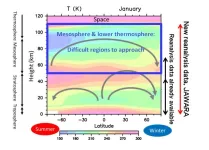
A team led by researchers at the University of Tokyo have created a dataset of the whole atmosphere, enabling new research to be conducted on previously difficult-to-study regions. Using a new data-assimilation system called JAGUAR-DAS, which combines numerical modeling with observational data, the team created a nearly 20-yearlong set of data spanning multiple levels of the atmosphere from ground level up to the lower edges of space. Being able to study the interactions of these layers vertically and around the globe could improve climate modeling and seasonal weather forecasting. There is also potential for interdisciplinary research between atmospheric scientists ...

Read the release
From the original Press-News collection. Issuers of news releases are responsible for the accuracy of their content.