THE ORIGINAL COLLECTION · SINCE 2010

Space
press releases.

Research announcements from universities, hospitals and scientific institutions. Explore the stories, people and discoveries behind the headlines.

Original publication datesPage 16
FIND A STORY

Find a past release.

Dates and source material belong to the original release.

Read our research explainers

Browse the collection · original publication order

Space

Young star clusters give birth to rogue planetary-mass objects

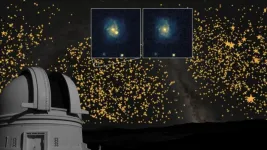
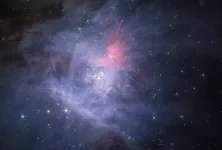
Planetary-mass objects (PMOs) are cosmic nomads: they drift freely through space, unbound to any star, and weigh less than 13 times the mass of Jupiter. While they have been spotted in abundance in young star clusters such as the Trapezium Cluster in Orion (Fig. 1), their origin has puzzled scientists. Traditional theories have suggested that they might be failed stars or planets ejected from their solar systems. An international team of astronomers, in collaboration with the University of Zurich (UZH), has used advanced simulations to demonstrate that these enigmatic objects can form directly from the violent interactions of disks around young stars. “PMOs don’t ...

Read the release
New study reveals how rogue planetary-mass objects form in young star clusters
Space

New study reveals how rogue planetary-mass objects form in young star clusters

A groundbreaking study published in Science Advances sheds new light on the mysterious origins of free-floating planetary-mass objects (PMOs)—celestial bodies with masses between stars and planets. Led by Dr. DENG Hongping of the Shanghai Astronomical Observatory of the Chinese Academy of Sciences, an international team of astronomers used advanced simulations to uncover a novel formation process for these enigmatic objects. The research suggests that PMOs can form directly through violent interactions between circumstellar disks in young star clusters. The Mystery of Rogue Planetary-Mass ...

Read the release
Lunar Trailblazer blasts off to map water on the moon
Space

Lunar Trailblazer blasts off to map water on the moon

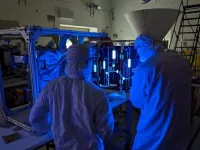
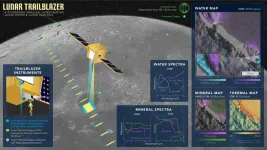
On Wednesday 26 February, a thermal imaging camera built by researchers at the University of Oxford’s Department of Physics will blast off to the Moon as part of NASA’s Lunar Trailblazer mission. This aims to map sources of water on the Moon to shed light on the lunar water cycle and to guide future robotic and human missions. Once in orbit, the spacecraft – weighing 200kg and about the size of a washing machine- will map the surface temperature and composition of the ...

Read the release
SwRI-led PUNCH spacecraft poised for launch into polar orbit
Space

SwRI-led PUNCH spacecraft poised for launch into polar orbit

SAN ANTONIO — February 25, 2025 —Four small suitcase-sized spacecraft, designed and built by Southwest Research Institute headquartered in San Antonio, are poised to launch from Vandenberg Space Force Base in California no earlier than Feb. 28. NASA’s Polarimeter to Unify the Corona and Heliosphere, or PUNCH, spacecraft is sharing a ride to space with the Spectro-Photometer for the History of the Universe, Epoch of Reionization and Ices Explorer (SPHEREx) observatory. “The PUNCH mission will study the solar corona, the Sun’s outer atmosphere, and the solar wind that fills ...

Read the release
Have we been wrong about why Mars is red?
Space

Have we been wrong about why Mars is red?

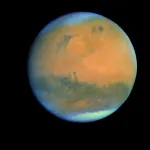
Mars is easily identifiable in the night sky by its prominent red hue. Thanks to the fleet of spacecraft that have studied the planet over the last decades, we know that this red colour is due to rusted iron minerals in the dust. That is, iron bound up in Mars’s rocks has at some point reacted with liquid water, or water and oxygen in the air, similar to how rust forms on Earth. Over billions of years this rusty material – iron oxide – has been broken down into dust and spread all around the planet by winds, a process that continues today. But iron ...

Read the release
Space

Why is Mars red? Scientists may finally have the answer

PROVIDENCE, R.I. [Brown University] — Mars has captivated scientists and the public alike for centuries. One of the biggest reasons is the planet’s reddish hue, earning the third rock from the sun one its most popular nicknames — the “Red Planet.” But what exactly gives the planet its iconic color? Scientists have wondered this for as long as they’ve studied the planet. Today, they may finally have a concrete answer, one that ties into Mar’s watery past. Results from a new study published in the journal Nature Communications and led by researchers from Brown University and the University of Bern suggest that the water-rich iron mineral ...

Read the release
Award-winning research may unlock universe’s origins
Space

Award-winning research may unlock universe’s origins

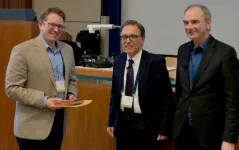
University of Texas at Arlington physicist Ben Jones has received an international honor for his contributions to developing advanced instruments used in particle physics research. Dr. Jones, an associate professor of physics, was awarded the 2025 International Committee for Future Accelerators (ICFA) Early Career Researcher Instrumentation Award. Presented by the ICFA Instrumentation Innovation and Development Panel, the award recognizes significant advancements in the innovation and development of new instrumentation for future accelerator experiments. He accepted the award last week at the 2025 Vienna ...

Read the release
Space

Gulf of Mars: Rover finds evidence of ‘vacation-style’ beaches on Mars

UNIVERSITY PARK, Pa. — Mars may have once been home to sun-soaked, sandy beaches with gentle, lapping waves according to a new study published today (Feb. 24) in the Proceedings of the National Academy of Sciences (PNAS). An international team of scientists, including Penn State researchers, used data from the Zhurong Mars rover to identify hidden layers of rock under the planet’s surface that strongly suggest the presence of an ancient northern ocean. The new research offers the clearest evidence yet that the planet ...

Read the release
In ancient stellar nurseries, some stars are born of fluffy clouds
Space

In ancient stellar nurseries, some stars are born of fluffy clouds

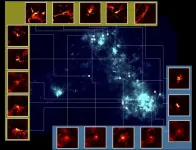
Fukuoka, Japan—How are stars born, and has it always been this way? Stars form in regions of space known as stellar nurseries, where high concentrations of gas and dust coalesce to form a baby star. Also called molecular clouds, these regions of space can be massive, spanning hundreds of light-years and forming thousands of stars. And while we know much about the life cycle of a star thanks to advances in technology and observational tools, precise details remain obscure. For example, did stars form this way in the early universe? Publishing in The Astrophysical Journal, researchers from Kyushu University, in collaboration with Osaka Metropolitan ...

Read the release
Does planetary evolution favor human-like life? Study ups odds we’re not alone
Space

Does planetary evolution favor human-like life? Study ups odds we’re not alone

UNIVERSITY PARK, Pa. — Humanity may not be extraordinary but rather the natural evolutionary outcome for our planet and likely others, according to a new model for how intelligent life developed on Earth. The model, which upends the decades-old “hard steps” theory that intelligent life was an incredibly improbable event, suggests that maybe it wasn't all that hard or improbable. A team of researchers at Penn State, who led the work, said the new interpretation of humanity’s origin increases the probability ...

Read the release
New research sheds light on using multiple CubeSats for in-space servicing and repair missions
Space

New research sheds light on using multiple CubeSats for in-space servicing and repair missions

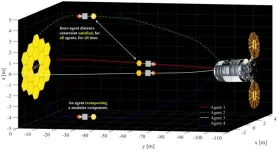
As more satellites, telescopes, and other spacecraft are built to be repairable, it will take reliable trajectories for service spacecraft to reach them safely. Researchers in the Department of Aerospace Engineering in The Grainger College of Engineering, University of Illinois Urbana-Champaign are developing a methodology that will allow multiple CubeSats to act as servicing agents to assemble or repair a space telescope. Their method minimizes fuel consumption, guarantees that servicing agents never come closer to each other ...

Read the release
From collisions to stellar cannibalism – the surprising diversity of exploding white dwarfs
Space

From collisions to stellar cannibalism – the surprising diversity of exploding white dwarfs

Astrophysicists have unearthed a surprising diversity in the ways in which white dwarf stars explode in deep space after assessing almost 4,000 such events captured in detail by a next-gen astronomical sky survey. Their findings may help us more accurately measure distances in the Universe and further our knowledge of “dark energy”. The dramatic explosions of white dwarf stars at the ends of their lives have for decades played a pivotal role in the study of dark energy – the mysterious force responsible for the accelerating expansion of the Universe. They also provide the origin of many elements in our ...

Read the release
Space

UC Irvine astronomers gauge livability of exoplanets orbiting white dwarf stars

Irvine, Calif., Feb. 13, 2025 — Among the roughly 10 billion white dwarf stars in the Milky Way galaxy, a greater number than previously expected could provide a stellar environment hospitable to life-supporting exoplanets, according to astronomers at the University of California, Irvine. In a paper published recently in The Astrophysical Journal, a research team led by Aomawa Shields, UC Irvine associate professor of physics and astronomy, share the results of a study comparing the climates of exoplanets at two different stars. One is a hypothetical white dwarf that’s passed through much of its life cycle and is on a slow path ...

Read the release
Jumping workouts could help astronauts on the moon and Mars, study in mice suggests
Space

Jumping workouts could help astronauts on the moon and Mars, study in mice suggests

Jumping workouts could help astronauts prevent the type of cartilage damage they are likely to endure during lengthy missions to Mars and the Moon, a new Johns Hopkins University study suggests. The research adds to ongoing efforts by space agencies to protect astronauts against deconditioning/getting out of shape due to low gravity, a crucial aspect of their ability to perform spacewalks, handle equipment and repairs, and carry out other physically demanding tasks. The study, which shows knee cartilage in mice grew healthier following jumping exercises, appears ...

Read the release
Tidal energy measurements help SwRI scientists understand Titan’s composition, orbital history
Space

Tidal energy measurements help SwRI scientists understand Titan’s composition, orbital history

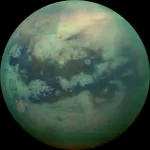
SAN ANTONIO — February 12, 2025 —Southwest Research Institute (SwRI) scientists are studying Saturn’s moon Titan to assess its tidal dissipation rate, the energy lost as it orbits the ringed planet with its massive gravitational force. Understanding tidal dissipation helps scientists infer many other things about Titan, such as the makeup of its inner core and its orbital history. “When most people think of tides they think of the movement of the oceans, in and out, with the passage of the Moon overhead, said Dr. Brynna Downey. “But that is just because water moves ...

Read the release
Does the universe behave the same way everywhere? Gravitational lenses could help us find out
Space

Does the universe behave the same way everywhere? Gravitational lenses could help us find out

“The cosmological principle is like an ultimate kind of statement of humility,” explains James Adam, astrophysicist at the University of the Western Cape, Cape Town, South Africa, and lead author of the new paper. According to the Cosmological Principle, not only are we not at the center of the Universe, but a true center does not exist. A further assumption, similar to but distinct and independent from homogeneity, is that the Universe is also isotropic, meaning it has no preferred directions. These assumptions underlie the Standard Model of Cosmology, the theoretical ...

Read the release
Researchers from South Korea reveal how gender shapes perceptions of safety in urban parking spaces
Space

Researchers from South Korea reveal how gender shapes perceptions of safety in urban parking spaces

Multifamily residential buildings with multiple floors are common in South Korea. These buildings usually have pilotis—support structures like pillars that elevate the building, creating an open ground floor generally used for parking vehicles. These piloti parking spaces are often risky to navigate for pedestrians and residents due to limited visibility, unclear boundaries between adjacent areas, and poor management. For instance, these spaces have blind spots that criminals could exploit, which induces fear among people. Though evidence-based architectural design strategies ...

Read the release
Multinational research project shows how life on Earth can be measured from space
Space

Multinational research project shows how life on Earth can be measured from space

Measurements and data collected from space can be used to better understand life on Earth. An ambitious, multinational research project funded by NASA and co-led by UC Merced civil and environmental engineering Professor Erin Hestir demonstrated that Earth’s biodiversity can be monitored and measured from space, leading to a better understanding of terrestrial and aquatic ecosystems. Hestir led the team alongside University of Buffalo geography Professor Adam Wilson and Professor Jasper Slingsby from the University ...

Read the release
Gemini North teams up with LOFAR to reveal largest radio jet ever seen in the early universe
Space

Gemini North teams up with LOFAR to reveal largest radio jet ever seen in the early universe

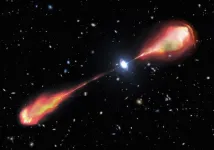
From decades of astronomical observations scientists know that most galaxies contain massive black holes at their centers. The gas and dust falling into these black holes liberates an enormous amount of energy as a result of friction, forming luminous galactic cores, called quasars, that expel jets of energetic matter. These jets can be detected with radio telescopes up to large distances. In our local Universe these radio jets are not uncommon, with a small fraction being found in nearby galaxies, but they have remained elusive in the distant, early Universe until now. Using a combination of telescopes, astronomers have discovered a distant, two-lobed radio ...

Read the release
High-precision NEID spectrograph helps confirm first Gaia astrometric planet discovery
Space

High-precision NEID spectrograph helps confirm first Gaia astrometric planet discovery

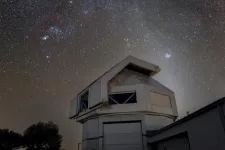
NEID (rhymes with fluid) is a high-precision radial-velocity spectrograph that is designed to measure the extremely minute wobble of nearby stars using the radial velocity effect. This effect results from the mutual gravitational force between a planet and its host star which causes the star’s position to shift very slightly as the planet travels around it. With this powerful capability, one of NEID’s main science goals is to confirm exoplanet candidates found by other exoplanet missions. NEID is funded by the NASA/NSF Exoplanet Exploration Program (NN-EXPLORE) and is mounted on the WIYN 3.5-meter Telescope at ...

Read the release
Space

A less ‘clumpy,’ more complex universe?

Across cosmic history, powerful forces have acted on matter, reshaping the universe into an increasingly complex web of structures. Now, new research led by Joshua Kim and Mathew Madhavacheril at the University of Pennsylvania and their collaborators at Lawrence Berkeley National Laboratory suggests our universe has become “messier and more complicated” over the roughly 13.8 billion years it’s been around, or rather, the distribution of matter over the years is less “clumpy” ...

Read the release
Berkeley Lab helps explore mysteries of Asteroid Bennu
Space

Berkeley Lab helps explore mysteries of Asteroid Bennu

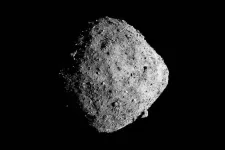
During the past year, there’s been an unusual set of samples at the Department of Energy’s Lawrence Berkeley National Laboratory (Berkeley Lab): material gathered from the 4.5-billion-year-old asteroid Bennu when it was roughly 200 million miles from Earth. Berkeley Lab is one of more than 40 institutions investigating Bennu’s chemical makeup to better understand how our solar system and planets evolved. In a new study published today in the journal Nature, researchers found evidence that Bennu comes from an ancient wet world, with some material from the coldest regions of the solar system, likely beyond the orbit of ...

Read the release
Traces of ancient brine discovered on the asteroid Bennu contain minerals crucial to life
Space

Traces of ancient brine discovered on the asteroid Bennu contain minerals crucial to life

A new analysis of samples from the asteroid Bennu, NASA’s first asteroid sample captured in space and delivered to Earth, reveals that evaporated water left a briny broth where salts and minerals allowed the elemental ingredients of life to intermingle and create more complex structures. The discovery suggests that extraterrestrial brines provided a crucial setting for the development of organic compounds. In a paper published today, Jan. 29, in the journal Nature, scientists at the Smithsonian’s National Museum ...

Read the release
2024 ISS National Lab Annual Report highlights momentum in space-based R&D
Space

2024 ISS National Lab Annual Report highlights momentum in space-based R&D

KENNEDY SPACE CENTER (FL), January 28, 2025 – The International Space Station (ISS) National Laboratory highlighted the rapid growth of space-based R&D in its annual report, released today by the Center for the Advancement of Science in Space® (CASIS®). Over the past fiscal year, the ISS National Lab sponsored more than 100 payloads delivered to the orbiting laboratory—the second-highest annual total to date. Also this year, ISS National Lab-related results were published in 51 peer-reviewed articles—the most ever in a year—underscoring the vital role of the ISS National Lab in advancing scientific discovery and innovation. Since 2011, ...

Read the release
Space

Explaining persistent hydrogen in Mars’ atmosphere

The fact that the cold, dry Mars of today had flowing rivers and lakes several billion years ago has puzzled scientists for decades. Now, Harvard researchers think they have a good explanation for a warmer, wetter ancient Mars. Building on prior theories describing the Mars of yore as a hot again, cold again place, a team led by researchers at the Harvard John A. Paulson School of Engineering and Applied Sciences (SEAS) have determined the chemical mechanisms by which ancient Mars was able to sustain enough warmth in its early days ...

Read the release
From the original Press-News collection. Issuers of news releases are responsible for the accuracy of their content.