THE ORIGINAL COLLECTION · SINCE 2010

Space
press releases.

Research announcements from universities, hospitals and scientific institutions. Explore the stories, people and discoveries behind the headlines.

Original publication datesPage 21
FIND A STORY

Find a past release.

Dates and source material belong to the original release.

Read our research explainers

Browse the collection · original publication order

Astronomers detect ancient lonely quasars with murky origins
Space

Astronomers detect ancient lonely quasars with murky origins

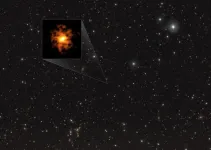
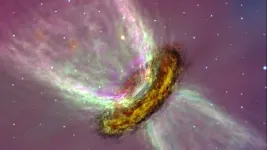
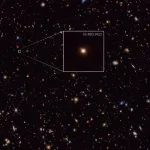
A quasar is the extremely bright core of a galaxy that hosts an active supermassive black hole at its center. As the black hole draws in surrounding gas and dust, it blasts out an enormous amount of energy, making quasars some of the brightest objects in the universe. Quasars have been observed as early as a few hundred million years after the Big Bang, and it’s been a mystery as to how these objects could have grown so bright and massive in such a short amount of cosmic time. Scientists have proposed that the earliest quasars sprang from overly dense ...

Read the release
Scientists use Allen Telescope Array to search for radio signals in the TRAPPIST-1 star system
Space

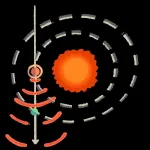
Scientists use Allen Telescope Array to search for radio signals in the TRAPPIST-1 star system

October 16, 2024, Mountain View, CA - Scientists at the SETI Institute and partners from Penn State University used the Allen Telescope Array (ATA) to search for signs of alien technology in the TRAPPIST-1 star system. The team spent 28 hours scanning the system, looking for radio signals that could indicate extraterrestrial technology. This project marks the longest single-target search for radio signals from TRAPPIST-1. Although they didn’t find any evidence of extraterrestrial technology, their work provided valuable data ...

Read the release
Beware of the full moon: Tropical forest mammals shy away from the moonlight
Space

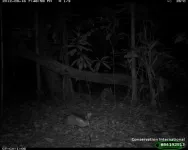
Beware of the full moon: Tropical forest mammals shy away from the moonlight

A recent study using automatic wildlife cameras across three continents has shed light on how the moon's phases affect the behaviour of tropical forest mammals. Half of the species studied altered their activity levels or timing, or both, in response to the full moon. The findings suggest that even in some of the darkest places on earth - the floors of tropical forests - the moon's phases can influence animal behaviour. This impact could be even more pronounced in degraded and fragmented forests. “Imagine playing hide-and-seek in a dark room, and then somebody lights ...

Read the release
Out-of-this-world simulation key to collecting moon dust
Space

Out-of-this-world simulation key to collecting moon dust

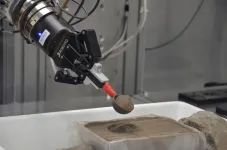
Teleoperated robots for gathering moon dust are a step closer, according to new research by scientists at the University of Bristol. The team were able to complete a sample collection task by controlling a virtual simulation, which then sent commands to a physical robot to mirror the simulation’s actions. They were able to do so while only monitoring the simulation - without needing physical camera streams - meaning this tool could be particularly useful for delayed teleoperation on the Moon. Alongside a boom in lunar lander missions ...

Read the release
SwRI-developed instruments will study potential habitability of Jupiter’s moon Europa
Space

SwRI-developed instruments will study potential habitability of Jupiter’s moon Europa

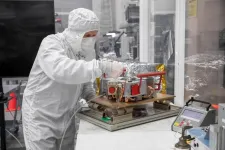
SAN ANTONIO — October 15, 2024 —Two Southwest Research Institute instruments were launched aboard NASA’s Europa Clipper spacecraft on Oct. 14 from the agency’s Kennedy Space Center. The spacecraft is designed to conduct a detailed reconnaissance of Jupiter’s moon Europa, investigating whether it could hold conditions suitable for life. The SwRI-developed MAss Spectrometer for Planetary EXploration (MASPEX) and Ultraviolet Spectrograph (Europa-UVS) are among nine science instruments and a gravity science investigation that were developed to explore Europa, Jupiter’s fourth-largest ...

Read the release
Giant Magellan telescope begins primary mirror support system testing
Space

Giant Magellan telescope begins primary mirror support system testing

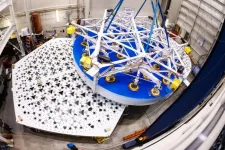
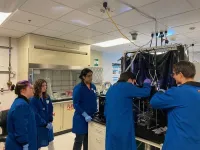
TUCSON, AZ — October 15, 2024 — The Giant Magellan Telescope today announced the successful installation of one of its completed 8.4-meter-diameter primary mirrors into a support system prototype at the University of Arizona’s Richard F. Caris Mirror Lab. This highly sophisticated system — comparable in size to half a basketball court and containing three times the number of parts of a typical car — is vital to the telescope’s optical performance and precision control. The milestone marks the start of a six-month optical testing phase to demonstrate that the support system can control the mirror as required, validating the revolutionary capabilities ...

Read the release
New hub for high-energy astrophysics — CTAO Science Data Management Centre opens at DESY in Zeuthen
Space

New hub for high-energy astrophysics — CTAO Science Data Management Centre opens at DESY in Zeuthen

Zeuthen, Germany – On 14 October 2024, the Cherenkov Telescope Array Observatory (CTAO), along with hosting partners and shareholders Deutsches Elektronen-Synchrotron DESY, celebrated the official inauguration of the Science Data Management Centre (SDMC) on the DESY campus in Zeuthen, Germany. The ceremony, chaired by Prof. Christian Stegmann, Head of DESY Zeuthen, was opened by Mario Brandenburg, Parliamentary State Secretary at the German Federal Ministry of Education and Research (BMBF), and Tobias Dünow, State Secretary at ...

Read the release
‘Inside-out’ galaxy growth observed in the early universe
Space

‘Inside-out’ galaxy growth observed in the early universe

Astronomers have used the NASA/ESA James Webb Space Telescope (JWST) to observe the ‘inside-out’ growth of a galaxy in the early universe, only 700 million years after the Big Bang. This galaxy is one hundred times smaller than the Milky Way, but is surprisingly mature for so early in the universe. Like a large city, this galaxy has a dense collection of stars at its core but becomes less dense in the galactic ‘suburbs’. And like a large city, this galaxy is starting to sprawl, with star formation accelerating in the outskirts. This is the earliest-ever detection of inside-out galactic growth. ...

Read the release
SwRI-led instrument aboard Jupiter-bound spacecraft nails in-flight test
Space

SwRI-led instrument aboard Jupiter-bound spacecraft nails in-flight test

SAN ANTONIO — October 9, 2024 —As European Space Agency (ESA)’s Jupiter Icy Moons Explorer (Juice) spacecraft hurtled past the Moon and Earth in mid-August to provide its first gravity assist maneuver to the Jovian system, the Southwest Research Institute-led Ultraviolet Spectrograph (UVS) instrument imaged the UV emissions radiating from the Earth and Moon. It was a successful test of one of three science instrument projects comprising NASA’s contribution to ESA’s Juice mission. The UVS data collected were then analyzed and found to be consistent with expectations for the Moon and the Earth. This confirmation that the instrument works ...

Read the release
Space oddity: Most distant rotating disc galaxy found
Space

Space oddity: Most distant rotating disc galaxy found

Researchers have discovered the most distant Milky-Way-like galaxy yet observed. Dubbed REBELS-25, this disc galaxy seems as orderly as present-day galaxies, but we see it as it was when the Universe was only 700 million years old. This is surprising since, according to our current understanding of galaxy formation, such early galaxies are expected to appear more chaotic. The rotation and structure of REBELS-25 were revealed using the Atacama Large Millimeter/submillimeter Array (ALMA), in which the European ...

Read the release
Space

NCSA building stronger connections among observatories, astronomers

With hundreds of observatories scattered throughout the world, there has never been a better time for astronomers to observe the infinite universe that lies beyond Earth. At any moment in time, a telescope pointed at the night sky can observe new transient phenomena, such as supernovae that brighten rapidly and then fade away over days to months, releasing massive amounts of energy in the process. These events are rare in any single galaxy and each gives researchers more insight into the dynamic time-domain sky. But what if these observatories could work even closer together to view these important astronomical events? The National ...

Read the release
The University of Texas at San Antonio is advancing space exploration as the lead of a multimillion-dollar DOE project
Space

The University of Texas at San Antonio is advancing space exploration as the lead of a multimillion-dollar DOE project

UTSA was selected by the U.S. Department of Energy’s (DOE) Office of Nuclear Energy (NE) to lead a multimillion-dollar project that will stimulate nuclear energy research at UTSA, leverage novel experimental data to bolster computational efforts at the university, and provide professional training to prepare undergraduate and graduate students for careers in nuclear energy science. UTSA researchers will collaborate with a leading nuclear energy laboratory as well as across academic institutions. The award is part of the DOE’s Nuclear Energy University Program’s Integrated Research Projects (IRPs). These projects aim to provide research and development solutions ...

Read the release
UMass Amherst astronomer leads science team helping to develop billion-dollar NASA satellite mission concept
Space

UMass Amherst astronomer leads science team helping to develop billion-dollar NASA satellite mission concept

October 4, 2024 UMass Amherst Astronomer Leads Science Team Helping to Develop Billion-Dollar NASA Satellite Mission Concept Alexandra Pope, science lead for the PRIMA space telescope, is on team developing next-generation space probe that will explore evolution of the universe AMHERST, Mass. – A University of Massachusetts astronomy professor is science lead on a $5 million proposal selected by NASA to develop new space satellite missions that bridge gaps in our understanding of the evolution of ...

Read the release
Winds of change: James Webb Space Telescope reveals elusive details in young star systems
Space

Winds of change: James Webb Space Telescope reveals elusive details in young star systems

Every second, more than 3,000 stars are born in the visible universe. Many are surrounded by what astronomers call a protoplanetary disk – a swirling "pancake" of hot gas and dust from which planets form. The exact processes that give rise to stars and planetary systems, however, are still poorly understood. A team of astronomers led by University of Arizona researchers has used NASA's James Webb Space Telescope to obtain some of the most detailed insights into the forces that shape protoplanetary disks. The observations offer glimpses into what our solar system may have looked like 4.6 billion years ago. Specifically, the team was able to trace so-called ...

Read the release
Glimmers of antimatter to explain the "dark" part of the universe
Space

Glimmers of antimatter to explain the "dark" part of the universe

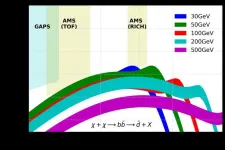
One of the great challenges of modern cosmology is to reveal the nature of dark matter. We know it exists (it constitutes over 85% of the matter in the Universe), but we have never seen it directly and still do not know what it is. A new study published in JCAP has examined traces of antimatter in the cosmos that could reveal a new class of never-before-observed particles, called WIMP (Weakly Interacting Massive Particles), which could make up dark matter. The study suggests that some recent observations ...

Read the release
Two UMD Astronomy space probes advance to next round of $1 billion NASA mission selection
Space

Two UMD Astronomy space probes advance to next round of $1 billion NASA mission selection

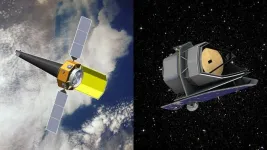
On October 3, 2024, NASA announced that two space probes proposed by University of Maryland astronomers have advanced to the next round of consideration for a $1 billion mission slated to launch into orbit in 2032. The selected probes include the Advanced X-ray Imaging Satellite (AXIS) mission with UMD Astronomy Professor Christopher Reynolds as its principal investigator and the PRobe far-Infrared Mission for Astrophysics (PRIMA) with UMD Astronomy Professor Alb­erto Bolatto as a co-investigator and NASA Goddard Space Flight Center researcher and UMD Astronomy ...

Read the release
In odd galaxy, NASA's Webb finds potential missing link to first stars
Space

In odd galaxy, NASA's Webb finds potential missing link to first stars

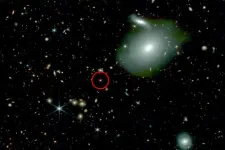
Looking deep into the early universe with NASA’s James Webb Space Telescope, astronomers have found something unprecedented: a galaxy with an odd light signature, which they attribute to its gas outshining its stars. Found approximately one billion years after the big bang, galaxy GS-NDG-9422 (9422) may be a missing-link phase of galactic evolution between the universe’s first stars and familiar, well-established galaxies. “My first thought in looking at the galaxy’s spectrum was, ‘that’s weird,’ which is ...

Read the release
Ant agriculture began 66 million years ago in the aftermath of the asteroid that doomed the dinosaurs
Space

Ant agriculture began 66 million years ago in the aftermath of the asteroid that doomed the dinosaurs

When humans began farming crops thousands of years ago, agriculture had already been around for millions of years. In fact, several animal lineages have been growing their own food since long before humans evolved as a species. According to a new study, colonies of ants began farming fungi when an asteroid struck Earth 66 million years ago. This impact caused a global mass extinction but also created ideal conditions for fungi to thrive. Innovative ants began cultivating the fungi, creating an evolutionary partnership that became even more tightly intertwined 27 million years ago and continues to this day. In a paper published today, Oct. 3, in the journal Science, scientists at the Smithsonian’s ...

Read the release
Discovery of orbital angular momentum monopoles enables orbital electronics with chiral materials
Space

Discovery of orbital angular momentum monopoles enables orbital electronics with chiral materials

In traditional electronics, information is transferred using the charge of electrons. However, future technologies may rely on a different property of electrons—their intrinsic angular momentum. Historically, the focus has been on electron spin, a form of build-in angular momentum that creates a magnetic moment, as the leading candidate for next-generation devices. Now, researchers are exploring the potential of orbitronics, a field that utilizes the angular momentum of electrons generated as they orbit the atomic nucleus. Orbitronics holds great promise ...

Read the release
Scientists discover planet orbiting closest single star to our Sun
Space

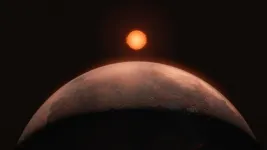
Scientists discover planet orbiting closest single star to our Sun

Using the European Southern Observatory’s Very Large Telescope (ESO’s VLT), astronomers have discovered an exoplanet orbiting Barnard’s star, the closest single star to our Sun. On this newly discovered exoplanet, which has at least half the mass of Venus, a year lasts just over three Earth days. The team’s observations also hint at the existence of three more exoplanet candidates, in various orbits around the star. Located just six light-years away, Barnard’s star is the second-closest stellar system — after Alpha Centauri’s three-star group — and the closest individual star to us. Owing to its proximity, it is a primary target in ...

Read the release
A new birthplace for asteroid Ryugu
Space

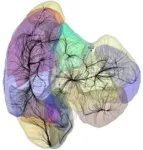
A new birthplace for asteroid Ryugu

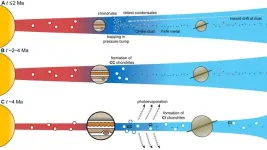
In December 2020 the space probe Hayabusa 2 brought samples of asteroid Ryugu back to Earth. Since then, the few grams of material have been through quite a lot. After initial examinations in Japan, some of the tiny, jet-black grains traveled to research facilities around the world. There they were measured, weighed, chemically analyzed and exposed to infrared, X-ray and synchroton radiation, among other things. At the MPS, researchers examine the ratios of certain metal isotopes in the samples, as in the current study. Scientists refer to isotopes as variants of the same element that differ only in the number of neutrons in the nucleus. Investigations ...

Read the release

Research sheds light on large-scale cosmic structures
Space

Research sheds light on large-scale cosmic structures

A new study has mapped out the gravitational “basins of attraction” in the local Universe, offering fresh insights into the large-scale cosmic structures that shape the movement of galaxies. Using advanced data from the Cosmicflows-4 compilation of distances and velocities of roughly 56,000 galaxies, the international research team applied cutting-edge algorithms to identify regions where gravity dominates, such as the Sloan Great Wall and the Shapley Supercluster. This research suggests that our Milky Way most probably resides within the larger Shapley basin, shifting ...

Read the release
Orbitronics: New material property advances energy-efficient tech
Space

Orbitronics: New material property advances energy-efficient tech

Orbital angular momentum monopoles have been the subject of great theoretical interest as they offer major practical advantages for the emerging field of orbitronics, a potential energy-efficient alternative to traditional electronics. Now, through a combination of robust theory and experiments at the Swiss Light Source SLS at Paul Scherrer Institute PSI, their existence has been demonstrated. The discovery is published in the journal Nature Physics. Whereas electronics uses the charge of the electron to transfer information, technology ...

Read the release
ESO telescope captures the most detailed infrared map ever of our Milky Way
Space

ESO telescope captures the most detailed infrared map ever of our Milky Way

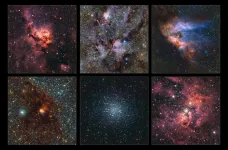
Astronomers have published a gigantic infrared map of the Milky Way containing more than 1.5 billion objects ― the most detailed one ever made. Using the European Southern Observatory’s VISTA telescope, the team monitored the central regions of our Galaxy over more than 13 years. At 500 terabytes of data, this is the largest observational project ever carried out with an ESO telescope. “We made so many discoveries, we have changed the view of our Galaxy forever,” says Dante Minniti, ...

Read the release
This rocky planet around a white dwarf resembles Earth — 8 billion years from now
Space

This rocky planet around a white dwarf resembles Earth — 8 billion years from now

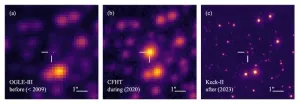
The discovery of an Earth-like planet 4,000 light years away in the Milky Way galaxy provides a preview of one possible fate for our planet billions of years in the future, when the sun has turned into a white dwarf, and a blasted and frozen Earth has migrated beyond the orbit of Mars. This distant planetary system, identified by University of California, Berkeley, astronomers after observations with the Keck 10-meter telescope in Hawaii, looks very similar to expectations for the sun-Earth system: it consists of a white dwarf about half the mass of the sun and an Earth-size companion in an orbit twice as large as Earth’s today. That is likely to be Earth’s fate. ...

Read the release
From the original Press-News collection. Issuers of news releases are responsible for the accuracy of their content.