THE ORIGINAL COLLECTION · SINCE 2010

Space
press releases.

Research announcements from universities, hospitals and scientific institutions. Explore the stories, people and discoveries behind the headlines.

Original publication datesPage 20
FIND A STORY

Find a past release.

Dates and source material belong to the original release.

Read our research explainers

Browse the collection · original publication order

Chang’e-6 basalts offer insights on lunar farside volcanism
Space

Chang’e-6 basalts offer insights on lunar farside volcanism

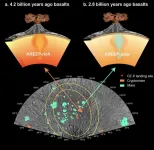
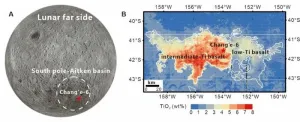
Basalt samples returned by the Chang’e-6 mission have revealed volcanic events on the lunar farside at 2.8 billion years ago (Ga) and 4.2 Ga, according to research conducted by Prof. LI Qiuli’s lab at the Institute of Geology and Geophysics of the Chinese Academy of Sciences. This work was recently published in Nature. “Unraveling the volcanic history of the lunar farside is crucial for understanding the hemispheric dichotomy of the Moon,” said Prof. LI. The asymmetry between the Moon’s nearside and farside—encompassing differences in basalt distribution, topography, crustal thickness, and thorium ...

Read the release
Chang’e-6 lunar samples reveal 2.83-billion-year-old basalt with depleted mantle source
Space

Chang’e-6 lunar samples reveal 2.83-billion-year-old basalt with depleted mantle source

The Moon has a global dichotomy, with its near and far sides having different geomorphology, topography, chemical composition, crustal thickness, and evidence of volcanism. To better understand this dichotomy, Professor XU Yigang’s team from the Guangzhou Institute of Geochemistry of the Chinese Academy of Sciences investigated lunar soil samples from the far side South Pole-Aitken (SPA) Basin of the Moon returned by the Chang’e-6 mission. Their work was published in Science on Nov. 15. “The samples returned by Chang’e-6 provide a best opportunity to investigate the lunar global dichotomy,” said Professor ...

Read the release
Space

Scientists compile library for evaluating exoplanet water

ITHACA, N.Y. – By probing chemical processes observed in the Earth’s hot mantle, Cornell scientists have started developing a library of basalt-based spectral signatures that not only will help reveal the composition of planets outside of our solar system but could demonstrate evidence of water on those exoplanets. “When the Earth’s mantle melts, it produces basalts,” said Esteban Gazel, professor of engineering. Basalt, a gray-black volcanic rock found throughout the solar system, are key recorders of geologic history, he said. “When the Martian mantle melted, it also produced basalts. The moon is mostly basaltic,” he said. “We’re ...

Read the release
Meteorite contains evidence of liquid water on Mars 742 million years ago
Space

Meteorite contains evidence of liquid water on Mars 742 million years ago

An asteroid struck Mars 11 million years ago and sent pieces of the red planet hurtling through space. One of these chunks of Mars eventually crashed into the Earth somewhere near Purdue and is one of the few meteorites that can be traced directly to Mars. This meteorite was rediscovered in a drawer at Purdue University in 1931 and therefore named the Lafayette Meteorite. During early investigations of the Lafayette Meteorite, scientists discovered that it had interacted with liquid water while on Mars. Scientists have long wondered when that interaction with liquid water took place. ...

Read the release
Three galactic “red monsters” in the early Universe
Space

Three galactic “red monsters” in the early Universe

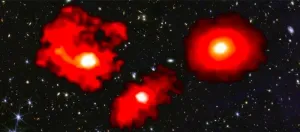
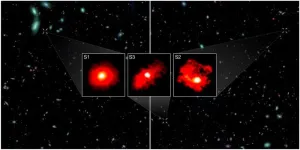
An international team led by the University of Geneva (UNIGE) has identified three ultra-massive galaxies – nearly as massive as the Milky Way – already in place within the first billion years after the Big Bang. This surprising discovery was made possible by the James Webb Space Telescope's FRESCO program, which uses the NIRCam/grism spectrograph to measure accurate distances and stellar masses of galaxies. The results indicate that the formation of stars in the early Universe was far more efficient than previously thought, challenging existing galaxy formation models. The study is published in Nature. In the theoretical model favored by scientists, galaxies form ...

Read the release
Astronomers discover mysterious ‘Red Monster’ galaxies in the early Universe
Space

Astronomers discover mysterious ‘Red Monster’ galaxies in the early Universe

An international team that was led by the University of Geneva (UNIGE) and includes Professor Stijn Wuyts from the University of Bath in the UK has identified three ultra-massive galaxies – each nearly as massive as the Milky Way – that had already assembled within the first billion years after the Big Bang. The researchers’ results indicate that the formation of stars in the early Universe was far more efficient than previously thought, challenging existing galaxy formation models. The surprising discovery – described today in the journal Nature – was made by the James Webb Space Telescope (JWST) ...

Read the release
A formula for life? New model calculates chances of intelligent beings in our Universe and beyond
Space

A formula for life? New model calculates chances of intelligent beings in our Universe and beyond

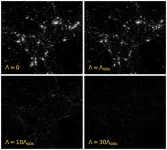
The chances of intelligent life emerging in our Universe – and in any hypothetical ones beyond it – can be estimated by a new theoretical model which has echoes of the famous Drake Equation. This was the formula that American astronomer Dr Frank Drake came up with in the 1960s to calculate the number of detectable extraterrestrial civilisations in our Milky Way galaxy. More than 60 years on, astrophysicists led by Durham University have produced a different model which instead focuses on the conditions created by the acceleration of the Universe's expansion and the amount ...

Read the release
Astronomers’ theory of how galaxies formed may be upended
Space

Astronomers’ theory of how galaxies formed may be upended

CLEVELAND—The standard model for how galaxies formed in the early universe predicted that the James Webb Space Telescope (JWST) would see dim signals from small, primitive galaxies. But data are not confirming the popular hypothesis that invisible dark matter helped the earliest stars and galaxies clump together. Instead, the oldest galaxies are large and bright, in agreement with an alternate theory of gravity, according to new research from Case Western Reserve University published Tuesday November 12 in The Astrophysical Journal. The results challenge astronomers’ understanding of the early universe. “What the theory of dark matter predicted is not what we ...

Read the release
Off-the-shelf thermoelectric generators can upgrade CO2 into chemicals. The combination could help us colonize Mars
Space

Off-the-shelf thermoelectric generators can upgrade CO2 into chemicals. The combination could help us colonize Mars

Readily available thermoelectric generators operating under modest temperature differences can power CO2 conversion, according to a proof-of-concept study by chemists at the University of British Columbia (UBC). The findings open up the intriguing possibility that the temperature differentials encountered in an array of environments—from a typical geothermal installation on Earth to the cold, desolate surface of Mars—could power the conversion of CO2 into a range of useful fuels and chemicals. “The environment ...

Read the release
Space

Study assesses "gendered space" in financial institutions in Pakistan

In Islamic cultures, purdah, which literally means “curtain,” is a practice that involves the seclusion of women from public observation and the enforcement of high standards of female modesty. Research published in the Journal of Management Studies examines the significance of purdah (spatial modesty) in gender relations in financial institutions in Pakistan. The research was based on the lived experiences of women and men working in two banks based in Pakistan. One of the study’s co-authors, Shafaq Chaudhry, PhD, of the University of Central Lancashire, in the UK, sought internships for six weeks ...

Read the release
NSF NOIRLab astronomers discover the fastest-feeding black hole in the early universe
Space

NSF NOIRLab astronomers discover the fastest-feeding black hole in the early universe

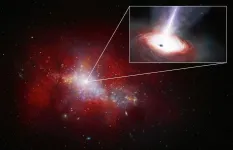
Supermassive black holes exist at the center of most galaxies, and modern telescopes continue to observe them at surprisingly early times in the Universe’s evolution. It’s difficult to understand how these black holes were able to grow so big so rapidly. But with the discovery of a low-mass supermassive black hole feasting on material at an extreme rate, seen just 1.5 billion years after the Big Bang, astronomers now have valuable new insights into the mechanisms of rapidly growing black holes in the early Universe. LID-568 was discovered ...

Read the release
Space

The dynamic core of black holes

Black holes continue to captivate scientists: they are purely gravitational objects, remarkably simple, yet capable of hiding mysteries that challenge our understanding of natural laws. Most observations thus far have focused on their external characteristics and surrounding environment, leaving their internal nature largely unexplored. A new study, conducted through a collaboration between the University of Southern Denmark, Charles University in Prague, Scuola Internazionale Superiore di Studi Avanzati (SISSA) in Trieste, and Victoria University of Wellington ...

Read the release
Ancient rocks may bring dark matter to light
Space

Ancient rocks may bring dark matter to light

The visible universe — all the potatoes, gas giants, steamy romance novels, black holes, questionable tattoos, and overwritten sentences — accounts for only 5 percent of the cosmos. A Virginia Tech-led team is hunting for the rest of it, not with telescopes or particle colliders, but by scrutinizing billion-year-old rocks for traces of dark matter. In leading a transdisciplinary team from multiple universities on this unconventional search, physics’ Patrick Huber is also taking an unconventional step: from theoretical work into experimental work. With support from a $3.5 million Growing Convergence Research ...

Read the release
Faster space communication with record-sensitive receiver
Space

Faster space communication with record-sensitive receiver

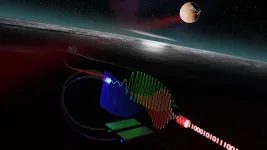
In space exploration, long-distance optical links can now be used to transmit images, films and data from space probes to Earth using light. But in order for the signals to reach all the way and not be disturbed along the way, hypersensitive receivers and noise-free amplifiers are required. Now, researchers at Chalmers University of Technology, in Sweden, have created a system that, with a silent amplifier and record-sensitive receiver, paves the way for faster and improved space communication. Space communication systems are increasingly based on optical laser beams rather than radio waves, as the signal loss has been shown to be less when light is used ...

Read the release
Space

Seeing a black hole's jet in a new light

Image Research led by the University of Michigan has pored over more than two decades' worth of data from NASA's Chandra X-Ray Observatory to show there's new knotty science to discover around black holes. In particular, the study looks at the high-energy jet of particles being blasted across space by the supermassive black hole at the center of the galaxy Centaurus A. Jets are visible to different types of telescopes, including those that detect radio waves and others that collect X-rays. Since Chandra's 1999 launch, many astronomers have been particularly interested ...

Read the release
Space

Evidence mounts for dark energy from black holes

Image Almost 14 billion years ago, at the very beginning of the Big Bang, a mysterious energy drove an exponential expansion of the infant universe and produced all known matter, according to the prevailing inflationary universe theory. That ancient energy shared key features of the current universe's dark energy, which is the largest mystery of our time by at least one objective standard: It makes up the majority—roughly 70%—of the universe, but scientists ...

Read the release
SwRI adds new chamber for spacecraft-related EMC, EMI testing
Space

SwRI adds new chamber for spacecraft-related EMC, EMI testing

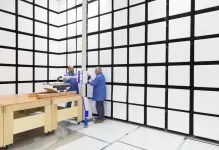
SAN ANTONIO — October 28, 2024 —Southwest Research Institute (SwRI) has added a semi-anechoic shielded enclosure for electromagnetic compatibility and interference (EMC/EMI) testing for spacecraft. The test chamber is the next step in SwRI’s plans to create a turnkey spacecraft integration and test center within its 74,000-square-foot Space System Spacecraft and Payload Processing Facility. The 400-square-foot EMC/EMI Chamber is semi-anechoic, or free of echo, and shielded from electromagnetic interference. It supports performance of standard emissions and susceptibility testing with an upper frequency limit of 40 gigahertz ...

Read the release
Dandelion-shaped supernova and zombie star
Space

Dandelion-shaped supernova and zombie star

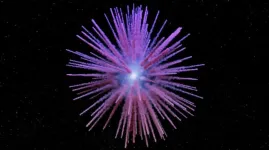
In 1181, a new star shone near the Cassiopeia constellation for six months before disappearing. This event, recorded as a “guest star” by Chinese and Japanese observers almost a millennium ago, has puzzled astronomers for centuries. It is one of a few supernovae to be documented before the invention of telescopes. In addition, it remained an “orphan” the longest, meaning that none of the celestial objects visible today could be assigned to it. Now known as the supernova SN 1181, its remnant has only been traced in 2021 to the nebula ...

Read the release
Physicists discover first “black hole triple”
Space

Physicists discover first “black hole triple”

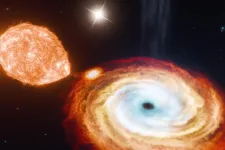
Many black holes detected to date appear to be part of a pair. These binary systems comprise a black hole and a secondary object — such as a star, a much denser neutron star, or another black hole — that spiral around each other, drawn together by the black hole’s gravity to form a tight orbital pair. Now a surprising discovery is expanding the picture of black holes, the objects they can host, and the way they form. In a study appearing in Nature, physicists at MIT and Caltech report that they have observed a “black hole triple” for the first time. The new system holds a central black hole in the act of consuming a small star ...

Read the release
Rocky planets orbiting small stars could have stable atmospheres needed to support life
Space

Rocky planets orbiting small stars could have stable atmospheres needed to support life

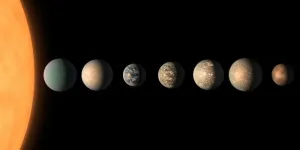
Since its launch in late 2021, NASA’s James Webb Space Telescope has raised the possibility that we could detect signs of life on exoplanets, or planets outside our solar system. Top candidates in this search are rocky, rather than gaseous, planets orbiting low-mass stars called M-dwarfs — easily the most common stars in the universe. One nearby M-dwarf is TRAPPIST-1, a star about 40 light years away that hosts a system of orbiting planets under intense scrutiny in the search for life on planets orbiting stars other than the sun. Previous research questioned the habitability of planets orbiting TRAPPIST-1, finding that intense UV rays would burn away their ...

Read the release
Space

Study: Marshes provide cost-effective coastal protection

Images of coastal houses being carried off into the sea due to eroding coastlines and powerful storm surges are becoming more commonplace as climate change brings a rising sea level coupled with more powerful storms. In the U.S. alone, coastal storms caused $165 billion in losses in 2022. Now, a study from MIT shows that protecting and enhancing salt marshes in front of protective seawalls can significantly help protect some coastlines, at a cost that makes this approach reasonable to implement. The new findings are being reported in the journal Communications ...

Read the release
NASA reveals prototype telescope for gravitational wave observatory
Space

NASA reveals prototype telescope for gravitational wave observatory

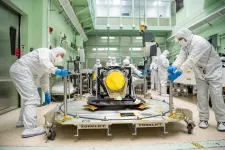
NASA has revealed the first look at a full-scale prototype for six telescopes that will enable, in the next decade, the space-based detection of gravitational waves — ripples in space-time caused by merging black holes and other cosmic sources. The LISA (Laser Interferometer Space Antenna) mission is led by ESA (European Space Agency) in partnership with NASA to detect gravitational waves by using lasers to measure precise distances — down to picometers, or trillionths of a meter — between a trio of spacecraft distributed in a vast configuration larger than the Sun. Each side of the triangular array ...

Read the release
Betelgeuse Betelgeuse? Bright star Betelgeuse likely has a ‘Betelbuddy’ stellar companion
Space

Betelgeuse Betelgeuse? Bright star Betelgeuse likely has a ‘Betelbuddy’ stellar companion

The 10th-brightest star in the night sky, Betelgeuse, may not be on the brink of exploding as a supernova, according to a new study of the star’s brightening and dimming. Instead, recent research shows that the observed pulsing of the starlight is probably caused by an unseen companion star orbiting Betelgeuse. Formally named Alpha Ori B, the “Betelbuddy” (as astrophysicist Jared Goldberg calls it) acts like a snowplow as it orbits Betelgeuse, pushing light-blocking dust out of the way and temporarily making Betelgeuse seem brighter. Goldberg and his colleagues present their simulations of this process in ...

Read the release
Space

Tropical mammals react to changes in lunar light

The full moon has a bad reputation for bringing out the worst in people, from werewolves to lunatics. However, it turns out that the lunar cycle can impact behavior – at least in tropical mammals. New research appearing in the Proceedings of the Royal Society B reveals that half of the mammal species in tropical forests adjust their behaviors in response to the moon's phases and corresponding variations in light. By Caleb Hess, Cathrine Glosli Michigan State University ecologist Lydia Beaudrot, who studies tropical ecology and conservation, was among the international cohort of researchers who contributed to the study. ...

Read the release
Scientists create new overwintering sites for monarch butterflies on a warming planet
Space

Scientists create new overwintering sites for monarch butterflies on a warming planet

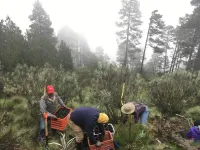
The migration of the monarch butterfly is one of the wonders of the natural world. Each autumn, a new generation of monarch butterflies is born in the northern United States and southern Canada. Hundreds of millions of these butterflies then fly to the mountains of Central Mexico, between 4,000km and 4,800km away. There, they overwinter in forests of the sacred fir Abies religiosa at high altitudes. Without these sacred firs, the monarchs couldn’t survive their grueling migration. But under global warming, these forests are predicted to slowly ...

Read the release
From the original Press-News collection. Issuers of news releases are responsible for the accuracy of their content.