THE ORIGINAL COLLECTION · SINCE 2010

Space
press releases.

Research announcements from universities, hospitals and scientific institutions. Explore the stories, people and discoveries behind the headlines.

Original publication datesPage 31
FIND A STORY

Find a past release.

Dates and source material belong to the original release.

Read our research explainers

Browse the collection · original publication order

Space

Do astronauts experience “space headaches”?

EMBARGOED FOR RELEASE UNTIL 4 P.M. ET, WEDNESDAY, MARCH 13, 2024 MINNEAPOLIS – Space travel and zero gravity can take a toll on the body. A new study has found that astronauts with no prior history of headaches may experience migraine and tension-type headaches during long-haul space flight, which includes more than 10 days in space. The study was published in the March 13, 2024, online issue of Neurology®, the medical journal of the American Academy of Neurology. “Changes in gravity caused by space flight affect the function of many parts of the body, including the brain,” said study author W. P. J. van Oosterhout, MD, PhD, of Leiden University ...

Read the release
Cheers! NASA’s Webb finds ethanol, other icy ingredients for worlds
Space

Cheers! NASA’s Webb finds ethanol, other icy ingredients for worlds

What do margaritas, vinegar, and ant stings have in common? They contain chemical ingredients that NASA’s James Webb Space Telescope has identified surrounding two young protostars known as IRAS 2A and IRAS 23385. Although planets are not yet forming around those stars, these and other molecules detected there by Webb represent key ingredients for making potentially habitable worlds. An international team of astronomers used Webb’s MIRI (Mid-Infrared Instrument) to identify a variety of icy compounds made up of complex organic molecules ...

Read the release
SwRI receives $2 million NASA grant to develop lunar-regolith-measuring instrument
Space

SwRI receives $2 million NASA grant to develop lunar-regolith-measuring instrument

SAN ANTONIO — March 13, 2024 —Southwest Research Institute (SwRI) has been awarded a three-year, $2,041,000 grant from NASA’s Development and Advancement of Lunar Instrumentation (DALI) program to further develop a novel ground-penetrating radar instrument. The Synthetic Pulse Artemis Radar for Crustal Imaging (SPARCI, pronounced “sparky”) instrument is designed to characterize the depth of the regolith and upper megaregolith, the upper broken-up layers of lunar crust associated with ...

Read the release
Space

Explaining a supernova's 'string of pearls'

Images Physicists often turn to the Rayleigh-Taylor instability to explain why fluid structures form in plasmas, but that may not be the full story when it comes to the ring of hydrogen clumps around supernova 1987A, research from the University of Michigan suggests. In a study published in Physical Review Letters, the team argues that the Crow instability does a better job of explaining the "string of pearls" encircling the remnant of the star, shedding light on a longstanding astrophysical mystery. "The fascinating ...

Read the release
The Alliance of World Scientists announces 2024 Planet Earth Award laureates
Space

The Alliance of World Scientists announces 2024 Planet Earth Award laureates

Corvallis, OR — The Alliance of World Scientists (AWS) is pleased to announce the six recipients of the 2024 Planet Earth Award: Dr. S Faizi, Dr. James Hansen, Dr. Denise Margaret S. Matias, Dr. Kimberly Nicholas, Dr. Jamie Pittock, and Dr. Fernando Valladares. Planet Earth Award The AWS Planet Earth Award acknowledges individuals who champion life on Earth. These individuals demonstrate exceptional creativity or contributions in their work in science-based advocacy with the public, ...

Read the release
Space

New UAF lidar will add to space weather research capability

University of Alaska Fairbanks scientists are developing a new light detection and ranging instrument to help gain a better understanding of space weather enveloping Earth. The new laser radar, or lidar, will be the third for the UAF Geophysical Institute. It will measure temperature and neutrally charged iron in the upper atmosphere at altitudes of 75 to 125 miles, where the mesosphere and thermosphere meet. Understanding the processes and influences at that altitude has become increasingly important as the proliferation of low-Earth orbit satellites continues and more nations send probes through ...

Read the release
Ultrablack coating could make next-gen telescopes even better
Space

Ultrablack coating could make next-gen telescopes even better

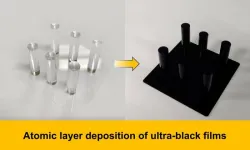
WASHINGTON, March 12, 2024 – Sometimes, seeing clearly requires complete black. For astronomy and precision optics, coating devices in black paint can cut down on stray light, enhancing images and boosting performance. For the most advanced telescopes and optical systems, every little bit matters, so their manufacturers seek out the blackest blacks to coat them. In the Journal of Vacuum Science & Technology A, by AIP Publishing, researchers from the University of Shanghai for Science and Technology and the Chinese Academy of Sciences developed an ultrablack thin-film coating for aerospace-grade magnesium alloys. Their coating absorbs 99.3% of light while being ...

Read the release
Mars attracts: How Earth’s interactions with the red planet drive deep-sea circulation
Space

Mars attracts: How Earth’s interactions with the red planet drive deep-sea circulation

Scientists from the Universities of Sydney and Sorbonne University have used the geological record of the deep sea to discover a connection between the orbits of Earth and Mars, past global warming patterns and the speeding up of deep ocean circulation. They discovered a surprising 2.4-million-year cycle where deep currents wax and wane which, in turn, is linked to periods of increased solar energy and a warmer climate. The study, published in Nature Communications, tackles the questions of how geological-timescale climate ...

Read the release
Complex chemistry in the cold depths of space (video)
Space

Complex chemistry in the cold depths of space (video)

WASHINGTON, March 11, 2024 — For years, scientists thought some complex molecules could only be formed on Earth. But what if we found these kinds of molecules out in space after all? In this episode of Reactions, we explore new findings that show complex carbon ring structures can be formed in space, and what that might mean for biology, chemistry and our own chemical history! https://youtu.be/Jh_O5JP10aQ?si=HFvdSchFY95y4idV Reactions is a video series produced by the American Chemical Society and PBS Digital Studios. Subscribe to Reactions at http://bit.ly/ACSReactions and follow us on Twitter @ACSReactions. The ...

Read the release
Space

Pushing the boundary on ultralow frequency gravitational waves

A team of physicists has developed a method to detect gravity waves with such low frequencies that they could unlock the secrets behind the early phases of mergers between supermassive black holes, the heaviest objects in the universe. The method can detect gravitational waves that oscillate just once every thousand years, 100 times slower than any previously measured gravitational waves. “These are waves reaching us from the farthest corners of the universe, capable of affecting how light travels,” said Jeff Dror, Ph.D., an assistant ...

Read the release
Baby quasars: Growing supermassive black holes
Space

Baby quasars: Growing supermassive black holes

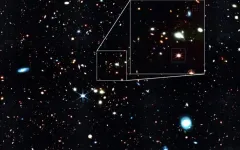
The James Webb Space Telescope makes one of the most unexpected findings within its first year of service: A high number of faint little red dots in the distant Universe could change the way we understand the genesis of supermassive black holes. The research, led by Jorryt Matthee, Assistant Professor in astrophysics at the Institute of Science and Technology Austria (ISTA), is now published in The Astrophysical Journal. A bunch of little red dots found in a tiny region of our night sky might be an unexpected breakthrough for the James Webb Space Telescope (JWST) within its first year of service. These objects were indistinguishable from normal galaxies through the ...

Read the release
What are Hubble and Webb observing right now? NASA tool has the answer
Space

What are Hubble and Webb observing right now? NASA tool has the answer

It’s not hard to find out what NASA’s Hubble and James Webb space telescopes have observed in the past. Barely a week goes by without news of a cosmic discovery made possible using images, spectra, and other data captured by NASA’s prolific astronomical observatories. But what are Hubble and Webb looking at right this minute? A shadowy pillar harboring nascent stars? A pair of colliding galaxies? The atmosphere of a distant planet? Galactic light, stretched and distorted on a 13-billion-year journey across ...

Read the release
Scientist proposed a research on space noncooperative target trajectory tracking based on maneuvering parameter estimation
Space

Scientist proposed a research on space noncooperative target trajectory tracking based on maneuvering parameter estimation

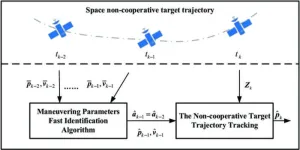
Firstly, the authors briefly describe two models for tracking the maneuvering trajectories of non-cooperative space targets: the relative dynamics model and the indirect measurement model. In the relative dynamics model, tracking the maneuvering trajectory of the target is modeled as a problem of tracking the target's position over short discrete time intervals. On the other hand, the indirect measurement model transforms radar-derived values directly into measurements in the Local Vertical Local Horizontal (LVLH) coordinate system. Next, the authors address the tracking problem of targets ...

Read the release
Groundbreaking survey reveals secrets of planet birth around dozens of stars
Space

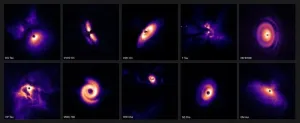
Groundbreaking survey reveals secrets of planet birth around dozens of stars

In a series of studies, a team of astronomers has shed new light on the fascinating and complex process of planet formation. The stunning images, captured using the European Southern Observatory's Very Large Telescope (ESO’s VLT) in Chile, represent one of the largest ever surveys of planet-forming discs. The research brings together observations of more than 80 young stars that might have planets forming around them, providing astronomers with a wealth of data and unique insights into how planets arise in different regions of our galaxy. “This is really a shift in our field of study,” says Christian Ginski, a lecturer at the University of Galway, Ireland, ...

Read the release
JWST captures the end of planet formation
Space

JWST captures the end of planet formation

March 4, 2024, Mountain View, CA – The James Webb Space Telescope (JWST) is helping scientists uncover how planets form by advancing understanding of their birthplaces and the circumstellar disks surrounding young stars, in a paper published in the Astronomical Journal, a team of scientists led by Naman Bajaj of the University of Arizona and including Dr. Uma Gorti at the SETI Institute, image for the first time, winds from an old planet-forming disk (still very young relative to the Sun) which is actively dispersing its gas ...

Read the release
Study determines the original orientations of rocks drilled on Mars
Space

Study determines the original orientations of rocks drilled on Mars

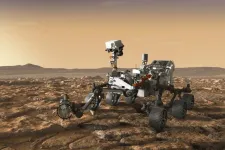
As it trundles around an ancient lakebed on Mars, NASA’s Perseverance rover is assembling a one-of-a-kind rock collection. The car-sized explorer is methodically drilling into the Red Planet’s surface and pulling out cores of bedrock that it’s storing in sturdy titanium tubes. Scientists hope to one day return the tubes to Earth and analyze their contents for traces of embedded microbial life. Since it touched down on the surface of Mars in 2021, the rover has filled 20 of its 43 tubes with cores of bedrock. Now, MIT geologists have remotely determined a crucial property of the rocks collected to date, which will help scientists answer key questions about the planet’s ...

Read the release
Ultraviolet radiation from massive stars shapes planetary systems
Space

Ultraviolet radiation from massive stars shapes planetary systems

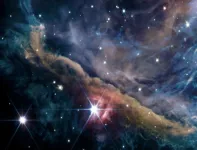
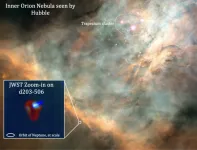
To find out how planetary systems such as our Solar System form, an international research team including scientists from the University of Cologne studied a stellar nursery, the Orion Nebula, using the James Webb Space Telescope (JWST). By observing a protoplanetary disc named d203-506, they discovered the key role massive stars play in the formation of planetary systems that are less than a million years old. The study, led by Dr Olivier Berné from the National Centre for Scientific Research (CNRS) ...

Read the release
Astronomers measure heaviest black hole pair ever found
Space

Astronomers measure heaviest black hole pair ever found

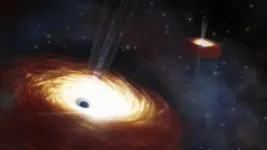
Nearly every massive galaxy hosts a supermassive black hole at its center. When two galaxies merge, their black holes can form a binary pair, meaning they are in a bound orbit with one another. It’s hypothesized that these binaries are fated to eventually merge, but this has never been observed [1]. The question of whether such an event is possible has been a topic of discussion amongst astronomers for decades. In a recently published paper in The Astrophysical Journal, a team of astronomers have presented new insight into this question. The team used data from the Gemini North telescope in ...

Read the release
Space

Ultraviolet “winds” erode a young star’s protoplanetary disk in Orion Nebula

Ultraviolet “winds” from nearby massive stars are stripping the gas from a young star’s protoplanetary disk, causing it to rapidly lose mass, according to a new study. It reports the first directly observed evidence of far-ultraviolet (FUV)-driven photoevaporation of a protoplanetary disk. The findings, which use observations from the James Web Space Telescope (JWST), provide new insights into the constraints of gas giant planet formation, including in our own Solar System. Young low-mass stars are often surrounded by relatively short-lived protoplanetary disks of dust and gas, which provide the raw materials from which planets ...

Read the release
Radiation from massive stars shapes planetary systems
Space

Radiation from massive stars shapes planetary systems

How do planetary systems such as the Solar System form? To find out, CNRS scientists taking part in an international research team1 studied a stellar nursery, the Orion Nebula, using the James Webb Space Telescope2. By observing a protoplanetary disc named d203-506, they have discovered the key role played by massive stars in the formation of such nascent planetary systems3. These stars, which are around 10 times more massive, and more importantly 100,000 times more luminous than the Sun, expose any planets forming in such systems nearby to very intense ultraviolet radiation. Depending on the mass of the star at the centre of the planetary system, this radiation can either help planets to ...

Read the release
Astronomers discover heavy elements after bright gamma-ray burst from neutron star merger
Space

Astronomers discover heavy elements after bright gamma-ray burst from neutron star merger

An international team of astronomers — including Clemson University astrophysicist Dieter Hartmann — obtained observational evidence for the creation of rare heavy elements in the aftermath of a cataclysmic explosion triggered by the merger of two neutron stars. The massive explosion unleashed a gamma-ray burst, GRB230307A, the second brightest in 50 years of observations and about 1,000 times brighter than a typical gamma-ray burst. GRB230307A was first detected by NASA’s Fermi Gamma-Ray Space Telescope on March 7, 2023. Using multiple space- and ground-based ...

Read the release
UBC Okanagan researchers create new compound to build space-age antennas
Space

UBC Okanagan researchers create new compound to build space-age antennas

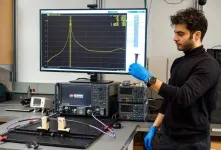
In a first-of-its-kind development, UBC Okanagan researchers, in collaboration with Drexel University, have created a new compound that can be used to 3D print telecommunication antennas and other connectivity devices. These 3D printed products, created by combining a two-dimensional compound called MXenes with a polymer, can be used as an alternative for metallic counterparts and can make a vast improvement in communication technology including elements such as antennas, waveguides and filters. Waveguides are everywhere, yet most people don’t know what they are, says Dr. Mohammad Zarifi, a researcher in UBC Okanagan’s Microelectronics and Gigahertz ...

Read the release
Space

Astronomers reveal a new link between water and planet formation

Researchers have found water vapour in the disc around a young star exactly where planets may be forming. Water is a key ingredient for life on Earth and is also thought to play a significant role in planet formation, yet, until now, astronomers have never been able to map how water is distributed in a stable, cool disc — the type of disc that offers the most favourable conditions for planets to form around stars. For the first time, astronomers have weighed the amount of water vapour around a typical planet-forming star. The new findings were made possible thanks to the Atacama Large Millimeter/submillimeter Array (ALMA) - a collection of telescopes ...

Read the release
Could fiber optic cable help scientists probe the deep layers of the moon?
Space

Could fiber optic cable help scientists probe the deep layers of the moon?

An increasing number of seismologists are using fiber optic cables to detect seismic waves on Earth—but how would this technology fare on the Moon, and what would it tell us about the deep layers of our nearest neighbor in space? In Seismological Research Letters, Wenbo Wu of Woods Hole Oceanographic Institute and colleagues explore the idea of deploying a fiber seismic network on the Moon, discussing some of the challenges to overcome. They also test this hypothetical network using artificial seismograms created from data collected by seismometers placed on the Moon’s surface ...

Read the release
'Cosmic lighthouses' that cleared primordial fog identified with JWST
Space

'Cosmic lighthouses' that cleared primordial fog identified with JWST

UNIVERSITY PARK, Pa. — Scientists working with data from NASA's James Webb Space Telescope (JWST) have obtained the first full spectra of some of the earliest starlight in the universe. The images provide the clearest picture yet of very low-mass, newborn galaxies, created less than a billion years after the Big Bang, and suggest the tiny galaxies are central to the cosmic origin story. The international team of researchers, including two Penn State astrophysicists, published their results ...

Read the release
From the original Press-News collection. Issuers of news releases are responsible for the accuracy of their content.