THE ORIGINAL COLLECTION · SINCE 2010

Space
press releases.

Research announcements from universities, hospitals and scientific institutions. Explore the stories, people and discoveries behind the headlines.

Original publication datesPage 30
FIND A STORY

Find a past release.

Dates and source material belong to the original release.

Read our research explainers

Browse the collection · original publication order

Stellar collisions produce strange, zombie-like survivors
Space

Stellar collisions produce strange, zombie-like survivors

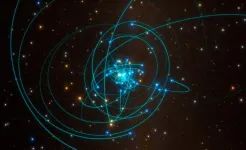
Despite their ancient ages, some stars orbiting the Milky Way’s central supermassive black hole appear deceptively youthful. But unlike humans, who might appear rejuvenated from a fresh round of collagen injections, these stars look young for a much darker reason. They ate their neighbors. This is just one of the more peculiar findings from new Northwestern University research. Using a new model, astrophysicists traced the violent journeys of 1,000 simulated stars orbiting our galaxy’s central supermassive black hole, Sagittarius A* (Sgr A*). So densely packed with stars, the region commonly experiences brutal stellar collisions. ...

Read the release
Space

New findings shed light on the expanding universe

An astrophysicist from The University of Texas at Dallas and his colleagues from the Dark Energy Spectroscopic Instrument (DESI) collaboration are at the forefront of an ambitious experiment to study the expansion of the universe and its acceleration. Dr. Mustapha Ishak-Boushaki, professor of physics in the School of Natural Sciences and Mathematics (NSM) at UT Dallas, is a member of the DESI collaboration, an international group of more than 900 researchers from over 70 institutions around the world engaged in a multiyear experiment to increase understanding of the ...

Read the release
Exploring the effect of the presence of familiar people in interpersonal space
Space

Exploring the effect of the presence of familiar people in interpersonal space

When we communicate with other people face-to-face, we do so by maintaining a certain physical distance from each other. This space surrounding our body while interacting is called the interpersonal space (IPS), and maintaining adequate IPS is crucial for better communication. Many studies have investigated the psychological and physiological changes that occur based on the presence of another person in the IPS during face-to-face interactions. These studies are based on the avoidance behaviour that we experience when a stranger invades our IPS, which manifests in the form of increased heart rate and discomfort. However, ...

Read the release
Space

First results from BREAD experiment demonstrate a new approach to searching for dark matter

One of the great mysteries of modern science is dark matter. We know dark matter exists thanks to its effects on other objects in the cosmos, but we have never been able to directly see it. And it’s no minor thing—currently, scientists think it makes up about 85% of all the mass in the universe. A new experiment by a collaboration led by the University of Chicago and Fermi National Accelerator Laboratory, known as the Broadband Reflector Experiment for Axion Detection or BREAD, has released its first results in the search for dark matter in a ...

Read the release
New satellite dataset sheds light on Earth's plant growth
Space

New satellite dataset sheds light on Earth's plant growth

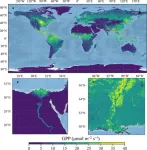
In the field of environmental and climate science, researchers have developed the Comprehensive Mechanistic Light Response (CMLR) gross primary production (GPP) dataset. Derived from the TROPOMI satellite's solar-induced chlorophyll fluorescence (SIF) observations, this global dataset offers unprecedented insights into Earth's GPP, the process through which plants convert carbon dioxide and sunlight into essential resources. Gross Primary Production (GPP), the process through which plants convert carbon dioxide and sunlight into glucose and oxygen, is the Earth's largest carbon flux. Accurate quantification ...

Read the release
Three-year study of young stars with NASA’s Hubble enters new chapter
Space

Three-year study of young stars with NASA’s Hubble enters new chapter

In the largest and one of the most ambitious Hubble Space Telescope programs ever executed, a team of scientists and engineers collected information on almost 500 stars over a three-year period. This effort offers new insights into the stars' formation, evolution, and impact on their surroundings. This comprehensive survey, called ULLYSES (Ultraviolet Legacy Library of Young Stars as Essential Standards), was completed in December 2023, and provides a rich spectroscopic dataset obtained in ultraviolet light that astronomers will be mining for decades to come. Because ultraviolet light can ...

Read the release
ALMA finds new molecular signposts in starburst galaxy
Space

ALMA finds new molecular signposts in starburst galaxy

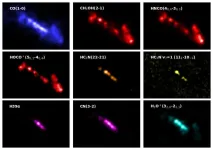
The ALMA radio telescope has detected more than 100 molecular species, including many indicative of different star formation and evolution processes, in a galaxy where stars are forming much more actively than in the Milky Way. This is far more molecules than were found in previous studies. Now the team will try to apply this knowledge to other galaxies. A team of researchers led by Sergio Martin of the European Southern Observatory/Joint ALMA Observatory, Nanase Harada of the National Astronomical Observatory of Japan, and Jeff Mangum of the National Radio Astronomy Observatory ...

Read the release
Space

Curtin research unlocks supernova stardust secrets

Curtin University-led research has discovered a rare dust particle trapped in an ancient extra-terrestrial meteorite that was formed by a star other than our sun. The discovery was made by lead author Dr Nicole Nevill and colleagues during her PhD studies at Curtin, now working at the Lunar and Planetary Science Institute in collaboration with NASA’s Johnson Space Centre. Meteorites are mostly made up of material that formed in our solar system and can also contain tiny particles which originate from stars born long before our sun. Clues that these particles, known as presolar grains, are relics from other stars ...

Read the release
Space

Persistent hiccups in a far-off galaxy draw astronomers to new black hole behavior

At the heart of a far-off galaxy, a supermassive black hole appears to have had a case of the hiccups. Astronomers from MIT, Italy, the Czech Republic, and elsewhere have found that a previously quiet black hole, which sits at the center of a galaxy about 800 million light years away, has suddenly erupted, giving off plumes of gas every 8.5 days before settling back to its normal, quiet state. The periodic hiccups are a new behavior that has not been observed in black ...

Read the release
New image of the center of our Milky Way: Spiral magnetic fields surround black hole Sagittarius A*
Space

New image of the center of our Milky Way: Spiral magnetic fields surround black hole Sagittarius A*

FRANKFURT. In 2022, scientists of the EHT unveiled the first image of Sgr A* – which is approximately 27,000 light-years away from Earth – revealing that the Milky Way’s supermassive black hole looks remarkably similar to M87’s, even though it is more than a thousand times smaller and less massive. This made scientists wonder whether the two shared common traits outside of their looks. To find out, the team decided to study Sgr A* in polarized light. Previous studies of light around M87* had shown that the magnetic fields around the gigantic black hole allowed it to launch powerful jets of material back into the surrounding environment. ...

Read the release
Astronomers unveil strong magnetic fields spiraling at the edge of Milky Way’s central black hole
Space

Astronomers unveil strong magnetic fields spiraling at the edge of Milky Way’s central black hole

A new image from the Event Horizon Telescope (EHT) collaboration— which includes scientists from the Center for Astrophysics | Harvard & Smithsonian (CfA)— has uncovered strong and organized magnetic fields spiraling from the edge of the supermassive black hole Sagittarius A* (Sgr A*). Seen in polarized light for the first time, this new view of the monster lurking at the heart of the Milky Way Galaxy has revealed a magnetic field structure strikingly similar to that of the black hole at the center of the M87 galaxy, suggesting that strong magnetic fields may be common to all black holes. This similarity also hints toward a hidden ...

Read the release
Sleeping supermassive black holes awakened briefly by shredded stars
Space

Sleeping supermassive black holes awakened briefly by shredded stars

A new investigation into an obscure class of galaxies known as Compact Symmetric Objects, or CSOs, has revealed that these objects are not entirely what they seem. CSOs are active galaxies that host supermassive black holes at their cores. Out of these monstrous black holes spring two jets traveling in opposite directions at nearly the speed of light. But in comparison to other galaxies that boast fierce jets, these jets do not extend out to great distances—they are much more compact. For many decades, astronomers suspected that CSOs were simply young and that their jets would eventually travel out to greater distances. Now, reporting in three different papers in The ...

Read the release
SwRI’s Dr. Rohini Giles receives NASA Early Career Achievement Medal
Space

SwRI’s Dr. Rohini Giles receives NASA Early Career Achievement Medal

SAN ANTONIO — March 26, 2024 —Southwest Research Institute Senior Research Scientist Dr. Rohini Giles has received the NASA Early Career Achievement Medal. The medal recognizes unusual and significant performance supporting NASA’s mission during the first 10 years of their career. Giles was cited for “significant early career achievements in the analysis of Juno data to study Jovian Transient Luminous Events and the distribution of constituents in Jupiter’s atmosphere.” “It’s ...

Read the release
SwRI develops more effective particle conversion surfaces for space instruments
Space

SwRI develops more effective particle conversion surfaces for space instruments

SAN ANTONIO — March 25, 2024 —Southwest Research Institute is investing internal funding to develop more effective conversion surfaces to allow future spacecraft instruments to collect and analyze low-energy particles. Conversion surfaces are ultra-smooth, ultra-thin surfaces covering a silicon wafer that convert neutral atoms into ions to more effectively detect particles from outer space. Changing the charge of particles simplifies and enhances detection and analysis capabilities. Dr. Jianliang Lin of the Institute’s Mechanical Engineering Division and Dr. Justyna Sokół of SwRI’s Space Science Division lead the multidisciplinary project. The project builds ...

Read the release
Signs of life detectable in single ice grain emitted from extraterrestrial moons
Space

Signs of life detectable in single ice grain emitted from extraterrestrial moons

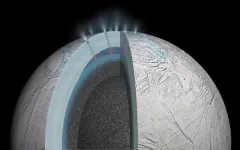
The ice-encrusted oceans of some of the moons orbiting Saturn and Jupiter are leading candidates in the search for extraterrestrial life. A new lab-based study led by the University of Washington in Seattle and the Freie Universität Berlin shows that individual ice grains ejected from these planetary bodies may contain enough material for instruments headed there in the fall to detect signs of life, if such life exists. “For the first time we have shown that even a tiny fraction of cellular material could be identified by a mass spectrometer onboard a spacecraft,” said lead author Fabian Klenner, a UW postdoctoral researcher in Earth and space sciences. ...

Read the release
James Webb Space Telescope captures the end of planet formation
Space

James Webb Space Telescope captures the end of planet formation

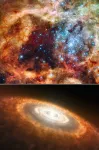
Scientists believe that planetary systems like our solar system contain more rocky objects than gas-rich ones. Around our sun, these include the inner planets – Mercury, Venus, Earth and Mars – the asteroid belt and the Kuiper belt objects such as Pluto. Jupiter, Saturn, Uranus and Neptune, on the other hand, contain mostly gas. But scientists also have known for a long time that planet-forming disks start out with 100 times more mass in gas than solids, which leads to a pressing question: When ...

Read the release
NASA’s tiny BurstCube mission launches to study cosmic blasts
Space

NASA’s tiny BurstCube mission launches to study cosmic blasts

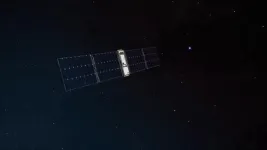
NASA’s BurstCube, a shoebox-sized satellite designed to study the universe’s most powerful explosions, is on its way to the International Space Station. The spacecraft travels aboard SpaceX’s 30th Commercial Resupply Services mission, which lifted off at 4:55 p.m. EDT on Thursday, March 21, from Launch Complex 40 at Cape Canaveral Space Force Station in Florida. After arriving at the station, BurstCube will be unpacked and later released into orbit, where it will detect, locate, and study short gamma-ray ...

Read the release
Satellite data assimilation improves forecasts of severe weather
Space

Satellite data assimilation improves forecasts of severe weather

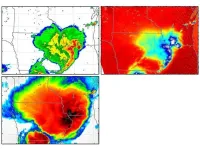
UNIVERSITY PARK, Pa. — In 2020, a line of severe thunderstorms unleashed powerful winds that caused billions in damages across the Midwest United States. A technique developed by Penn State scientists that incorporates satellite data could improve forecasts — including where the most powerful winds will occur — for similar severe weather events. The researchers reported in the journal Geophysical Research Letters that adding microwave data collected by low-Earth-orbiting satellites to existing computer weather forecast models produced more accurate forecasts of surface gusts in a case study of the 2020 Midwest ...

Read the release
Space

Scientists find one of the most ancient stars that formed in another galaxy

The first generation of stars transformed the universe. Inside their cores, simple hydrogen and helium fused into a rainbow of elements. When these stars died, they exploded and sent these new elements across the universe. The iron running in your veins and the calcium in your teeth and the sodium powering your thoughts were all born in the heart of a long-dead star. No one has been able to find one of those first generation of stars, but scientists have announced a unique finding: a star from the second generation that originally formed in a different galaxy from ours. “This ...

Read the release
Space

Icy impacts: Planetary scientists use physics and images of impact craters to gauge the thickness of ice on Europa

WEST LAFAYETTE, Ind. — Sometimes planetary physics is like being in a snowball fight. Most people, if handed an already-formed snowball, can use their experience and the feel of the ball to guess what kind of snow it is comprised of: packable and fluffy, or wet and icy. Using nearly the same principles, planetary scientists have been able to study the structure of Europa, Jupiter’s icy moon. Additional Information When worlds collide: Studying impact craters to uncover the secrets of the solar system Breaking in a new planet Purdue scientists and engineers push the boundaries of space knowledge, studying the ...

Read the release
Study reveals ‘cozy domesticity’ of prehistoric stilt-house dwellers in England’s ancient marshland
Space

Study reveals ‘cozy domesticity’ of prehistoric stilt-house dwellers in England’s ancient marshland

A major report on the remains of a stilt village that was engulfed in flames almost 3,000 years ago reveals in unprecedented detail the daily lives of England’s prehistoric fenlanders. Must Farm, a late Bronze Age settlement, dates to around 850BC, with University of Cambridge archaeologists unearthing four large wooden roundhouses and a square entranceway structure – all of which had been constructed on stilts above a slow-moving river. The entire hamlet stood approximately two metres above the riverbed, with walkways bridging some of the main houses, and ...

Read the release
Clemson astrophysicist’s research could provide a hint in the search for dark matter
Space

Clemson astrophysicist’s research could provide a hint in the search for dark matter

Dark matter is one of science’s greatest mysteries. It doesn’t absorb, reflect or emit light, so we can’t see it. But its presence is implied by the gravitational effects it appears to have on galaxies. Although dark matter makes up about 85 percent of the cosmos, scientists know very little about its fundamental nature. Theories abound, and research by Clemson University postdoctoral fellow Alex McDaniel provides some of the most stringent constraints on the nature of dark matter yet. His research also reveals a small hint of a signal that, if real, ...

Read the release
Rensselaer researcher receives DOE grant to develop models that track the formation of black holes
Space

Rensselaer researcher receives DOE grant to develop models that track the formation of black holes

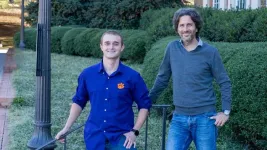
When a star goes supernova, a massive burst of neutrinos is the first signal that can escape the density of the collapsing star. Detecting and analyzing this phenomenon in real time would allow us insight into stellar dynamics and, potentially, black hole formation. Detection of these types of signals from modern physics detectors is notoriously hard and presents computational challenges that push the bounds of modern and next-generation computing. Transmitting and analyzing the data from the massive particle physics detectors to the next generation of extreme-scale ...

Read the release
Largest-ever map of universe’s active supermassive black holes released
Space

Largest-ever map of universe’s active supermassive black holes released

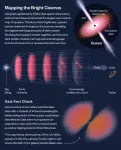
Astronomers have charted the largest-ever volume of the universe with a new map of active supermassive black holes living at the centers of galaxies. Called quasars, the gas-gobbling black holes are, ironically, some of the universe’s brightest objects. The new map logs the location of about 1.3 million quasars in space and time, the furthest of which shone bright when the universe was only 1.5 billion years old. (For comparison, the universe is now 13.7 billion years old.) “This quasar catalog is different from all previous catalogs in that it gives us a three-dimensional map of the largest-ever volume of the universe,” says map co-creator David Hogg, a ...

Read the release
New research suggests that our universe has no dark matter
Space

New research suggests that our universe has no dark matter

The current theoretical model for the composition of the universe is that it’s made of ‘normal matter,’ ‘dark energy’ and ‘dark matter.’ A new uOttawa study challenges this. A University of Ottawa study published today challenges the current model of the universe by showing that, in fact, it has no room for dark matter. In cosmology, the term “dark matter” describes all that appears not to interact with light or the electromagnetic field, or that can only be explained through gravitational force. We can’t see it, nor do we know what ...

Read the release
From the original Press-News collection. Issuers of news releases are responsible for the accuracy of their content.