THE ORIGINAL COLLECTION · SINCE 2010

Space
press releases.

Research announcements from universities, hospitals and scientific institutions. Explore the stories, people and discoveries behind the headlines.

Original publication datesPage 32
FIND A STORY

Find a past release.

Dates and source material belong to the original release.

Read our research explainers

Browse the collection · original publication order

Space

The James Webb Space Telescope reveals the central role of low-mass galaxies in the reionization process of the Universe

PARIS, France and BEER-SHEVA, Israel, February 28, 2024 – The James Webb Space Telescope (JWST)[1], developed by NASA and ESA, has just obtained the first spectra of very low-mass galaxies less than a billion years after the Big Bang. A technological feat made possible by the unique combination of JWST sensitivity and the gravitational lensing effect of the Abell 2744 cluster: nearby galaxies act like cosmic magnifiers, distorting space and amplifying the light of background galaxies. By demonstrating that small galaxies are very likely at the origin of the reionization of the universe, this discovery represents a major breakthrough in our knowledge of the cosmos. The international research ...

Read the release
Space

How decades of expertise with the fourth state of matter could bring satellites closer to Earth

Thousands of satellites take pictures, gather information and relay internet traffic from high above the Earth. Now, the challenge is making satellites that operate closer to home, in what is called a very low earth orbit (VLEO), where there is ample space for additional satellites, and the pictures taken would be clearer. Working at an altitude with air would mean more force would be needed to propel the satellite forward, but many scientists believe there is also an advantage: the air could be used as the propellant. They say charged particles of air-breathing plasma – the fourth state of matter – could be used to propel the thrusters, potentially ...

Read the release
Award-winning researcher dreams of stellar explosions and strives for equity and inclusion in academia
Space

Award-winning researcher dreams of stellar explosions and strives for equity and inclusion in academia

She studies the giant explosions of dying stars and dreams of experiencing and extracting data from a supernova close to Earth. Professor Irene Tamborra from the Niels Bohr Institute also tirelessly promotes equity and inclusion in research. Today she receives the prestigious Elite Research Prize and DKK 1.2 million in honor of her research in astrophysics. "I am fascinated by anything that explodes in the sky," Professor Irene Tamborra says as she begins to describe her research. The professor from the University of Copenhagen’s ...

Read the release
Space

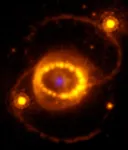
Uncovered with JWST: A neutron star in the remnant of Supernova 1987A

Astronomers using the James Webb Space Telescope (JWST) have found conclusive evidence of a neutron star in the remnant of Supernova 1987A, the only supernova visible to the naked eye in the last 400 years and the most studied supernova in history. Although Supernova 1987A has been observed for more than three decades, scientists have not seen the compact object expected to have been produced during the explosion. Some indirect evidence had suggested that the supernova produced a neutron star, but a black hole wasn’t ruled ...

Read the release
James Webb telescope detects traces of neutron star in iconic supernova
Space

James Webb telescope detects traces of neutron star in iconic supernova

Scientists can finally show that a neutron star formed from our most well-studied supernova, SN 1987A. The breakthrough was made possible thanks to the James Webb telescope. Supernovae are the spectacular end result of the collapse of stars more massive than 8-10 times the mass of the sun. Besides being the main sources of chemical elements such as carbon, oxygen, silicon, and iron that make life possible, they are also responsible for creating the most exotic objects in the universe, neutron stars and black holes. In 1987, supernova 1987A (SN 1987A) ...

Read the release
Wistar scientists discover link between leaky gut and accelerated biological aging
Space

Wistar scientists discover link between leaky gut and accelerated biological aging

PHILADELPHIA—(Feb. 21, 2024)—The Wistar Institute’s associate professor Mohamed Abdel-Mohsen, Ph.D., has demonstrated, with his lab and collaborators, a connection between viral damage to the gut and premature biological aging. The group found that this pro-aging connection can contribute to both gut permeability and premature systemic & intestinal tissue aging in people living with chronic HIV infection, and their discovery is detailed in the newly published paper titled, “Distinct Intestinal Microbial Signatures Linked to Accelerated Systemic and Intestinal Biological Aging,” published in the journal Microbiome. When people's bodies age faster ...

Read the release
Little groundwater recharge in ancient Mars aquifer, according to new models
Space

Little groundwater recharge in ancient Mars aquifer, according to new models

Mars was once a wet world. The geological record of the Red Planet shows evidence for water flowing on the surface – from river deltas to valleys carved by massive flash floods. But a new study shows that no matter how much rainfall fell on the surface of ancient Mars, very little of it seeped into an aquifer in the planet’s southern highlands. A graduate student at The University of Texas at Austin made the discovery by modeling groundwater recharge dynamics for the aquifer using a range of methods ...

Read the release
Black hole at center of the Milky Way resembles a football
Space

Black hole at center of the Milky Way resembles a football

BERKS, Pa. — The supermassive black hole in the center of the Milky Way is spinning so quickly it is warping the spacetime surrounding it into a shape that can look like a football, according to a new study using data from NASA’s Chandra X-ray Observatory and the U.S. National Science Foundation’s Karl G. Jansky Very Large Array (VLA). That football shape suggests the black hole is spinning at a substantial speed, which researchers estimated to be about 60% of its potential limit. The work, led by Penn State Berks Professor of Physics Ruth Daly, was published in the Monthly Notices of the Royal Astronomical Society. Astronomers call this giant ...

Read the release
Second year of Cal Poly astronomy fellowship to examine high-energy particle jets near supermassive black holes
Space

Second year of Cal Poly astronomy fellowship to examine high-energy particle jets near supermassive black holes

February 16, 2024 Contact: Nick Wilson 805-235-8008; nwilso28@calpoly.edu Second Year of Cal Poly Astronomy Fellowship to Examine High-Energy Particle Jets Near Supermassive Black Holes SAN LUIS OBISPO — In the second year of the Astronomy Faculty Research Fellowship in Cal Poly’s Bailey College of Science and Mathematics, a research team will study extremely high-energy photons emitted by the extreme environment found near mega-sized black holes. The fellowship was ...

Read the release
Under pressure - space exploration in our time
Space

Under pressure - space exploration in our time

In the past decade, humanity has seen the birth and expansion of a commercial space sector with new, private players, addressing technological challenges - from space launch to communication and satellite imagery of Earth. Last year, the global space industry skyrocketed launching more than 2,660* satellites into orbit, and, into the universe, interplanetary probes, landers, and much more. In the United States, SpaceX was responsible for almost 90% of these launches. In parallel to this progression is the expansion of more than 70 countries** demonstrating space capabilities. It affirms the general consensus and understanding ...

Read the release
Space

Can astronomers use radar to spot a cataclysmic asteroid?

How can humans protect the Earth from “devastating asteroid and comet impacts?” According to the National Academies and their 2023-2032 Planetary Science and Astrobiology Decadal Survey, ground based astronomical radar systems will have a “unique role” to play in planetary defense. There is currently only one system in the world concentrating on these efforts, NASA’s Goldstone Solar System Radar, part of the Deep Space Network (DSN). However, a new instrument concept from the National Radio Astronomy Observatory ...

Read the release
Space

Competition for food drives the planet’s remaining mass migration of herbivores

Upending the prevailing theory of how and why multi-species mass-migration patterns occur in Serengeti National Park, researchers from Wake Forest University have confirmed that the millions-strong wildebeest population pushes zebra herds along in competition for the most nutrient-dense grasses. The study resulting from this research, “Interplay of competition and facilitation in grazing succession by migrant Serengeti herbivores,” appears today in the peer-reviewed journal Science. For decades, biologists have believed the major grazing ...

Read the release
Space

RIT's Center for Detectors to work on two NASA projects

Rochester Institute of Technology’s Center for Detectors has been chosen by NASA for two research programs: Early Stage Innovations (ESI) and Strategic Astrophysics Technology (SAT), with the hope of helping future spacecraft find new discoveries in the vast universe. Under the leadership of Center for Detectors Director Don Figer, the team will be advancing and characterizing single-photon sensing complementary metal-oxide semiconductor (CMOS) image sensors to determine if they can survive the harsh radiation environments in NASA missions. The intent is to fly these types of detectors on future missions to find life on Jupiter’s ...

Read the release
Migration solves exoplanet puzzle
Space

Migration solves exoplanet puzzle

Ordinarily, planets in evolved planetary systems, such as the Solar System, follow stable orbits around their central star. However, many indications suggest that some planets might depart from their birthplaces during their early evolution by migrating inward or outward. This planetary migration might also explain an observation that has puzzled researchers for several years: the relatively low number of exoplanets with sizes about twice as large as Earth, known as the radius valley or gap. Conversely, there are many exoplanets smaller and larger than this size. “Six years ago, a reanalysis of data from the Kepler space telescope revealed a shortage of exoplanets with sizes around ...

Read the release
Space

Researchers discover cosmic dust storms from Type Ia supernova

Cosmic dust—like dust on Earth—comprises groupings of molecules that have condensed and stuck together in a grain. But the exact nature of dust creation in the universe has long been a mystery. Now, however, an international team of astronomers from China, the United States, Chile, the United Kingdom, Spain, etc., has made a significant discovery by identifying a previously unknown source of dust in the universe: a Type Ia supernova interacting with gas from its surroundings. The study was published in Nature Astronomy on Feb. 9, and was led by Prof. WANG Lingzhi from the South America Center for Astronomy of the Chinese Academy ...

Read the release
Results from South Pole Telescope’s new camera emerge
Space

Results from South Pole Telescope’s new camera emerge

Argonne is part of a multi-institutional effort to survey the sky for clues about the origins and nature of our universe. For more than five years, scientists at the South Pole Telescope in Antarctica have been observing the sky with an upgraded camera. The extended gaze toward the cosmos is picking up remnant light from the universe’s early formation. Now researchers have analyzed an initial batch of data, publishing details in the journal Physical Review D. The results from this limited dataset hint at even more powerful future insights about the nature of our universe. The telescope at the Amundsen-Scott South Pole Station, which is operated by the National ...

Read the release
MXene-coated devices can guide microwaves in space and lighten the payload
Space

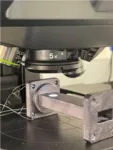
MXene-coated devices can guide microwaves in space and lighten the payload

One of the most important components of satellites that enable telecommunication is the waveguide, which is a metal tube for guiding radio waves. It is also one of the heaviest payloads satellites carry into orbit. As with all space technology, reducing weight means reducing the amount of expensive and greenhouse gas-producing fuel it takes to launch a rocket, or increasing the number of devices carried by the same rocket to space. Researchers from Drexel University and the University of British Columbia are trying to lighten the load by creating and testing a waveguide made ...

Read the release
Which came first: Black holes or galaxies?
Space

Which came first: Black holes or galaxies?

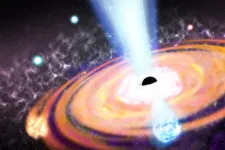
Black holes not only existed at the dawn of time, they birthed new stars and supercharged galaxy formation, a new analysis of James Webb Space Telescope data suggests. The insights upend theories of how black holes shape the cosmos, challenging classical understanding that they formed after the first stars and galaxies emerged. Instead, black holes might have dramatically accelerated the birth of new stars during the first 50 million years of the universe, a fleeting period within its 13.8 billion—year history. "We know these monster black holes ...

Read the release
Understanding the moon’s history with Chang’e-5 sample
Space

Understanding the moon’s history with Chang’e-5 sample

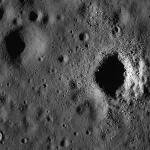
WASHINGTON, Feb. 6, 2024 – Earth’s moon achieved its Swiss cheese appearance from celestial objects crashing into its surface, forming impact craters. But craters weren’t all that was left behind; the intense pressure and temperature of such a collision also impacts the rocks and dust covering the lunar surface, known as regolith, altering its mineral composition and structure. Analyzing the resulting minerals provides modern researchers clues to the moon’s past. China’s Chang’e-5, the first lunar sample ...

Read the release
Space

Centuries-old texts penned by early astronomers Copernicus and Sacrobosco find new home at RIT

The ancient astronomer Nicolaus Copernicus was the first scientist to document the theory that the sun is the center of the universe in his book, De Revolutionibus Orbium Coelestium (On the Revolutions of the Heavenly Spheres). That first edition book, along with a delicate manuscript from astronomer Johannes de Sacrobosco, that is contrary to Copernicus’ groundbreaking theory, has now found a permanent home at Rochester Institute of Technology. The texts were donated to RIT’s Cary Graphic Arts Collection, one of the world’s premier libraries on graphic communication history and practices. The donor is Irene ...

Read the release
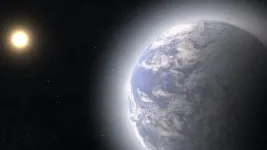
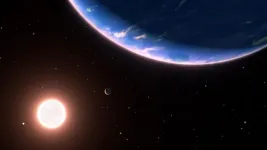
Neptune-like exoplanets can be cloudy or clear — new findings suggest the reason why
Space

Neptune-like exoplanets can be cloudy or clear — new findings suggest the reason why

LAWRENCE — The study of “exoplanets,” the sci-fi-sounding name for all planets in the cosmos beyond our own solar system, is a pretty new field. Mainly, exoplanet researchers like those in the ExoLab at the University of Kansas use data from space-borne telescopes such as the Hubble Space Telescope and Webb Space Telescope. Whenever news headlines offer findings of “Earth-like” planets or planets with the potential to support humanity, they’re talking about exoplanets within our own Milky Way. Jonathan Brande, a doctoral candidate in the ExoLab at the University of Kansas, has just published findings in the open-access ...

Read the release
Space

Strong European backing for Ukraine leaves “little space” for exploitation of pro-Russian politics, study shows

Strong support for Ukraine means there is “little space” for European politicians to exploit pro-Russia foreign policy messages, a new study shows. Researchers have found widespread backing for Ukraine across the continent, and for policies that help the nation, such as imposing sanctions on Russia. But public opinion is more mixed on the approach NATO should take and whether Ukraine should become a member. Experts found European nations can be classified into three distinct groups. Citizens ...

Read the release
Advanced simulations to provide new understanding of supermassive black holes
Space

Advanced simulations to provide new understanding of supermassive black holes

Rochester Institute of Technology scientists will be the lead researchers on a $1.8 million NASA grant to study electromagnetic signals from merging supermassive black holes. RIT’s Manuela Campanelli, Distinguished Professor in the School of Mathematics and Statistics and director of the Center for Computational Relativity and Gravitation, will lead the collaborative project with help from Yosef Zlochower, professor in the School of Mathematics and Statistics. The project will also include researchers from the University of Idaho, Johns Hopkins University, and the Goddard Space Flight Center. The team will combine astrophysical knowledge with state-of-the-art ...

Read the release
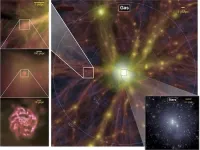
Researchers seek to understand how regions of 'cosmic web' influence behavior of galaxies
Space

Researchers seek to understand how regions of 'cosmic web' influence behavior of galaxies

LAWRENCE — Researchers at the University of Kansas hope to better understand intricate mechanisms behind the evolution of galaxies, which travel through a “cosmic web” of different environments during their lifespans. Gregory Rudnick, professor of physics & astronomy at KU, is leading a team that recently earned a $375,000 grant from the National Science Foundation to study “gas content and star-formation properties of galaxies” that are altered depending on where they are moving through the cosmos. “The primary objective of this project is to comprehend the impact of environmental factors on the transformation of galaxies,” Rudnick ...

Read the release
Space

Researchers spying for signs of life among exoplanet atmospheres

COLUMBUS, Ohio – The next generation of advanced telescopes could sharpen the hunt for potential extraterrestrial life by closely scrutinizing the atmospheres of nearby exoplanets, new research suggests. The next generation of advanced telescopes could sharpen the hunt for potential extraterrestrial life by closely scrutinizing the atmospheres of nearby exoplanets, new research suggests. Published recently in The Astronomical Journal, a new paper details how a team of astronomers from The Ohio State University examined upcoming telescopes’ ability to detect chemical ...

Read the release
From the original Press-News collection. Issuers of news releases are responsible for the accuracy of their content.