THE ORIGINAL COLLECTION · SINCE 2010

Space
press releases.

Research announcements from universities, hospitals and scientific institutions. Explore the stories, people and discoveries behind the headlines.

Original publication datesPage 44
FIND A STORY

Find a past release.

Dates and source material belong to the original release.

Read our research explainers

Browse the collection · original publication order

Space

One-third of galaxy’s most common planets could be in habitable zone

Our familiar, warm, yellow sun is a relative rarity in the Milky Way. By far the most common stars are considerably smaller and cooler, sporting just half the mass of our sun at most. Billions of planets orbit these common dwarf stars in our galaxy. To capture enough warmth to be habitable, these planets would need to huddle very close to their small stars, which leaves them susceptible to extreme tidal forces. In a new analysis based on the latest telescope data, University of Florida astronomers have discovered ...

Read the release

GPS tracking reveals how a female baboon stopped using urban space after giving birth
Space

GPS tracking reveals how a female baboon stopped using urban space after giving birth

A new study from Swansea University and the University of Cape Town provides the first documented evidence of a cessation in urban space use by a female baboon after giving birth: another example of how wild animals are adaptively responding to urbanisation. The study, recently published in the journal Ecology & Evolution, used GPS collars to track the movements of 13 chacma baboons in Cape Town, South Africa. The data revealed that when one collared female gave birth, she stopped using urban space without any significant change in daily distance travelled or social interactions that would be expected with general risk-sensitive behaviour during this ...

Read the release
NASA data could lead to more accurate weather forecasts
Space

NASA data could lead to more accurate weather forecasts

A University of Texas at Arlington civil engineering researcher will use a NASA grant to help forecasters better predict extreme weather events using a variety of existing NASA data sources. Yu Zhang, associate professor in the Department of Civil Engineering, said the $638,000 grant will use ocean circulation data, atmospheric conditions and current weather information to make longer-range forecasting more reliable. Having a more accurate forecast could help officials make better decisions about the state’s water resources—for example, knowing when to release water from reservoirs. “Using ...

Read the release
Multifunctional interface enables manipulation of light waves in free space
Space

Multifunctional interface enables manipulation of light waves in free space

Recent technological advances have given us a remarkable ability to manipulate and control light waves, opening up numerous applications in various fields, such as optical communication, sensing, imaging, energy, and quantum computing. At the heart of this progress are photonic structures that can control light waves, either at the chip level in the form of photonic integrated circuits (PICs) or in free space as meta-optics. Combining these structures allows for the creation of compact optical systems. The PICs can be used to make subtle changes to the light wave, ...

Read the release
Eruption of Tonga underwater volcano found to disrupt satellite signals halfway around the world
Space

Eruption of Tonga underwater volcano found to disrupt satellite signals halfway around the world

An international team has used satellite- and ground-based ionospheric observations to demonstrate that an air pressure wave triggered by volcanic eruptions could produce an equatorial plasma bubble (EPB) in the ionosphere, severely disrupting satellite-based communications. Their findings were published in the journal Scientific Reports. The ionosphere is the region of the Earth's upper atmosphere where molecules and atoms are ionized by solar radiation, creating positively charged ions. The area with the highest concentration of ionized particles is called the F-region, an area 150 to 800 km above the Earth's surface. The F-region plays ...

Read the release
Space

New high risk, high reward studies will tackle key unanswered questions about our planet

NERC has invested £25 million in a host of high risk, high reward research projects to tackle critical environment challenges. The 44 projects cover the full spectrum of environmental science including geology, atmospheric science, biodiversity and ecology. The research will, for example: improve our understanding of volcanic activity such as eruptions a lava flows age the Earth’s solid inner core investigate historic mass extinction events predict future changes to carbon ...

Read the release
First observed radio waves from a type Ia supernova
Space

First observed radio waves from a type Ia supernova

For the first time, astronomers have observed radio waves emitted by a Type Ia supernova, a type of explosion originating from a white dwarf star. This provides important clues to understand how white dwarfs explode. A Type Ia (One-A) supernova is the nuclear explosion of a white dwarf star. This type of supernova is well known; these supernovae are used by astronomers to measure cosmological distances and the expansion of the Universe. But the explosion mechanism of Type Ia supernovae is not well understood. Solitary white dwarfs don’t explode, so it is thought that mass accretion from a neighboring companion ...

Read the release
Space

NYU Abu Dhabi researcher contributes to the discovery of an Earth-sized exoplanet in the habitable zone with volcanic activity

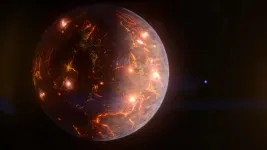
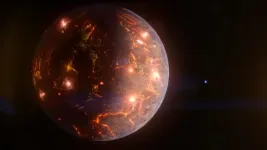
Abu Dhabi, UAE: – A team of scientists led by researchers at the University of Montreal has recently discovered an Earth-sized exoplanet, a world beyond our solar system, that may be carpeted with volcanoes and potentially hospitable to life. Called LP 791-18 d, the planet could undergo volcanic outbursts as often as Jupiter’s moon Io, the most volcanically active body in our solar system. The team includes Mohamad Ali-Dib, a research scientist at the NYU Abu Dhabi (NYUAD) Center for Astro, Particle, and Planetary Physics. The planet was found and studied using data ...

Read the release
Radio signal reveals supernova origin
Space

Radio signal reveals supernova origin

In the latest issue of the journal Nature, astronomers from Stockholm University reveal the origin of a thermonuclear supernova explosion. Strong emission lines of helium and the first detection of such a supernova in radio waves show that the exploding white dwarf star had a helium-rich companion. Supernovae of Type Ia are important for astronomers since they are used to measure the expansion of the Universe. However, the origin of these explosions has remained an open question. While it is established that the explosion is that of a compact ...

Read the release
Are Earth and Venus the only volcanic planets? Not anymore.
Space

Are Earth and Venus the only volcanic planets? Not anymore.

Imagine an Earth-sized planet that’s not at all Earth-like. Half this world is locked in permanent daytime, the other half in permanent night, and it’s carpeted with active volcanoes. Astronomers have discovered that planet. The planet, named LP 791-18d, orbits a small red dwarf star about 90 light years away. Volcanic activity makes the discovery particularly notable for astronomers because volcanism facilitates interaction between a world’s interior and its exterior. “Why is volcanism important? It is the major source contributing to a planetary atmosphere, and with an atmosphere you could have surface liquid water — a requirement for sustaining ...

Read the release
Astronomers find potentially volcano-covered Earth-size world
Space

Astronomers find potentially volcano-covered Earth-size world

Cambridge, Mass. – Astronomers have discovered an Earth-size exoplanet, a world beyond the solar system, that may be carpeted with volcanoes and could potentially support life. Called LP 791-18 d, the planet could undergo volcanic outbursts as often as Jupiter’s moon Io, the most volcanically active body in the solar system. The planet was first reported in Nature and the discovery was made possible in part due to ground-based observations made by the Center for Astrophysics | Harvard & Smithsonian. LP 791-18 d orbits a small red dwarf star about 90 light-years away in a southern constellation called Crater. The ...

Read the release
Space

Researchers design smaller, lighter space-based imaging spectrometers with high spectral resolution

Researchers have developed a new smaller, lighter design for space-based imaging spectrometers with high spectral resolution. These high-dispersion imaging spectrometers could be used onboard spacecraft or satellites to study the Earth’s atmosphere or the atmospheres of other planets. James P. McGuire, Jr. from NASA’s Jet Propulsion Laboratory in Southern California will present the new research at the Optica Design and Fabrication Conference, which will take place 04 – 08 June 2023 in Quebec City, Canada. “This spectrometer provides the same measurement capabilities as conventional designs, but at one tenth the ...

Read the release
Seeing electron orbital signatures
Space

Seeing electron orbital signatures

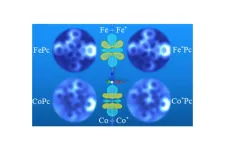
No one will ever be able to see a purely mathematical construct such as a perfect sphere. But now, scientists using supercomputer simulations and atomic resolution microscopes have imaged the signatures of electron orbitals, which are defined by mathematical equations of quantum mechanics and predict where an atom’s electron is most likely to be. Scientists at UT Austin, Princeton University, and ExxonMobil have directly observed the signatures of electron orbitals in two different transition-metal atoms, iron (Fe) and cobalt ...

Read the release
New deal inked to space test meta-optical surfaces
Space

New deal inked to space test meta-optical surfaces

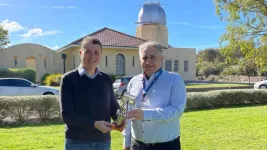
A new engineering study has been commissioned by the European Space Agency (under PECS, the Program for European Cooperating States), to prove the reliability of meta-optical elements for space use in a collaboration between the ESA, Bulgarian start-up company LaboraXpert and TMOS, the Australian Research Council Centre of Excellence for Transformative Meta-Optical Systems. In the first study of its kind, it will determine whether meta-optical components can withstand the pressures of space launch and prolonged exposure to the space environment. TMOS Centre Director Prof. Dragomir Neshev says, “The demand for Earth observation data is growing, yet the industry still faces the ...

Read the release
Portugal participates in the development of a first-class instrument for the largest telescope in the world
Space

Portugal participates in the development of a first-class instrument for the largest telescope in the world

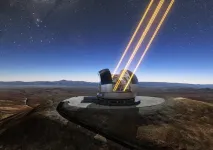
A research team from the University of Lisbon and University of Oporto (Portugal) participate in the development of METIS (Mid-infrared ELT Imager and Spectrograph). This powerful instrument will equip the largest telescope in the world - the Extremely Large Telescope (ELT) - under construction by the European Southern Observatory (ESO) in Armazones, Chile. At this critical acceptance stage of the complete and final METIS design, ESO is presenting an illustrative film demonstrating the exceptional capabilities of the instrument. The presentation will take place on May 12, at 4:00pm (CEST). METIS will detect ...

Read the release
Astronomers reveal the largest cosmic explosion ever seen
Space

Astronomers reveal the largest cosmic explosion ever seen

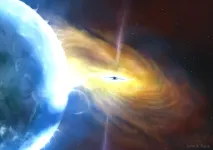
A team of astronomers led by the University of Southampton have uncovered the largest cosmic explosion ever witnessed. The explosion is more than ten times brighter than any known supernova (exploding star) and three times brighter than the brightest tidal disruption event, where a star falls into a supermassive black hole. The explosion, known as AT2021lwx, has currently lasted over three years, compared to most supernovae which are only visibly bright for a few months. It took place nearly 8 billion light years away, when the universe was around 6 billion years old, and is still being detected by a network of telescopes. The researchers believe that the explosion is ...

Read the release
SwRI to lead NASA/SSERVI Center for Lunar Origin and Evolution
Space

SwRI to lead NASA/SSERVI Center for Lunar Origin and Evolution

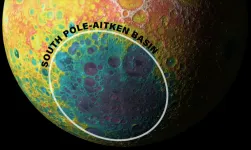
SAN ANTONIO — May 11, 2023 —Southwest Research Institute has entered into a five-year, $7.5-million cooperative agreement with NASA to lead the Center for Lunar Origin and Evolution (CLOE), which will conduct basic research to support science enabled by human exploration of the Moon and the Endurance-A mission concept, a far side lunar rover mission prioritized by the 2022 Planetary Science and Astrobiology Decadal Survey report, “Origins, Worlds, and Life.” CLOE will be part of NASA’s Solar System Exploration Research Virtual Institute (SSERVI). “The Moon is unmatched in its potential to provide ...

Read the release
First-of-its-kind measurement of the Universe’s expansion rate weighs in on a longstanding debate in physics and astronomy
Space

First-of-its-kind measurement of the Universe’s expansion rate weighs in on a longstanding debate in physics and astronomy

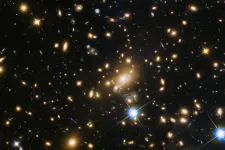
Thanks to data from a magnified, multiply imaged supernova, a team led by University of Minnesota Twin Cities researchers has successfully used a first-of-its-kind technique to measure the expansion rate of the Universe. Their data provide insight into a longstanding debate in the field and could help scientists more accurately determine the Universe’s age and better understand the cosmos. The work is divided into two papers, respectively published in Science, one of the world’s top peer-reviewed academic journals, and The Astrophysical Journal, a peer-reviewed scientific journal of astrophysics and astronomy. In astronomy, there are two precise ...

Read the release
ESO telescope reveals hidden views of vast stellar nurseries
Space

ESO telescope reveals hidden views of vast stellar nurseries

Using ESO’s Visible and Infrared Survey Telescope for Astronomy (VISTA), astronomers have created a vast infrared atlas of five nearby stellar nurseries by piecing together more than one million images. These large mosaics reveal young stars in the making, embedded in thick clouds of dust. Thanks to these observations, astronomers have a unique tool with which to decipher the complex puzzle of stellar birth. “In these images we can detect even the faintest sources of light, like stars far less massive than the Sun, revealing objects that no one has ever seen before,” says Stefan Meingast, an astronomer at the University of Vienna in Austria and lead author ...

Read the release
Hidden supermassive black holes brought to life by galaxies on collision course
Space

Hidden supermassive black holes brought to life by galaxies on collision course

Astronomers have found that supermassive black holes obscured by dust are more likely to grow and release tremendous amounts of energy when they are inside galaxies that are expected to collide with a neighbouring galaxy. The new work, led by researchers from Newcastle University, is published in Monthly Notices of the Royal Astronomical Society. Galaxies, including our own Milky Way, contain supermassive black holes at their centres. They have masses equivalent to millions, or even billions, times that of our ...

Read the release
Space

Researchers measure the light emitted by a sub-Neptune planet’s atmosphere for the first time

For more than a decade, astronomers have been trying to get a closer look at GJ 1214b, an exoplanet 40 light-years away from Earth. Their biggest obstacle is a thick layer of haze that blankets the planet, shielding it from the probing eyes of space telescopes and stymying efforts to study its atmosphere. NASA’s new James Webb Space Telescope (JWST) solved that issue. The telescope’s infrared technology allows it to see planetary objects and features that were previously obscured ...

Read the release
Salt marshes protect the coast – but not where it is needed most
Space

Salt marshes protect the coast – but not where it is needed most

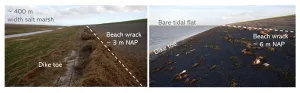
Salt marshes provide multiple ecosystem services, one of those is protection of the coast against flooding. This is especially important in low-lying countries like the Netherlands. Scientists from the University of Groningen and the Royal Netherlands Institute for Sea Research (NIOZ), in collaboration with the local water authority, have monitored wave run-up during storms over a three-year period. The results, which were published in the Journal of Applied Ecology on 10 May, help the water authority to quantify the protective effect of salt marshes. For three years, ecologist Beatriz Marin-Diaz always had one eye on the weather ...

Read the release
Virginia Tech, George Mason University partner to develop networking infrastructure for satellite constellations
Space

Virginia Tech, George Mason University partner to develop networking infrastructure for satellite constellations

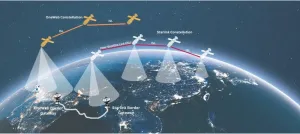
The race is on to provide high speed satellite internet to the Earth’s most remote areas. New tech companies such as Starlink, One Web, and Amazon’s Kuiper are competing with traditional, established “satcomm” companies such as Thuraya and Inmarsat to provide global high speed, low latency satellite internet across the globe. These new mega-constellations rely on tens of thousands of small low earth orbit satellites flying at a few hundred miles altitude. Network interconnectivity is a basic building block for providing the fastest, more reliable coverage to end users. While all these mega-constellations are driven to provide high ...

Read the release
Webb looks for Fomalhaut’s asteroid belt and finds much more
Space

Webb looks for Fomalhaut’s asteroid belt and finds much more

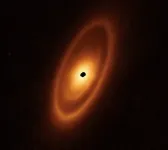
Astronomers used NASA’s James Webb Space Telescope to image the warm dust around a nearby young star, Fomalhaut, in order to study the first asteroid belt ever seen outside of our solar system in infrared light. But to their surprise, the dusty structures are much more complex than the asteroid and Kuiper dust belts of our solar system. Overall, there are three nested belts extending out to 14 billion miles (23 billion kilometers) from the star; that’s 150 times the distance of Earth from the Sun. The scale of the outermost belt is roughly twice the scale of our ...

Read the release
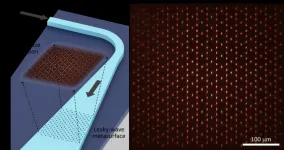
Leaky-wave metasurfaces: A perfect interface between free-space and integrated optical systems
Space

Leaky-wave metasurfaces: A perfect interface between free-space and integrated optical systems

New York, NY—May 8, 2023—Researchers at Columbia Engineering have developed a new class of integrated photonic devices--“leaky-wave metasurfaces”--that can convert light initially confined in an optical waveguide to an arbitrary optical pattern in free space. These devices are the first to demonstrate simultaneous control of all four optical degrees of freedom, namely, amplitude, phase, polarization ellipticity, and polarization orientation--a world record. Because the devices are so thin, transparent, and compatible with photonic integrated circuits ...

Read the release
From the original Press-News collection. Issuers of news releases are responsible for the accuracy of their content.