PRESS-NEWS.org - Press Release Distribution
PRESS RELEASES DISTRIBUTION

Pathogenicity threshold of SCA6 causative gene CACNA1A was identified
Pathogenicity threshold of SCA6 causative gene CACNA1A was identified
2025-03-03
(Press-News.org)

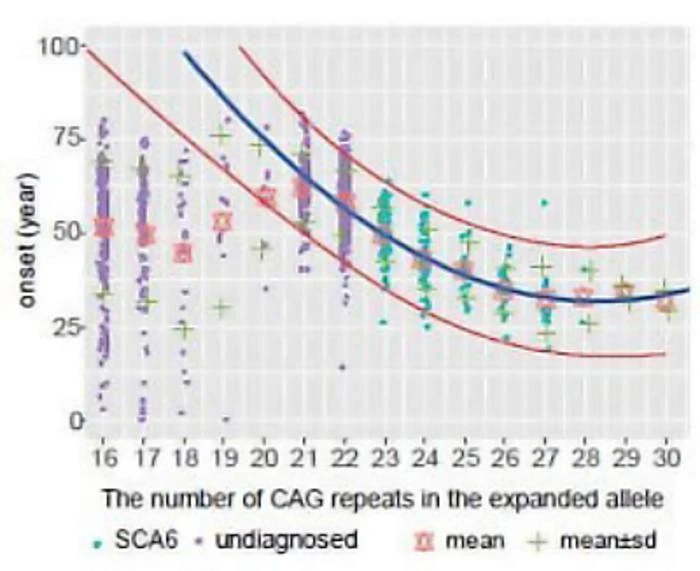
Niigata, Japan - The Department of Neurology at Niigata University and National Center of Neurology and Psychiatry(NCNP) has identified pathogenic thresholds for the CAG repeat units (RU) of the CACNA1A gene that causes SCA6. They investigated the SCA6 causative gene in 2,768 patients. They carefully examined the relationship between RU, age of onset, and family history. First, in cases with 18 or fewer RU, the proportion of family history was low. For 19 or more RU, the proportion of family history gradually increased and became almost constant at 23 or more RU. Next, based on the age of onset data for definitive SCA6 cases with 23 or more RU, they created a predictive curve for the relationship between RU and age of onset (figure). They found that over 90% of cases with 21 or more RU fell within the predicted age range. For cases with 19-20 RU, the proportion of cases within the predicted range decreased, and for cases with 18 or fewer RU, most cases fell outside the predicted range.
They evaluated the association between opposite alleles and age of onset using multiple regression analysis. The results showed that for cases with expanded alleles of 21 and 22 RU, opposite alleles were associated with age of onset. For cases with expanded alleles of 23 RU or more, no association was found between opposite alleles and age of onset. Additionally, cases with expanded alleles of 19-20 RU had a significantly higher proportion of opposite alleles of 19 or more compared to cases with expanded alleles of 23 RU or more.

"When examining ataxia patients with 21RU or more, it is reasonable to consider SCA6. However, for patients with 19-20 RU, careful consideration is necessary to determine if it is SCA6. When the OA is also 19-20 RU, the probability of having SCA6 increases. Our findings may have important implications for SCA6 diagnosis and genetic counseling." explain Dr. Hatano and Dr. Ishihara. The results of the study were published in the journal Neurology Genetics on 2025.

END


[Attachments] See images for this press release:
Pathogenicity threshold of SCA6 causative gene CACNA1A was identified

ELSE PRESS RELEASES FROM THIS DATE:

Mysterious interstellar icy objects

Mysterious interstellar icy objects
2025-03-03
Niigata, Japan - Organic molecules that serve as the building blocks of life are believed to form in space, but their exact formation sites and delivery mechanisms to planets remain a major mystery in astronomy and planetary science. One of the key elements in solving this mystery is the presence of ice in interstellar environments. In cold, dense, and shielded regions of the galaxy, atoms and molecules adhere to the surfaces of submicron-sized solid particles (dust), leading to the formation of interstellar ices. This process is similar to how snow forms in Earth’s clouds. Astronomers from Niigata University and ...

Chronic diseases misdiagnosed as psychosomatic can lead to long term damage to physical and mental wellbeing, study finds

2025-03-03
A ‘chasm of misunderstanding and miscommunication’ is often experienced between clinicians and patients, leading to autoimmune diseases such as lupus and vasculitis being wrongly diagnosed as psychiatric or psychosomatic conditions, with a profound and lasting impact on patients, researchers have found. A study involving over 3,000 participants – both patients and clinicians – found that these misdiagnoses (sometimes termed “in your head” by patients) were often associated with long term impacts on patients’ physical health and wellbeing and damaged trust in healthcare services. The researchers are calling for greater awareness ...

Omalizumab treats multi-food allergy better than oral immunotherapy

Omalizumab treats multi-food allergy better than oral immunotherapy
2025-03-02
A clinical trial has found that the medication omalizumab, marketed as Xolair, treated multi-food allergy more effectively than oral immunotherapy (OIT) in people with allergic reactions to very small amounts of common food allergens. OIT, the most common approach to treating food allergy in the United States, involves eating gradually increasing doses of a food allergen to reduce the allergic response to it. Thirty-six percent of study participants who received an extended course of omalizumab could tolerate 2 grams or more of peanut protein, or about eight peanuts, and two other ...

Sleep apnea linked to increased risk of Parkinson’s, but CPAP may reduce risk

2025-03-02
EMBARGOED FOR RELEASE UNTIL 4 P.M. ET, SUNDAY, MARCH 2, 2025 Media Contacts: Renee Tessman, rtessman@aan.com, (612) 928-6137 Natalie Conrad, nconrad@aan.com, (612) 928-6164 Sleep apnea linked to increased risk of Parkinson’s, but CPAP may reduce risk Risk reduced if treatment started within two years of diagnosis MINNEAPOLIS – People with obstructive sleep apnea have an increased risk of Parkinson’s disease, but if started early enough, continuous positive airway pressure ...

New insights into drug addiction: The role of astrocytic G protein-coupled receptors

New insights into drug addiction: The role of astrocytic G protein-coupled receptors
2025-03-02
A recent study published in Engineering delves into the complex mechanisms of drug addiction, highlighting the crucial role of astrocytic G protein-coupled receptors (GPCRs). This research offers fresh perspectives on understanding and potentially treating substance-use disorders (SUDs). For a long time, neuroscience research on drug addiction mainly focused on neuronal mechanisms. However, emerging evidence shows that astrocytes, the most abundant glial cells in the central nervous system, also play a significant part. Astrocytes ...

Digital twin technology: Transforming road engineering and its lifecycle applications

Digital twin technology: Transforming road engineering and its lifecycle applications
2025-03-02
A recent study published in the journal Engineering delves into the potential of digital twin (DT) technology in revolutionizing road engineering and its lifecycle applications. As road infrastructure worldwide faces the challenge of digitalization, DT has emerged as a promising solution. The research, conducted by a team of scholars from Tongji University and Harbin Institute of Technology (Shenzhen), systematically reviews DT-enabling technologies, including model creation, condition sensing, data processing, and interaction. The development of DT in road engineering has been ...

Next-generation AI and big data: Transforming crop breeding

Next-generation AI and big data: Transforming crop breeding
2025-03-01
A new study published in Engineering explores how next-generation artificial intelligence (AI) and big data are revolutionizing crop breeding, with potential far-reaching implications for global food security. Crop breeding has come a long way, evolving through distinct stages from domestication breeding to the current era of big data intelligent design breeding. The latest stage, “Breeding 4.0,” integrates biotechnology, big data, and AI. This convergence aims to achieve efficient, personalized breeding of new crop varieties, marking a significant shift from traditional “scientific” ...

Biomimetic synthesis of natural products: Progress, challenges and prospects

Biomimetic synthesis of natural products: Progress, challenges and prospects
2025-03-01
In a recent publication in Engineering, researchers from Jinan University in China and the University of Illinois Chicago in the US presented an in-depth perspective on the biomimetic synthesis of natural products. This research area, which bridges chemistry, biology, and pharmacy, has seen significant progress in recent years. Natural products are crucial in drug discovery, providing essential scaffolds for developing new medications. However, obtaining sufficient quantities of these compounds for research and production is challenging due to resource limitations. Traditional chemical synthesis and biosynthesis methods also face their own set of ...

New limits found for dark matter properties from latest search

New limits found for dark matter properties from latest search
2025-03-01
Tokyo, Japan – A team led by a member of Tokyo Metropolitan University have made advances in the search for dark matter, observing galaxies using new spectrographic technology and the Magellan Clay Telescope. With a mere 4 hours of observations, precise measurements in the infrared range have set new limits on the lifetime of dark matter. Their findings highlight the crucial utility of their technology and extend the search to less explored parts of the spectrum.   Over the past century, cosmologists have grappled with an apparent inconsistency in what they saw in the universe. Observations of the rotation of galaxies, for example, imply that there is a lot of mass out ...

SCAI expresses disappointment over ABMS decision to deny independent cardiovascular medicine boar

2025-02-28
WASHINGTON– The Society for Cardiovascular Angiography & Interventions (SCAI) today expressed profound disappointment in the American Board of Medical Specialties (ABMS) decision to deny the creation of the American Board of Cardiovascular Medicine (ABCVM). The ABCVM was proposed by SCAI, the American College of Cardiology (ACC), the American Heart Association (AHA), the Heart Failure Society of America (HFSA), and the Heart Rhythm Society (HRS) as a necessary step to establish cardiology as its own distinct medical specialty, separate from internal ...

LAST 30 PRESS RELEASES:

New expert guidance urges caution before surgery for patients with treatment-resistant constipation

Solar hydrogen can now be produced efficiently without the scarce metal platinum

Sleeping in on weekends may help boost teens’ mental health

Study: Teens use cellphones for an hour a day at school

After more than two years of war, Palestinian children are hungry, denied education and “like the living dead”

The untold story of life with Prader-Willi syndrome - according to the siblings who live it

How the parasite that ‘gave up sex’ found more hosts – and why its victory won’t last

When is it time to jump? The boiling frog problem of AI use in physics education

Twitter data reveals partisan divide in understanding why pollen season's getting worse

AI is quick but risky for updating old software

Revolutionizing biosecurity: new multi-omics framework to transform invasive species management

From ancient herb to modern medicine: new review unveils the multi-targeted healing potential of Borago officinalis

Building a global scientific community: Biological Diversity Journal announces dual recruitment of Editorial Board and Youth Editorial Board members

Microbes that break down antibiotics help protect ecosystems under drug pollution

Smart biochar that remembers pollutants offers a new way to clean water and recycle biomass

Rice genes matter more than domestication in shaping plant microbiomes

Ticking time bomb: Some farmers report as many as 70 tick encounters over a 6-month period

Turning garden and crop waste into plastics

Scientists discover ‘platypus galaxies’ in the early universe

Seeing thyroid cancer in a new light: when AI meets label-free imaging in the operating room

Neutrophil-to-lymphocyte ratio may aid risk stratification in depressive disorder

2026 Seismological Society of America Annual Meeting

AI-powered ECG analysis offers promising path for early detection of chronic obstructive pulmonary disease, says Mount Sinai researchers

GIMM uncovers flaws in lab-grown heart cells and paves the way for improved treatments

Cracking the evolutionary code of sleep

Medications could help the aging brain cope with surgery, memory impairment

Back pain linked to worse sleep years later in men over 65, according to study

CDC urges ‘shared decision-making’ on some childhood vaccines; many unclear about what that means

New research finds that an ‘equal treatment’ approach to economic opportunity advertising can backfire

Researchers create shape-shifting, self-navigating microparticles

[Press-News.org] Pathogenicity threshold of SCA6 causative gene CACNA1A was identified