A vast freshwater reservoir may sit beneath Utah's Great Salt Lake
What lies beneath a dying salt lake?
The Great Salt Lake has been shrinking for decades, exposing more than 800 square miles of dry lakebed — playa — that now sends clouds of dust laced with toxic metals drifting into Salt Lake City and surrounding communities. The ecological and public health crisis is well documented. But underneath that receding brine, something unexpected has been hiding: freshwater. A lot of it. And it's far deeper than anyone anticipated.
A new study from the University of Utah, published in Scientific Reports, used airborne electromagnetic surveys to peer through the lake's hypersaline surface layer and map the geological structures below. What the team found challenges basic assumptions about how water moves beneath terminal lakes.
How do you X-ray a lake from a helicopter?
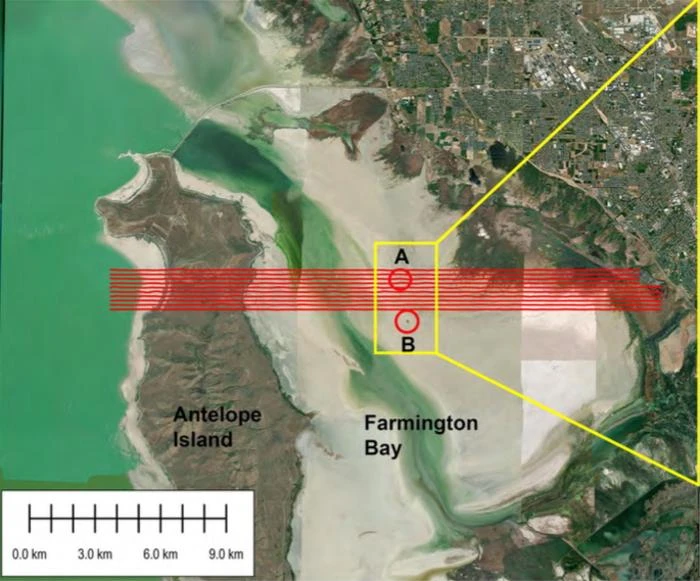
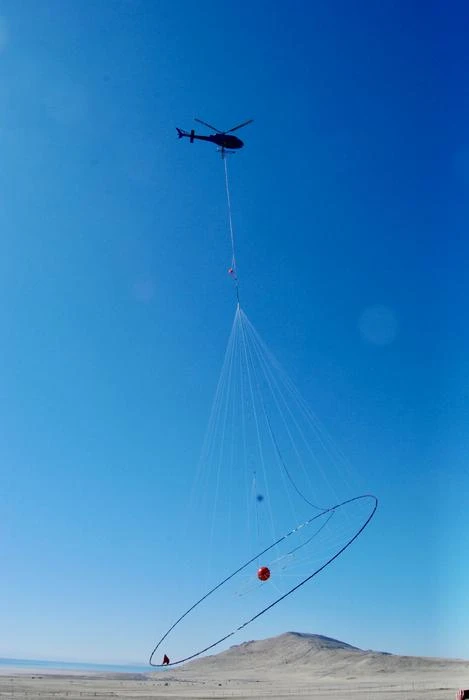
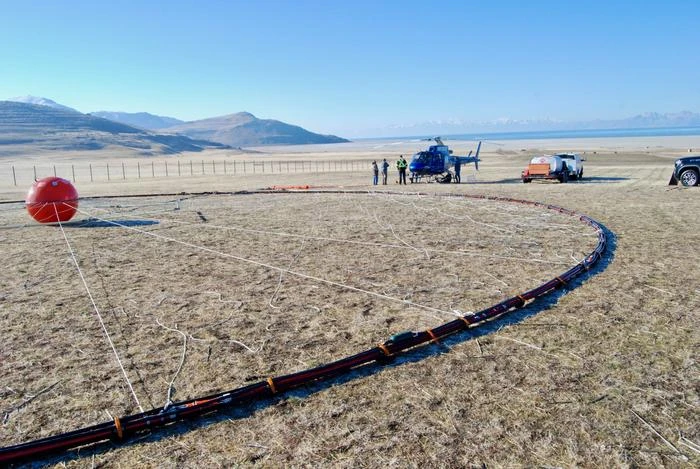
In February 2025, a geophysical crew from Canada flew electromagnetic survey equipment suspended beneath a helicopter across Farmington Bay and the northern portion of Antelope Island. The helicopter traced 10 east-west lines spanning 154 miles total.
The technique works by measuring electrical resistivity at depth. Brine conducts electricity readily; freshwater does not. By mapping where the subsurface shifts from conductive to resistive, the researchers could distinguish salt water from fresh. It's the first time anyone has demonstrated that airborne electromagnetic methods (AEM) can detect freshwater beneath the thin, highly conductive saline layer at the surface of a terminal lake.
Lead author Michael Zhdanov, a distinguished professor of geology and geophysics and director of the Consortium for Electromagnetic Modeling and Inversion (CEMI), described the resulting maps in blunt terms: near the surface, red — highly conductive brine. Ten meters below, blue — resistive freshwater. Everywhere they looked.
Freshwater pushing inward, not seeping from the edges
Hydrologists have a standard mental model for how water behaves around a salt lake. Brine, being denser than freshwater, sinks and fills the subsurface volume beneath the lake. Freshwater from surrounding mountains enters at the periphery. It's a tidy picture. The data broke it.
Co-author Bill Johnson, a professor of geology and geophysics at Utah, noted that the freshwater doesn't just fringe the lake's margins. It extends toward the interior — potentially beneath the entire lake. And it appears to be coming up under pressure, not trickling down from the sides.
The clearest evidence sits on the surface. In recent years, as water levels dropped and Farmington Bay dried out, circular mounds 50 to 100 meters across appeared on the exposed lakebed, each choked with 15-foot-tall stands of phragmites reeds. These mounds mark spots where pressurized freshwater is pushing through gaps in the impervious layer beneath the playa. The AEM data confirmed it: one surveyed mound sat directly above a breach in the subsurface where freshwater had forced its way up.
Three to four kilometers deep
Using both the electromagnetic data and magnetic measurements, Zhdanov's team built a three-dimensional tomographic image of the geology beneath Farmington Bay. The results show that the basement rock — the impermeable floor beneath which no water-bearing sediment exists — is shallow near the bay's edge, less than 200 meters down. But it then drops abruptly to 3 to 4 kilometers (roughly 10,000 to 13,000 feet).
That plunge defines the potential volume of the reservoir. If you know the depth to the basement, the lateral extent of the freshwater, and the porosity of the sediments in between, you can calculate how much water might be stored. The numbers haven't been published yet, but the geometry suggests a substantial volume.
This was a pilot study covering a narrow sliver of the lake's southeastern margin. Zhdanov believes the same approach can be scaled to the entire 1,500-square-mile footprint of the Great Salt Lake, and he is seeking funding to do exactly that.
Could this water fight the dust?
Johnson sees a practical application. The exposed playa is an accelerating public health problem — windborne dust carries arsenic, mercury, and other metals into communities along the Wasatch Front. Refilling Farmington Bay with diverted river water is one option, but it may not be enough. Some dust hotspots sit at higher elevations that surface water won't easily reach.
If the artesian groundwater could be safely tapped, it might be used to wet specific dust-producing areas — a targeted approach to suppression. But Johnson is cautious. The freshwater system may itself serve beneficial ecological functions that aren't yet understood. Extracting water before mapping those functions could trade one problem for another.
The immediate priority, he says, is understanding: how large the reservoir is, where the water originates, how fast it recharges, and what role it plays in the broader hydrological system of the Great Basin.
A pilot survey with global implications
Terminal lakes — bodies of water with no outflow to the ocean — exist on every continent and are shrinking worldwide as climate change and water diversion reduce their inflows. The Aral Sea, Lake Urmia, Lake Poopo. If freshwater reservoirs commonly exist beneath these lakes, undetected by conventional methods, the implications for water-resource planning extend well beyond Utah.
The study's demonstration that AEM can see through a conductive saline layer to detect freshwater below is a methodological advance with broad applicability. Before this work, the salt water at the surface was assumed to blind electromagnetic surveys. It doesn't.
For now, the Great Salt Lake team is working with what a single helicopter campaign revealed: a deep, laterally extensive freshwater body sitting beneath one of America's most iconic and most threatened lakes. How much water is down there, where it comes from, and whether it can responsibly be used are questions that will require surveys across the entire lake — and years of additional study.